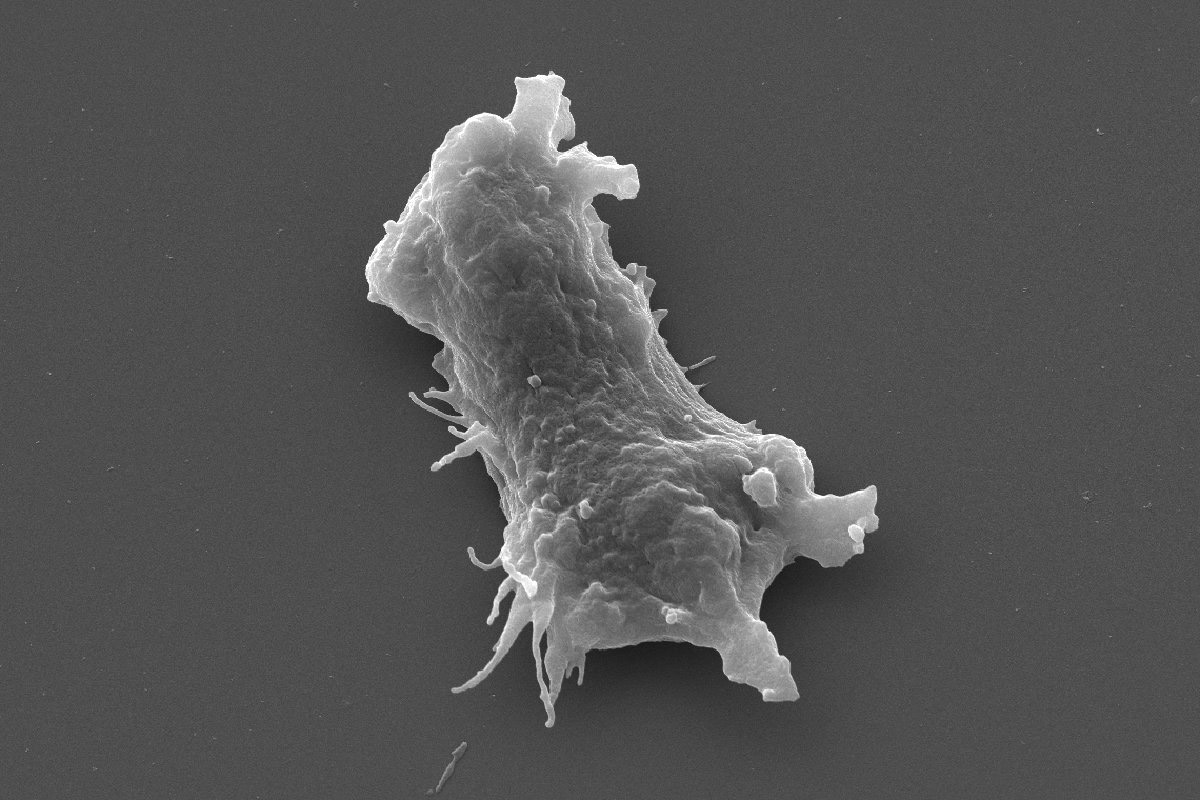
The Naegleria fowleri, More commonly known as the 'brain-eating amoeba', it is a free-living, pathogenic amoeba that inhabits warm waters. It is, as is known, the cause of primary amoebic meningoencephalitis (PAM), cases of which have increased in recent years and which have had a significant impact in warm regions during the summer months.
Scientists at the University of La Laguna are searching for new molecules that can eliminate these amoebas and that are accessible to all countries. The latest research from University Institute of Tropical Diseases and Public Health of the Canary Islands (which is part of the CIBERINFEC national network), together with the Antonio González University Institute of Bio-Organic Chemistry, also from the same university, and the Institute of Natural Products of the CSIC, have managed to make a molecule from the red algae Laurencia It is highly effective against this pathogen. In fact, this product has been patented both nationally and internationally.
Management of primary amebic meningoencephalitis due to N. fowleri This is the main challenge for all countries with a prevalence of the disease. However, there is currently no suitable and effective treatment that guarantees patient survival. Most of the information on the therapeutic efficacy of drugs against N. fowleri It is based on case reports or in vitro studies, with variable therapeutic success rates. The effectiveness of the treatments is unclear, as almost all infections have been fatal and the success rates are controversial.
The treatment of the disease is highly dependent on the time frame, is extremely limited and is not well defined – currently it is only possible through a strategy called "drug repurposing" with a combined therapeutic cocktail that includes known antifungals, antibiotics and microbicides.
Application GB2592782 A describes +elatol for treating free-living amoebic infections, including N. fowleri. The authors confirm the survival of three patients worldwide after treatment with this product. In fact, it shows promising and successful results in combination therapy, although mortality rates remain very high even with the best available regimens, its inventors note.
Currently, negotiations are underway with several pharmaceutical companies regarding the potential commercialization of the product. The inventors are José Javier Fernández Castro, Nathalia Peixoto Nocchi, Ana Raquel Díaz Marrero, Jacob Lorenzo-Morales, José Piñero Barroso, Íñigo Arberas Jiménez, Inés Sifaoui, and Aitor Rizo Liendo.
National Geographic
On the other hand, a recent article in the well-known magazine National Geographic It explains in detail how this amoeba develops and what effects it produces, with the participation of various international researchers, including Jacob Lorenzo-Morales.
This pathogen can penetrate the neuroolfactory tissue and migrate to the brain, where it feeds, when patients inhale water contaminated with this amoeba. This summer, more than 15 cases have been reported in Karachi, the capital of Pakistan, several in India, and also in Israel, where alarm has been raised because all the cases were linked to risky activities at a popular water park. Cases have also occurred in children participating in water activities in other regions, such as the United States.
Most affected patients, children under 12 years old, become infected by diving into bodies of water containing this amoeba (through the nose). It is an acute infection that is very difficult to detect and causes cerebral edema, hemorrhage, necrosis, and a massive and fulminant inflammatory response in brain tissue, ultimately resulting in coma and rapid death.
The global increase in water temperature has allowed these thermophilic amoebas (which grow best at temperatures above 30 degrees) to expand the range of environments in which they can survive and endure.
Early diagnosis and the availability of the only drug currently capable of eliminating this amoeba (which is not always available in disadvantaged countries) make it possible to save the lives of affected patients. Even so, the mortality rate is higher than that of 98%, as it is a rapidly progressing infection.

 Spanish
 English
 French