
The Chair of Disaster Risk Reduction and Resilient Cities the University has recently published an article in the magazine International Journal of Climatology This publication analyzes tropical nights in Spain between 1970 and 2023, focusing on minimum temperatures as an indicator of climate change. It is authored by [author's name missing]. Pedro Dorta, director of the Chair, Abel López-Díez, Jaime Díaz-Pacheco and Jordan Correa.
The idea was to characterize what are known as tropical nights, that is, those in which the temperature does not drop below 20°C. This is a widely used indicator, given the proven relationship between mortality and high nighttime temperatures; heat at night affects sleep and individual rest and, consequently, people's health, especially those with some type of pre-existing condition.
Methodologically, the research team obtained and standardized daily records of minimum temperature and humidity from 75 weather stations spread across 44 different provinces. Nine of the stations are located in the Canary Islands, which allowed for a comparison of the archipelago's situation with that of the rest of the country—something not very common in this type of study, despite the fact that, paradoxically, it is the most tropical region in all of Spain.
Several points can be highlighted from the results. By grouping the minimum temperature data from the 75 stations according to their degree of similarity, seven different groups (or clusters, technically) are obtained: Northwest, North-Inland, Inland, Mediterranean, Southeast, Southwest, and finally, the Canary Islands. Each of these groups exhibits different characteristics with regard to its minimum or nighttime temperatures.
In each and every one of the 75 stations analyzed, an increase in minimum temperature has been recorded since 1970. The upward trend shows a degree of statistical significance greater than 99% in all cases. The temperature increase is greater in the interior and southwest, and much lower in the Canary Islands (in some areas of the islands, the warming is less than half that of the Iberian interior).
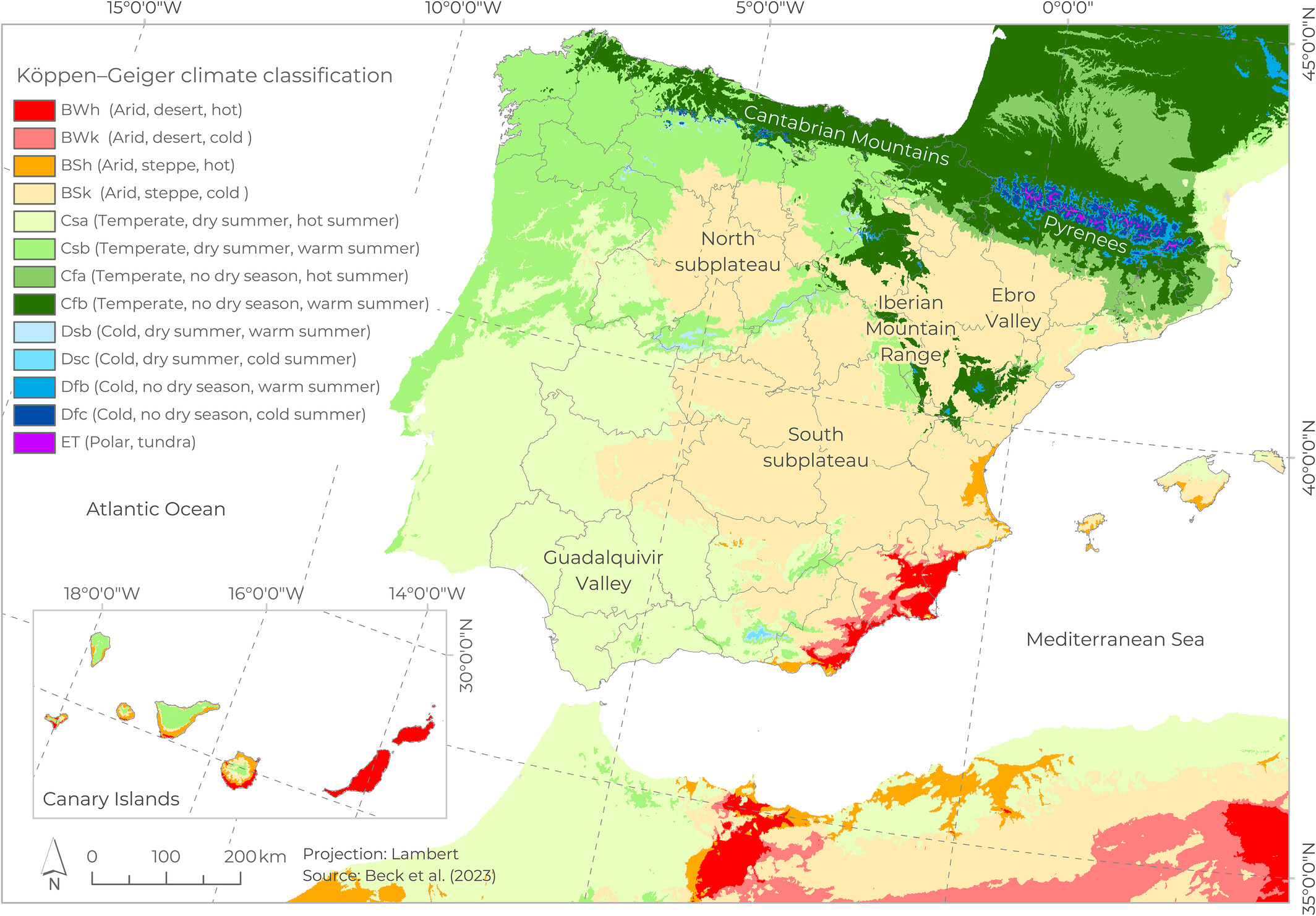
Geographical location and Köppen-Geiger climate classification of Spain. Prepared by the author based on Beck et al.
Tropical nights are very frequent in the Canary Islands, the southwestern Iberian Peninsula, and, to a lesser extent, the Mediterranean coast. In the Canary Islands, approximately one-third of all nights throughout the year can be considered tropical. “We have gone from an average annual frequency of tropical nights of 67 in the 1970s to 126 in the first three years of the current decade,” the researchers report. In contrast, tropical nights are still very sporadic in the Northwest and the North-Interior.
Despite this general overview, the Canary Islands exhibit significant contrasts directly linked to altitude. Tropical nights are very frequent along the coasts, but they become less common at higher altitudes. For example, Tenerife's capital city experiences a very high frequency of tropical nights (more than 150 in some recent years), in contrast to what is observed at Los Rodeos Airport and, of course, Izaña (at over 2,000 meters above sea level), where they are a completely exceptional phenomenon, although unfortunately becoming increasingly common.
The Canary Islands are also notable for the period in which these types of nights can occur. While in large parts of the Iberian Peninsula tropical nights are a phenomenon almost exclusively limited to summer or the adjacent months, in the islands the season in which these events occur is much longer (from May to November).
The number of consecutive tropical nights has also increased across Spain; the Canary Islands, once again, stands out as a region where tropical nights can last for several weeks or even months. Tropical nights in this region tend to be humid, as they are in most coastal areas of the Iberian Peninsula. However, inland, they are much drier.

 Spanish
 English
 French