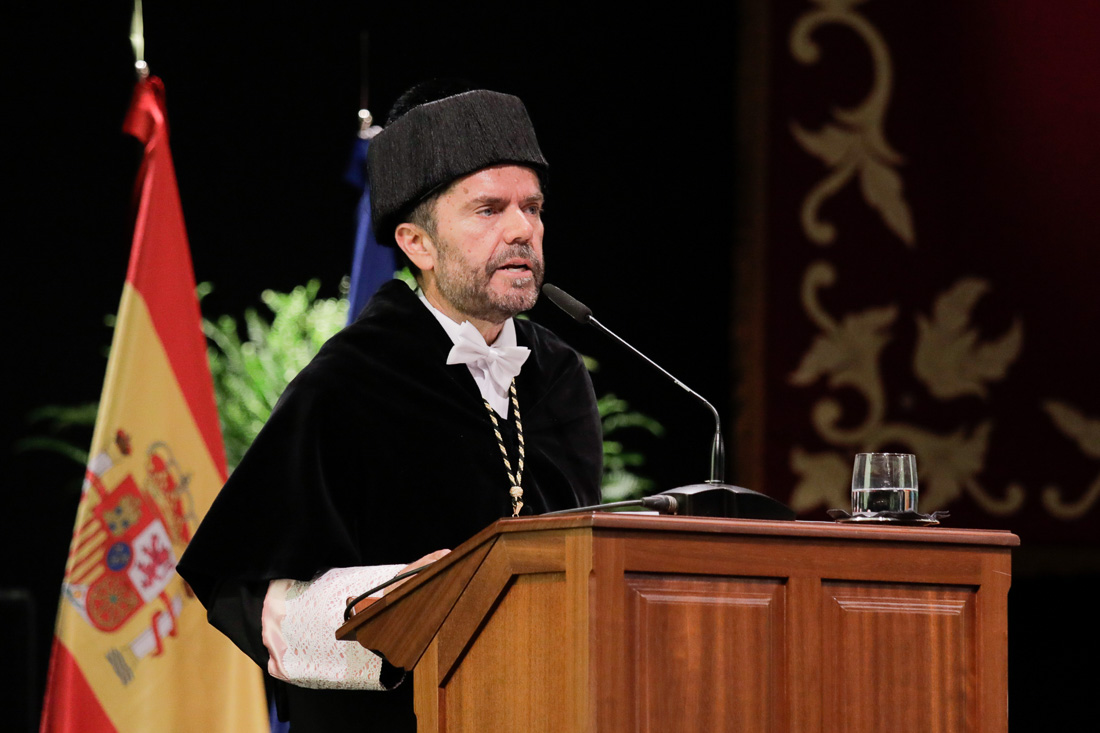
The Rector of the University of La Laguna, Francisco García, closed the opening ceremony of the 2024-25 academic year held today, Friday, September 13th in the Paraninfo., with a speech divided into three main areasThe importance of the institution's activities, its goals for the upcoming academic year, and the dangers and risks the center must address were discussed. Regarding the latter, the speaker emphasized the inherent negative consequences of the proliferation of private universities, which can generate "undesirable situations, compromising equity and equal opportunities, especially in degrees related to health sciences and education.".
He recalled that such proliferation is striking enough that a leading national media outlet recently dedicated an editorial to warning about the university privatization model that “has taken hold with particular intensity in several communities and cited Andalusia and the Canary Islands as examples,‘ a circumstance already confirmed at the first summit of rectors of Andalusian and Canary Islands public universities held last July.
The rector noted that competition in a regulated market is one of the pillars of a healthy economy. But “even from the most liberal perspectives, and we could go back to the originators of these ideas, such as Adam Smith or John Stuart Mill, it is accepted that the market alone is not adequate to supply certain goods and services, which must be provided or regulated by the state.”.
Therefore, he welcomed the progress being made in a working group between the Ministry of Universities and the CRUE (Conference of Rectors of Spanish Universities) to undertake the necessary regulation of private university operators. “This is not about going against free competition. It is about protecting a public good, such as higher education.”.
Aside from this issue, García also addressed the underfunding that has plagued the Canary Islands' public universities for several years, particularly impacting structural costs. In the case of the University of La Laguna, an increase in funding of approximately 13 million euros is needed for the next fiscal year to cover these costs. In any case, he emphasized the need to negotiate a program agreement with the regional government that provides resources, stability, and security in the medium and long term.
The social return on this investment is well-established, as the rector himself noted in the first part of his address. A recent study on the socioeconomic impact of the University of La Laguna demonstrated that every euro invested in the university generates almost four euros in GDP for the region. Furthermore, the latest Labor Force Survey indicates that the unemployment rate among university graduates in the Canary Islands is 4.2 percentage points lower than the overall Canary Islands average, and their employment rate is 17 percentage points higher.
The rector outlined many of the institution's objectives for the coming academic year; perhaps the most ambitious is in the area of education, with regulations for dual undergraduate and master's degrees, degrees with open academic pathways, sequential academic programs, and an assessment of the possible creation of virtual or hybrid education programs or the inclusion of dual specializations in some degrees. All of this is aimed at offering a revamped Degree Catalogue for the next academic year, the result of an analysis "that includes not only quantitative data related to employment, but also the opinions of companies, collaborating institutions, and graduates.".
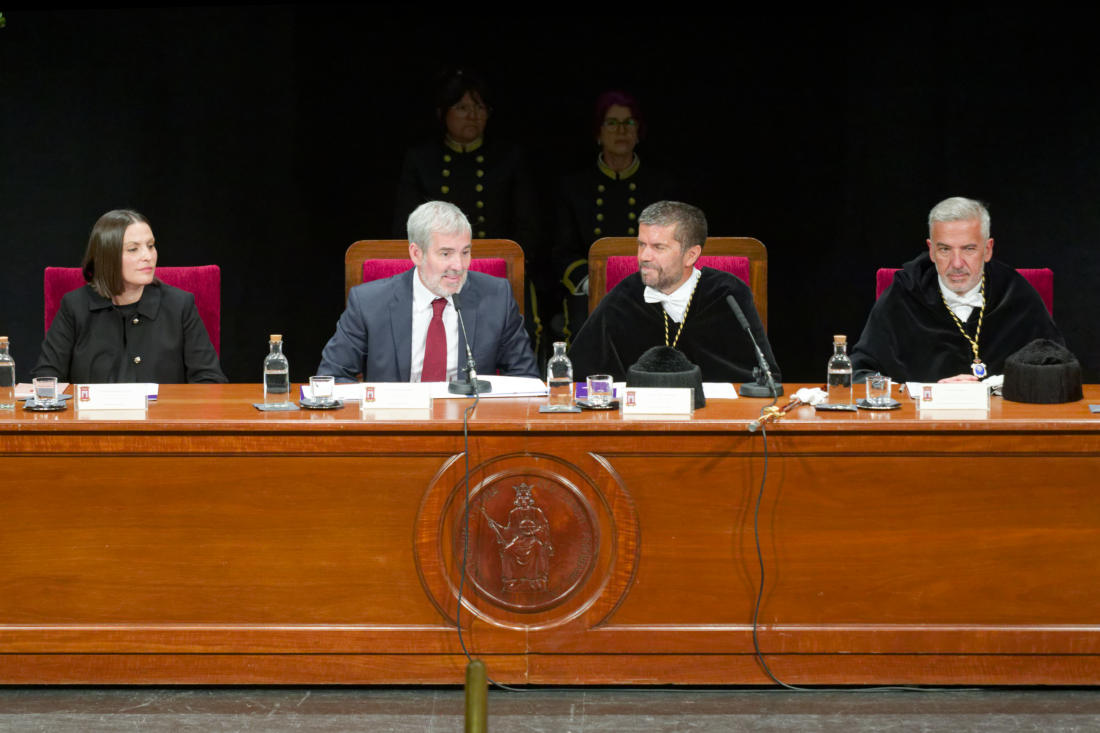
Fernando Clavijo closed the event.
President's speeche
The President of the Government of the Canary Islands, Fernando Clavijo, spoke briefly at the end of the event, reminding everyone that it was the third anniversary of the volcanic eruption in La Palma, and thanking the opening speaker, Marcial Morera, for his reflection on the true meaning of words, which are sometimes used without a full understanding of their meaning.
Clavijo recalled that his government made a firm commitment to higher education in partnership with the two public universities, creating a specific department dedicated to this area, recognizing its importance for social progress. He stated that the regional government has felt supported by both academic institutions in the many projects launched jointly with the aim of making sound decisions on crucial issues such as housing, tourism, and wealth distribution, among others.
The president of the Canary Islands government made a final request to the rector of the University of La Laguna and his counterpart from the University of Las Palmas de Gran Canaria, Lluís Serra, who was also present at the meeting. This legislative term presents two challenges that will shape both the political and academic landscape: immigration and regional funding, with the Catalan economic agreement looming. He asked the two academic institutions for their assistance in calmly reflecting on these issues so that the best decisions can be made thoughtfully, despite the “political noise” they will undoubtedly generate.
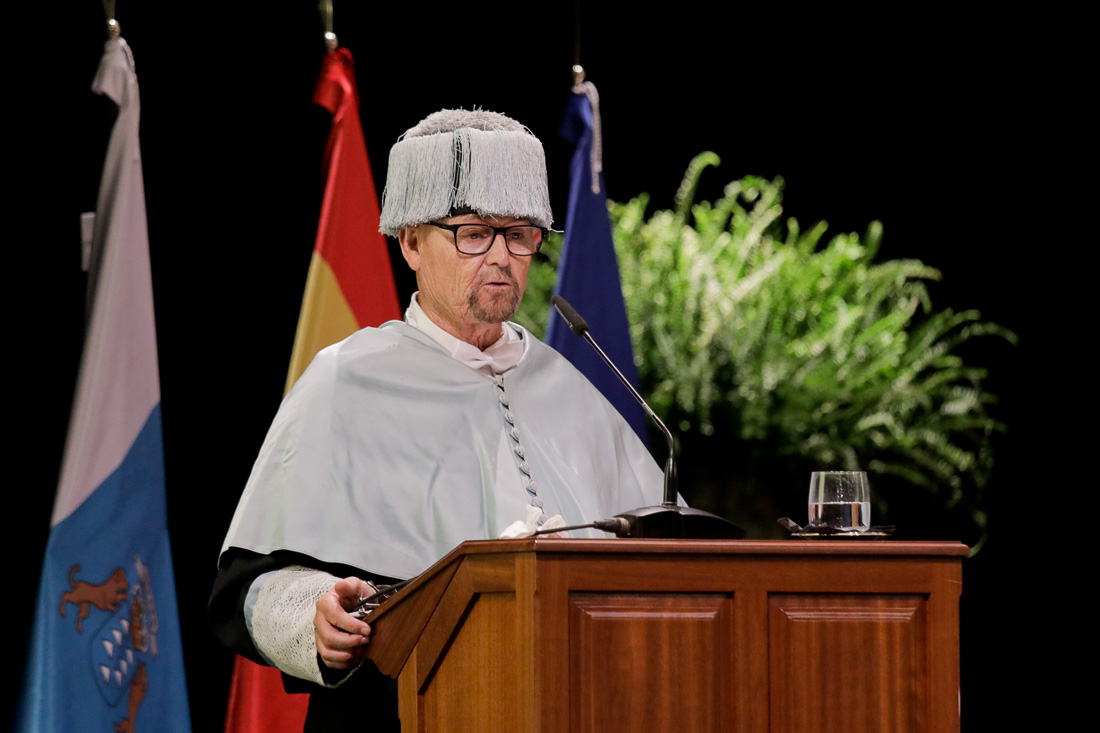
Marcial Morera
Linguistic homelands
Marcial Morera, professor of Hispanic Philology, was in charge of delivering the inaugural lecture, entitled '‘The spiritual homeland of the Canary Islanders’Analyzing the concept of a shared linguistic homeland in its entirety, he explained that it does not discriminate based on skin color or race, but rather unites all citizens in a common linguistic understanding. It is not related to the patriotic sentiment of national homelands, he argued, but rather a creative sentiment that allows for its expression in various literary genres.
Linguistic homelands demand that their citizens think for themselves, such that those who live entrenched in realities they repeat without independent thought are "parrots or cockatoos." Only through independent reflection is it possible to think freely and avoid irrationality, the professor pointed out. Linguistic homelands, as living and revolutionary elements, have nothing to do with states, the speaker affirmed.
Morera also pointed out that the strength of linguistic homelands is indestructible, as has been the case with the Hispanic linguistic homeland. “It is evident that the homeland of the Canary Islanders is not determined by their ethnic or geographical characteristics, but by the common, everyday Spanish language,” he said, “the one that has been spoken since the 15th century, with 500 or 600 million kindred spirits in its essence.”.
The role of the islanders in building the Hispanic homeland has been enormous, the philologist affirmed, thanks in large part to their privileged position between Europe, America, and Africa, adopting pre-Hispanic terms, enriching their language with new words, and also adapting phonemes and vocabulary from Portuguese. “We are a key people for understanding the Spanish linguistic homeland.”.
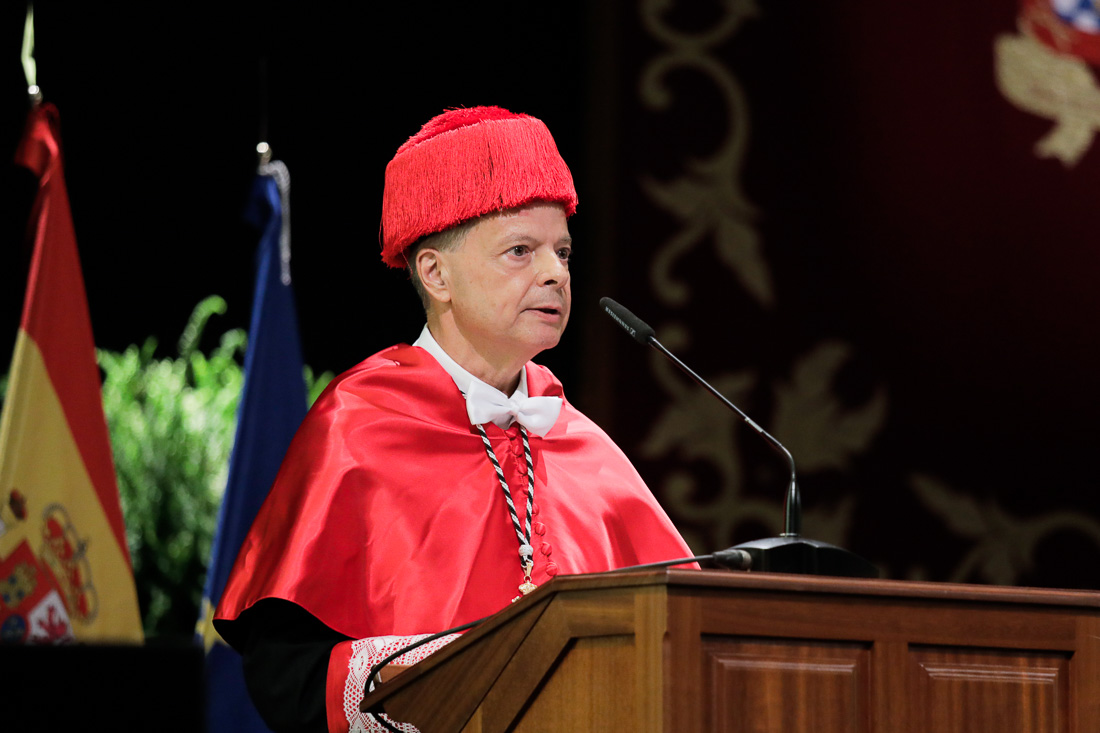
Juan Antonio García
Academic report
The session opened with a brief intervention by the Secretary General, Juan Antonio García, who gave a summary of the academic paper of the past year, highlighting the celebrations of the collegiate bodies, the new regulations in force, and the number of students enrolled in the 2023/24 academic year, which rose to 20,502, of which 4,66% represented newly admitted students.
During the same academic period, a total of 125 doctoral theses were defended. Regarding mobility figures, García highlighted that at the national level, this teaching center received 477 exchange students, a figure that rose to 837 in the European context, including both incoming and outgoing students.
During the event there was also a musical interlude by the Impropt Duo of violin and cello, made up of siblings Yiselle and Randy Bonucci

 Spanish
 English
 French