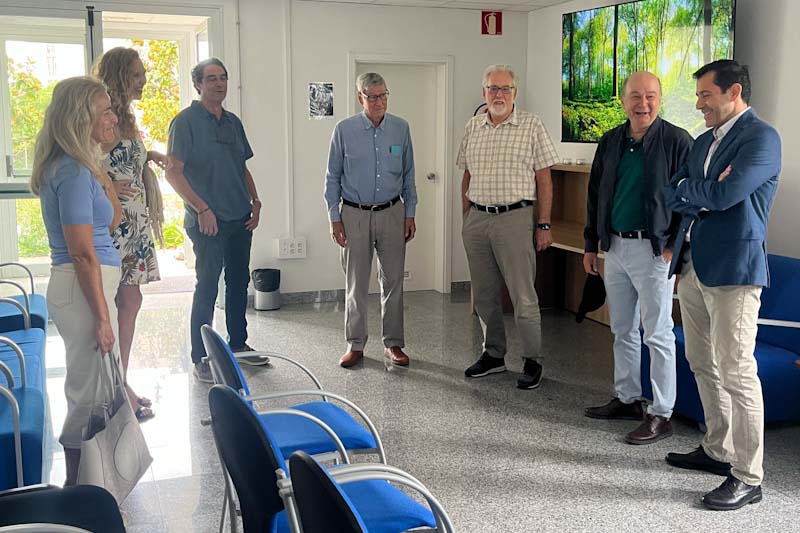
The Councillor for Innovation, Research and Development of the Tenerife Island Council, Juan José Martínez, and the Managing Director of the Technology Park, Olga Martín, recently visited the University Institute of Neuroscience at the University of La Laguna to tour its laboratories and learn about the research being conducted there. The aim of the visit was for them to become familiar with the health and biomedical technology projects underway at the Institute and, furthermore, to explore ways to collaborate on transferring research results to the Canary Islands community.
The director of the institute, Alberto Domínguez, accompanied by his management team, gave a brief introduction outlining the historical and research trajectory of the IUNE and its constituent research groups. He referred to its creation in 2010, made possible by a structuring project funded by the Canary Islands Research Agency, which enabled the construction of NEUROCOG, the current laboratory located on the Guajara Campus, as well as the provision of its equipment. The IUNE leadership also highlighted a significant milestone for the neuroscience institute: the completion of an infrastructure project that allowed for the purchase of the University Hospital's first 3-tesla Magnetic Resonance Imaging (MRI) scanner, which was upgraded last year thanks to a project led by José Luis González Mora from the IUNE. This team is carrying out important research projects, such as the GABACOG project, which studies brain inhibitory mechanisms, whose alteration can lead to disorders such as OCD (Obsessive-Compulsive Disorder) or schizophrenia.
The Regional Minister, Juan José Martínez, and the Managing Director, Olga Martín, showed great interest in the various technologies they saw in the laboratories and their applications, such as electroencephalographic (EEG) recording, which allows observation of the brain's electrical activity while performing certain tasks, and transcranial magnetic stimulation (TMS), which can activate or deactivate brain areas and functions. They even expressed a willingness to test the effects of this technology on their own nervous systems by stimulating one of the peripheral nerves in their arm to observe the motor response in their fingers. As they observed the recording equipment, they received detailed information on how these technologies enable the development of technology transfer projects in the fields of mental health and neurodegenerative disorders.
The IUNE management received congratulations from both visitors on the recent awarding of a Talentum project, funded by the Tenerife Island Council. Thanks to this project, one of the research teams, led by Manuel de Vega and Wenceslao Peñate, will study the functioning of inhibitory mechanisms in schizophrenia. This project will allow the IUNE to soon hire a postdoctoral researcher specializing in brain magnetic stimulation.
The visit was quite an event at IUNE. The management team expressed great optimism regarding the support the Tenerife Island Council could provide for future projects.

 Spanish
 English
 French