The existence of dark matter is probably one of the most perplexing problems facing the scientific community, and unraveling its nature has become a primary objective of modern physics. Simply put, we don't know what it's made of, despite representing 851,000,000 of all matter in the Universe.
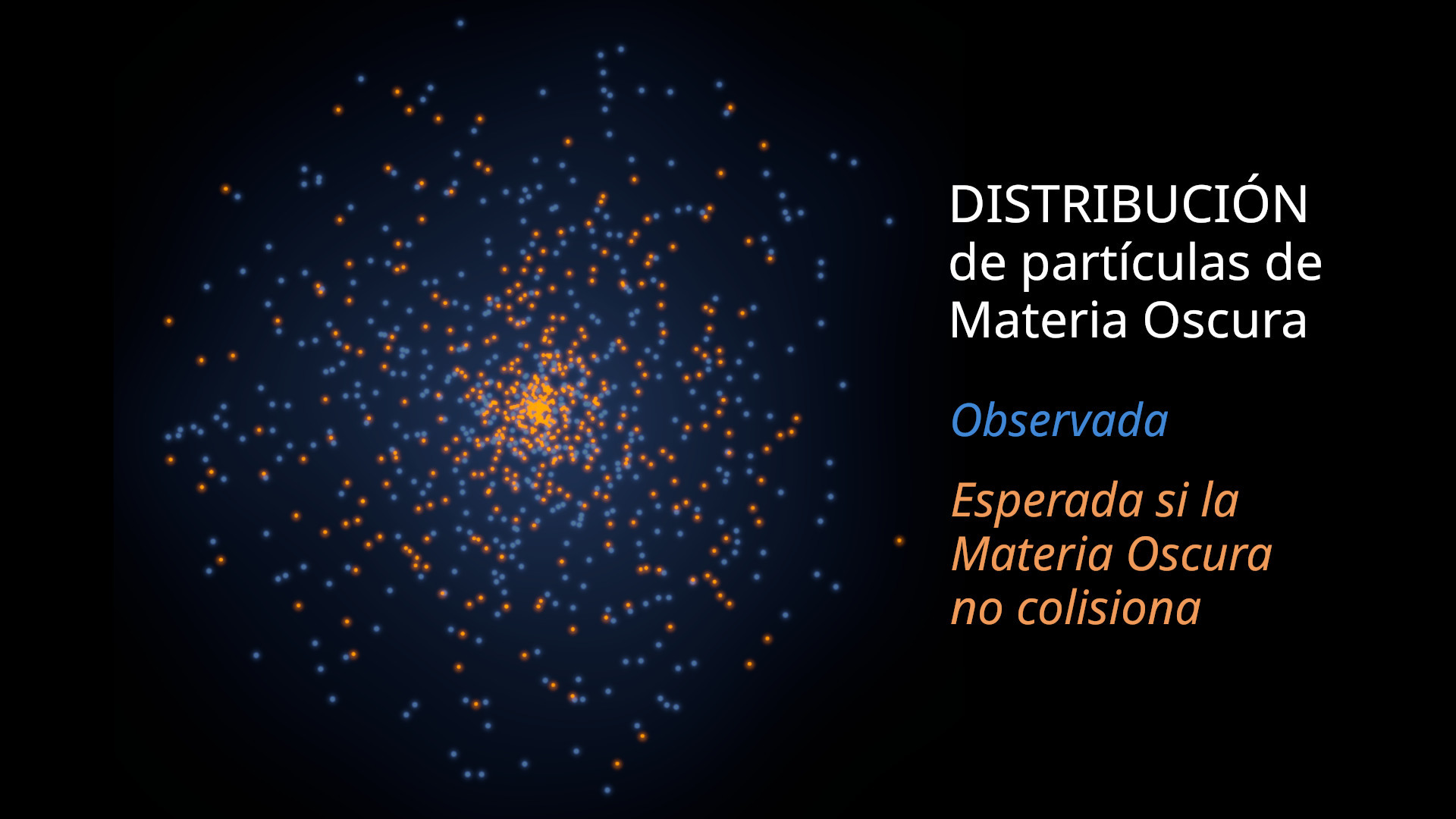
A study led by the Canary Islands Institute of Astrophysics (IAC) asserts that dark matter is not as described by the prevailing paradigm, in which dark matter particles only interact with each other and with ordinary matter through gravity. The IAC study determines that dark matter also experiences other forces which, although they only slightly modify its behavior, provide a new clue that will allow us to understand its nature.
The study, conducted using data from Hubble Space Telescope, has been published by the magazine Astrophysical Journal Letters and is signed by researchers from the IAC and the University of La Laguna Jorge Sánchez Almeida and Ignacio Trujillo, with the collaboration of the researcher from Northwest University of the Province of Buenos Aires (Argentina), Ángel Plastino.
Dark or invisible
The scientific community has known for decades that more than 85% of the matter in the Universe does not emit any type of radiation. For this reason, it is called dark matter, although some researchers suggest that more than ‘'dark'’ would it be appropriate to call it matter?‘invisible'’.
But how can we study something that doesn't emit radiation? The answer lies in observing the movement of ordinary matter (that is, stars and gas) under its influence. In this way, astronomers have been able to determine that dark matter is needed in large quantities and that it influences the rest of known matter primarily through the force of gravity.
For this reason, over the last four decades, the fundamental hypothesis has been that dark matter is composed of particles with mass but no other properties, with no interaction between them or with the rest of known matter beyond the force of gravity. This model of dark matter is known as collisionless cold dark matter. It explains well the effect of dark matter on the formation of structures in the Universe. However, it does not resolve the fundamental question of what it is and how its existence fits within the model of known elementary particles.
The study by the IAC and the ULL refutes the idea that dark matter only interacts through gravity and was carried out using a novel technique: analyzing the light distribution observed in very low-mass galaxies (with only a few thousand stars). The study of the properties of low-mass galaxies, both their structure and number, has garnered significant attention from the scientific community in recent years because the cold, collisionless dark matter model does not seem to fully fit this type of galaxy. Until now, none of these previous studies have been able to conclusively reject the simple dark matter model, since the effects of ordinary matter itself on the properties of galaxies are significant and compete with the effect of dark matter.
However, the study goes a step further. To do so, the researchers focused on a very particular type of galaxy where the scientific community believes that the effects of ordinary matter play no role in shaping the galaxy's form. These ultra-low-mass objects, with a million times fewer stars than our Milky Way, have been ideal laboratories for exploring the nature of dark matter.
“Using a novel technique based solely on the distribution of stars, we have been able to reject the collisionless cold dark matter model with high statistical significance,” explains Jorge Sánchez Almeida, adding that this work, therefore, «provides a very solid observational basis from which to explore more complex models of dark matter and reaffirms Astrophysics as a cutting-edge science for understanding the intimate properties of the matter that makes up most of the Universe.”.
(Note provided by the IAC).

 Spanish
 English
 French