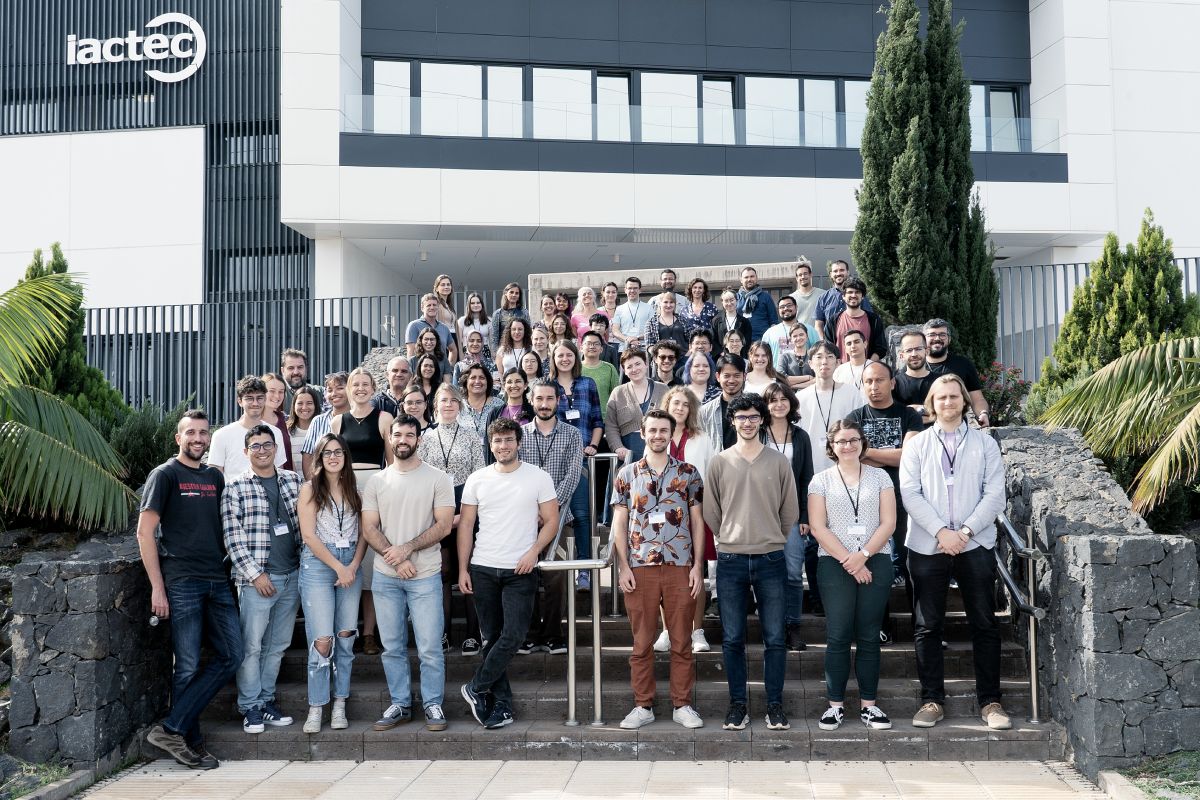
The Canary Islands Institute of Astrophysics and the University of La Laguna are organizing the 25th edition of the Canary Islands Winter School of Astrophysics, The event will take place between October 8th and 17th in La Laguna. This edition will host 60 master's, doctoral, and postdoctoral students from thirteen different countries who will meet in Tenerife to receive a comprehensive overview of galaxy evolution.
The Canary Islands Winter School of Astrophysics It is a central event in the calendar of the Canary Islands Institute of Astrophysics, which has been organizing it uninterruptedly since 1989. This time it will be spread over two venues: the Museum of Science and the Cosmos and the IACTEC building, where a teaching group belonging to ten research centers around the world will teach two weeks of classes.
As is customary, the school will also host lectures open to the public. The first of these, on Friday, October 11th at 6:00 PM in the Museum of Science and the Cosmos, will be given by astrophysicist Pablo Pérez González and is entitled "How did the matter we are made of get here and now?".
Pablo Pérez González is a researcher at the Center for Astrobiology (Madrid) and a renowned expert in the study of galactic evolution using multi-band data. He is currently actively involved in the analysis of the latest data from the James Webb Space Telescope.
Galaxies in a universe dominated by dark matter
Galaxies are highly complex systems, primarily resulting from the interaction of gas, stars, dark matter, and black holes. This complexity necessitates a multidisciplinary approach, combining various observational and computational modeling techniques.
The school's motivation is to offer participants the widest possible range of tools to further their research careers. From studying the effects of black holes to numerical simulations of the Universe, and including the use of artificial intelligence, the classes taught during the two-week program aim to provide the most up-to-date explanation possible of galaxy formation and evolution within a cosmological context.
“Although galaxies appear to change very little on a human timescale, they evolve significantly and in highly complex ways throughout their lives,” says Ginevra Favole, the event organizer. “That is precisely why we need many observational and modeling techniques to understand them,” explains Marc Huertas Company, a researcher and also one of the organizers of the school.
“"This Winter School "It is a unique opportunity for attendees to learn firsthand and interact with some of the world's leading experts in the study of galaxies," adds Ignacio Martín Navarro, a member of the organizing committee.
Visiting professors and topics covered
- Michaela Hirschmann (EPFL, Switzerland): Semi-analytical models.
- Daniel Anglés-Alcázar (UConn, USA): Hydrodynamic simulations.
- Peter Behroozi (University of Arizona, USA): Empirical models.
- Mariska Kriek (Leiden Observatory, Netherlands): Stellar populations.
- Xavier Prochaska (UCSC, USA): Circum-galactic medium.
- Glenn van de Ven (University of Vienna, Austria): Stellar kinematics.
- Cristina Ramos Almeida (IAC, Spain): Feedback processes.
- Christopher Conselice (University of Manchester, United Kingdom): Morphology.
- Adriana de Lorenzo-Cáceres Rodríguez (IAC, Spain): Galactic evolution.
- Shirley Ho (CCA, USA): Artificial intelligence.
- Pablo Pérez González (CAB, Spain): Latest results from the JWST.

 Spanish
 English
 French