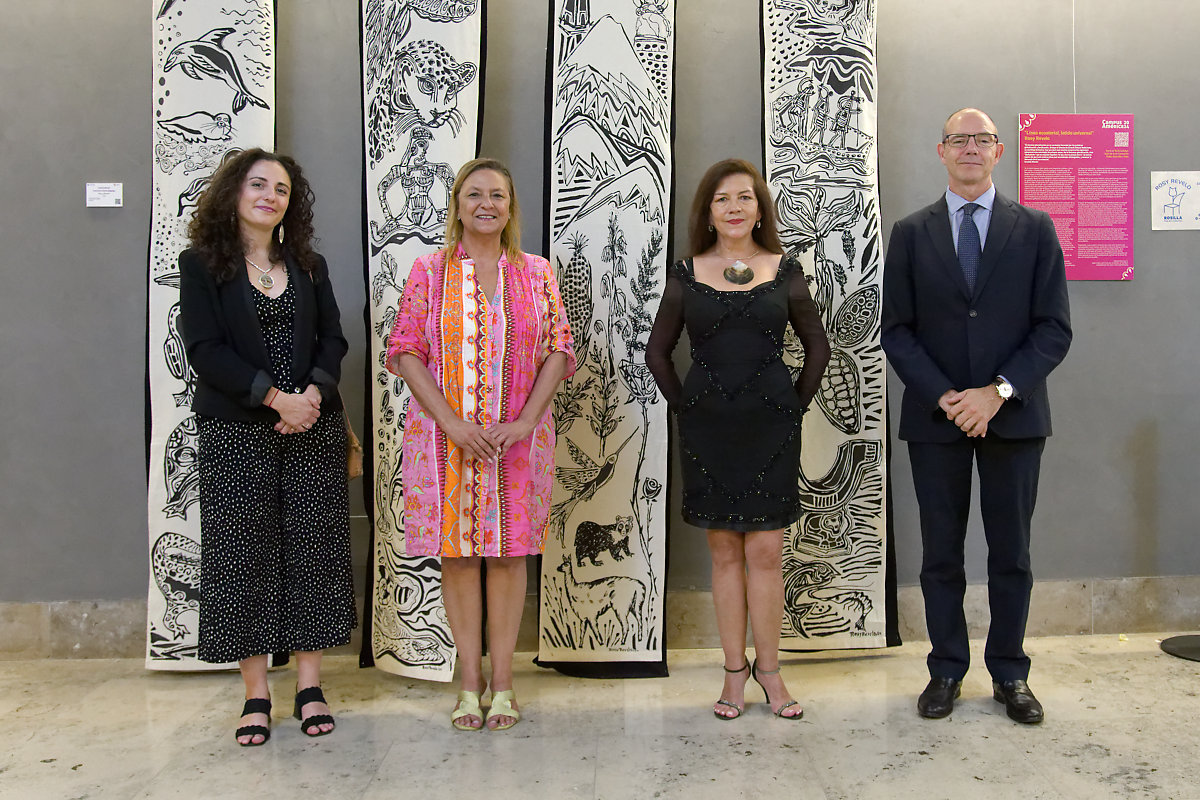
Four large vertical panels representing the regions of Ecuador occupy the central space of the Pablo González Vera Auditorium. To their left, five paintings depict the ethnic groups that inhabit the South American country, while on the opposite wall, dozens of small drawings feature novel versions of the characteristic ceremonial masks that local goldsmiths created long before Columbus's arrival. All of these are works by Rosy Revelo, creator who in this way has synthesized the diversity, identity and memory of Ecuador in the exhibition “Equator line, universal heartbeat”, which opened yesterday, Tuesday, October 8, in the exhibition space of the University of La Laguna.
A work that, as Inmaculada González, Vice-Rector for Internationalization and Cooperation of the academic institution, pointed out, not only reflects the complexity of Ecuador as a country, but also portrays the artist herself and her universalist zeal, demonstrated in the more than one hundred individual and collective exhibitions that Revelo has mounted in some thirty countries throughout her long and award-winning career, which the Vice-Rector briefly summarized in her speech.
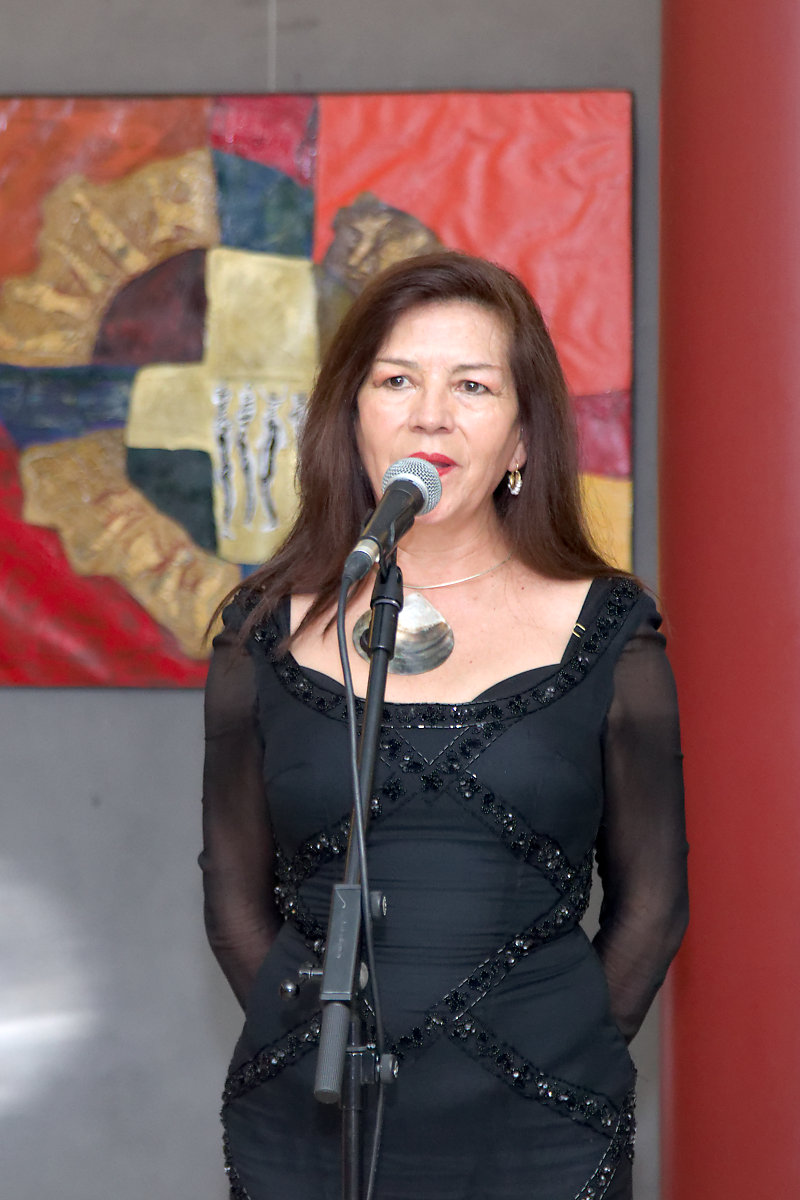 The artist herself alluded to this personal yearning for universality by referencing her own surnames, Revelo Potosí: the first, originating from the Europeans who arrived in her country five centuries ago, and the second, a pre-Columbian toponym for a Bolivian mountain once overflowing with gold, hence its current meaning as a synonym for abundant value. She is, in short, someone “as much from here as from there,” which, according to the artist, reflects Ecuador itself, one of the “most multicultural and mega-diverse nations in the Americas.”.
Revelo explained in broad strokes the works that make up the exhibition, divided into large thematic groups, and focused especially on the large format panels that, with expressive black line drawings, iconographically summarize the four great regions of his country with significant elements from each of them: the Guayas River, the banana and the monkeys of the Coast region; the llama, the cereals and the image of the Virgin of Quito in the Sierra region; the piranhas, the coffee and the jaguar of the Amazon; and the turtles, penguins and dolphins of the insular or Galapagos region.
Another aspect of her work reflects characteristic icons of her country, such as the condor, local architecture, pre-Hispanic idols, the cinnamon tree and, in a nod to Spain, the figure of the Gipuzkoan poet José María Iparraguirre, who emigrated to America for political reasons, in a nod to the artist's own biography, having earned a doctorate from the University of the Basque Country.
The honorary consul of Ecuador in the Canary Islands, Guillermo de la Torre, recounted during the inauguration how from the first moment, when the University of La Laguna asked him to collaborate in shaping the cultural program of Campus America 2024, he knew that the artist who could best represent Ecuador, the guest country of this edition, was Revelo, because of the colorfulness and thematic complexity that so well represent her country.
Carla Freile, Undersecretary of Social Memory at the Ministry of Culture and Heritage of Ecuador, also attended the opening and expressed her gratitude for the opportunity provided by the University of La Laguna to showcase the Ecuadorian artists, musicians, and filmmakers invited to participate in the Canary Islands. Furthermore, through Rosy Revelo, the ministerial representative also praised the program for its role in reclaiming the contributions of women artists, long overlooked by official history, and, in this regard, acknowledged the crucial role of universities in fostering social change.
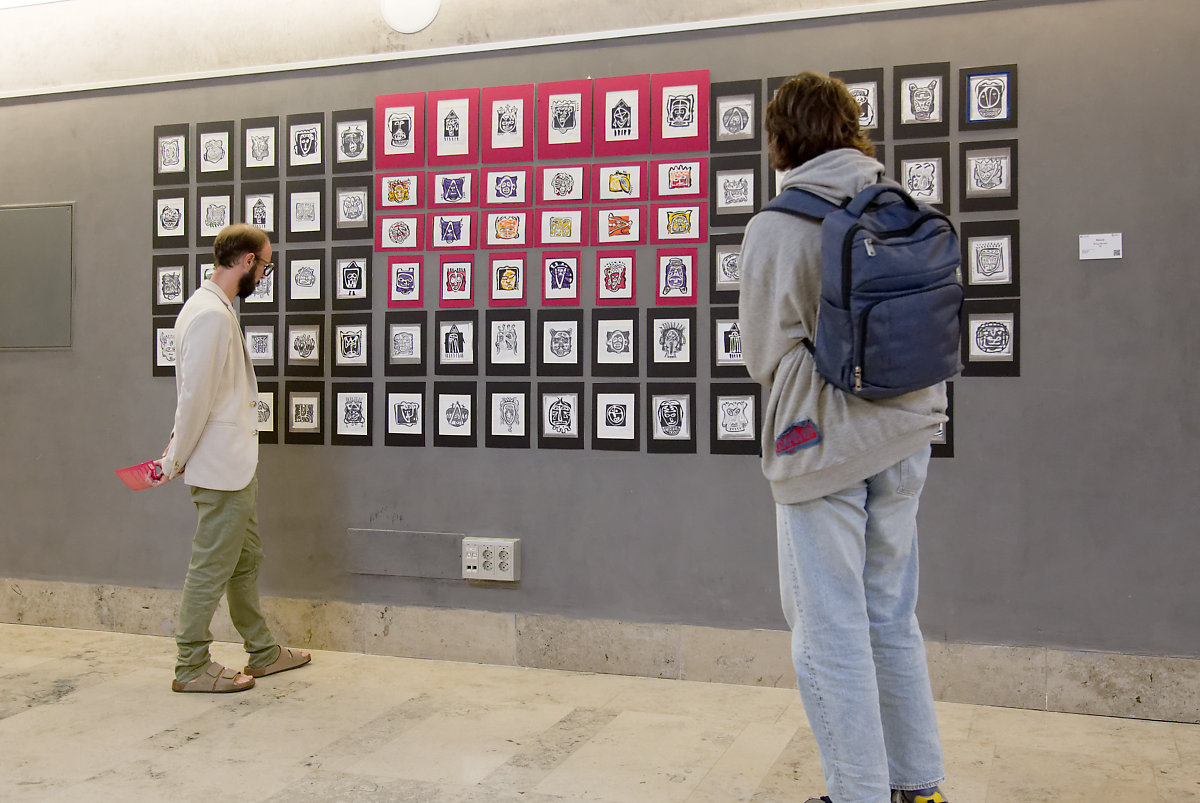 As critic Hernán Pacurucu, curator of this exhibition, points out in the review he has written for the program, Revelo's work represents a "visual intermediation" that allows us to know "the truth of a historical people" and also "the reality of the nomadic development of those who migrate and the consequences of that migration both in the context of the person who does it and in their environment.".
Thus, the exhibition oscillates between the descriptive and evocative nature of a geographical and cultural context as specific as Ecuador, and the personal vision of the artist, who reflects on all these historical and identity concepts from her female perspective.
The exhibition will remain open throughout the development of Campus America 2024, until October 18, and can be visited from Monday to Friday in the afternoon.

 Spanish
 English
 French