Climate migration, that is, population displacements caused by changes in environmental conditions, is a reality that is occurring and is expected to increase in the future. However, it is difficult to study due to a lack of specific data on the phenomenon: for example, there are statistics on the number of people displaced by armed conflicts and natural disasters, but not all of the latter are climate-related, as may be the case with earthquakes. This does not mean that it is not being studied, and yesterday, Monday, October 14, the seminar on Campus America called “Environmental displacement, gender, and vulnerable territories: Experiences in the Canary Islands and Latin America”"He gave examples of work done along these lines.".
The seminar has been organized by the Chair of Globalizations, Migrations and New Citizenships, coordinated by its director and co-director, Carmen Ascanio y Barbara Rostecka, Both are from the Department of Sociology and Anthropology at the University of La Laguna. As the latter explained during the presentation, the seminar addressed experiences in the Canary Islands and Latin America “that take climate change seriously, considering human rights and a gender perspective,” and suggested that, given the seriousness of this problem, perhaps we should speak of “environmental refugees” instead of “displaced persons.”.
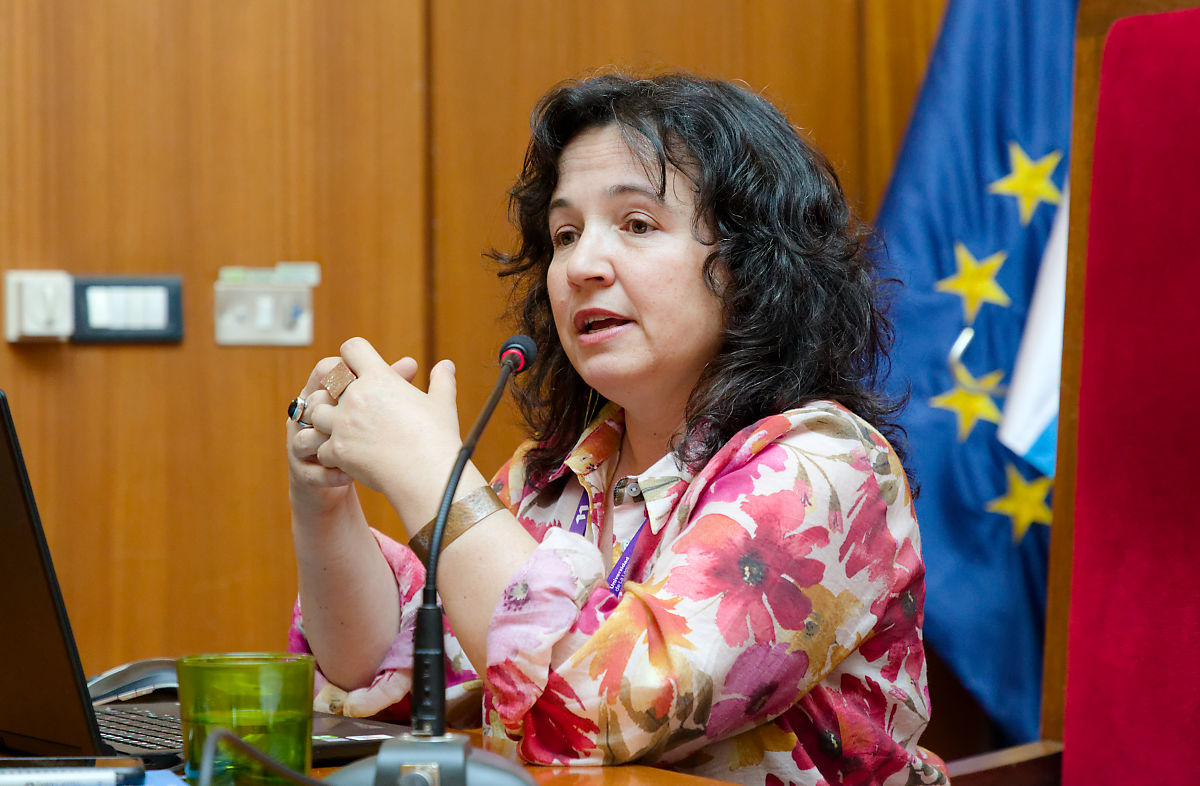
The first speaker was Laura Marrero, from the Uruguayan headquarters of the Latin American Faculty of Social Sciences (FLACSOIn her presentation, “Gender Perspective Under the Risk Approach to Climate Change: Approaches to Climate-Related Mobility and Migration,” she spoke from her dual perspective as an academic and manager, having served for years as an advisor to the Uruguayan government on integrating a gender perspective into climate policy. In fact, she stated that years ago it was easy for her to separate these two aspects, but now they are so intertwined in her work that she approaches them from a holistic perspective.
The expert outlined a series of conceptual frameworks useful for the study of climate migrations from a gender perspective; the first of these would be the sociology of risk, since it has been assumed that risk is a social construct: “It no longer comes from divine or only natural threats, there is a factor constructed on a human scale, they are of an anthropogenic nature and come from the form of development that we have given ourselves in this world.”.
Another such conceptual framework is the anthropology of states, which has changed considerably since the world became a trans-global network where decisions made by international organizations often have direct repercussions at the local level, frequently bypassing the state level. This explains, for example, the existence of networks of municipalities directly funded by multilateral organizations. This does not mean, however, that national policies have ceased to be relevant, since the climate change agenda is global and compels states to reach agreements.
In analyzing the problem of climate change, Laura Marrero highlighted the importance of incorporating a gender perspective because a series of structural social discriminations exist that make the problems arising from this situation more severe for women. However, this must be done from an intersectional approach that does not consider women as a uniform category, since in addition to sex, variables such as race, the type of society in which they live, and other specific factors must be taken into account.
Marrero detailed a series of highly relevant pre-existing structural gender inequalities, such as unpaid work, the gender gap in unemployment rates, and sexual violence, with femicides as its most brutal manifestation. And with climate change, these human rights violations are exacerbated: for example, in the event of a migration event caused by environmental factors, refugees could end up in another territory where sexual violence is even more prevalent. In general, migration always generates new risks.
The expert highlighted the rigor of the Intergovernmental Panel on Climate Change (IPCCThe UN Scientific Council (USCCA), a UN scientific body that compiles all existing research evidence worldwide to produce reports published periodically, has gained legitimacy, and states generally heed its findings, which also acknowledge the existence of these structural patterns of inequality. In its latest report, the USCCA addresses gender in several chapters, including those dedicated to water, food, cities and settlements, health and well-being, poverty, and climate resilience.
I also point out the relevance of the nationally determined contributions, These goals, stemming from the 2016 Paris Agreement on climate change, represent the commitments each country pledged to make from 2020 onwards regarding mitigating the effects of climate change. Initially, they were intended to focus solely on measures to reduce greenhouse gas emissions, but thanks to the contributions of countries in the Global South, they also incorporate strategies for adapting to the new climate situation.
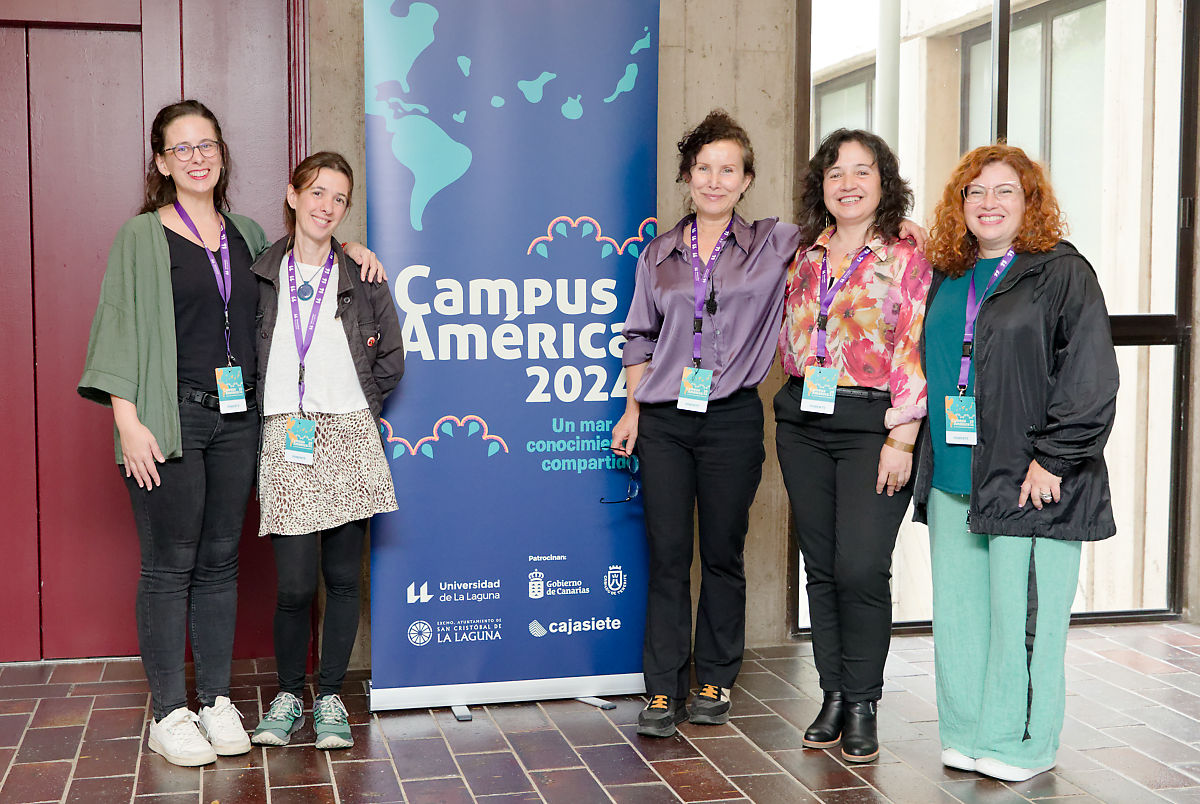
The participants in the session: Beatriz Felipe, Irene Polo, Barbara Rostecka, Laura Marrero and Sara García.
The Great American Chaco
Another of the presentations given at the event was that of Beatriz Felipe Pérez, a researcher at the Tarragona Centre for Environmental Law Studies from the Rovira i Virgili University and in the cooperative CICrA Environmental Justice. In it, she detailed a research project developed between 2022 and 2024 on the Gran Chaco Americano, a large geographical area that extends through territories of Argentina, Bolivia, Brazil and Paraguay, characterized by its wide population diversity, its deep inequalities and because there are large communities of displaced people who also live the effects of climate change.
In general, the four countries through which it expands consider it an impoverished area and there are great tensions arising from land ownership, with large latifundist landowners expelled to communities that inhabited land without papers or with common deeds.
The research preparation phase took a year, given the complexity of the territory and the diversity of its communities, which involved sending questionnaires to 190 stakeholders in the area. This was followed by the stages of documentation, structured interviews, and fieldwork, which was very intensive because the research team only had a dozen days to visit 18 different locations, survey 209 people from 44 different communities, conduct 8 semi-structured interviews, and organize 26 focus groups. This last task was quite a challenge: initially, the focus groups were mixed, but it soon became clear that the women weren't speaking, so they ended up separating them by gender to encourage female participation. In some cases, it was even necessary to separate the groups by age because only the oldest chief spoke.
The Chaco Americano has a population of 9 million people, 315,000 of whom are Indigenous, along with a Creole population and European migrants. It is a territory of increasing urbanization and unequal economic power and political influence, which leads to the marginalization of social groups, especially Indigenous peoples whose lands have been seized by large landowners. There is also limited access to services such as healthcare, education, water, and electricity, as well as significant gender inequalities and widespread gender-based violence.
Nor do the extreme weather conditions help, with many months of drought contrasting sharply with major floods, high temperatures, and high rates of deforestation and fires. Given the lack of quantitative data, the interviews proved useful in revealing clear evidence of climate migration. For example, Beatriz Felipe detailed the case of a community from the Bolivian highlands that had to leave their original location because they lacked land titles and were relocated to the Nueva Esperanza area within the Chaco region, where there is no water. They moved from a fertile area to an arid one to which they are not accustomed and must readjust. This is a consequence of migration.

 Spanish
 English
 French