
Campus America held its last institutional meeting today, Thursday, October 17, “Culture and Heritage: World Heritage Cities and Ibero-American Universities”The discussion, moderated by Isabel Karely León Pérez, Vice-Rector for Culture and University Extension at the University of La Laguna, highlighted the role of academia in heritage conservation and management, a widespread practice throughout the Americas. In countries like Guatemala, academia even participates in the design of educational programs to introduce conservation concepts at various school levels.
José Juan Cano Delgado, co-director of the La Laguna World Heritage Chair at the University of La Laguna, was in charge of opening the session by providing a series of key ideas around which to structure the interventions, such as the need to identify threats and risks to heritage, address sustainability in its triple aspect (economic, environmental and social), and link all actions to the 2030 Agenda, with Sustainable Development Goal number 11, on the safeguarding of heritage, as the central focus.
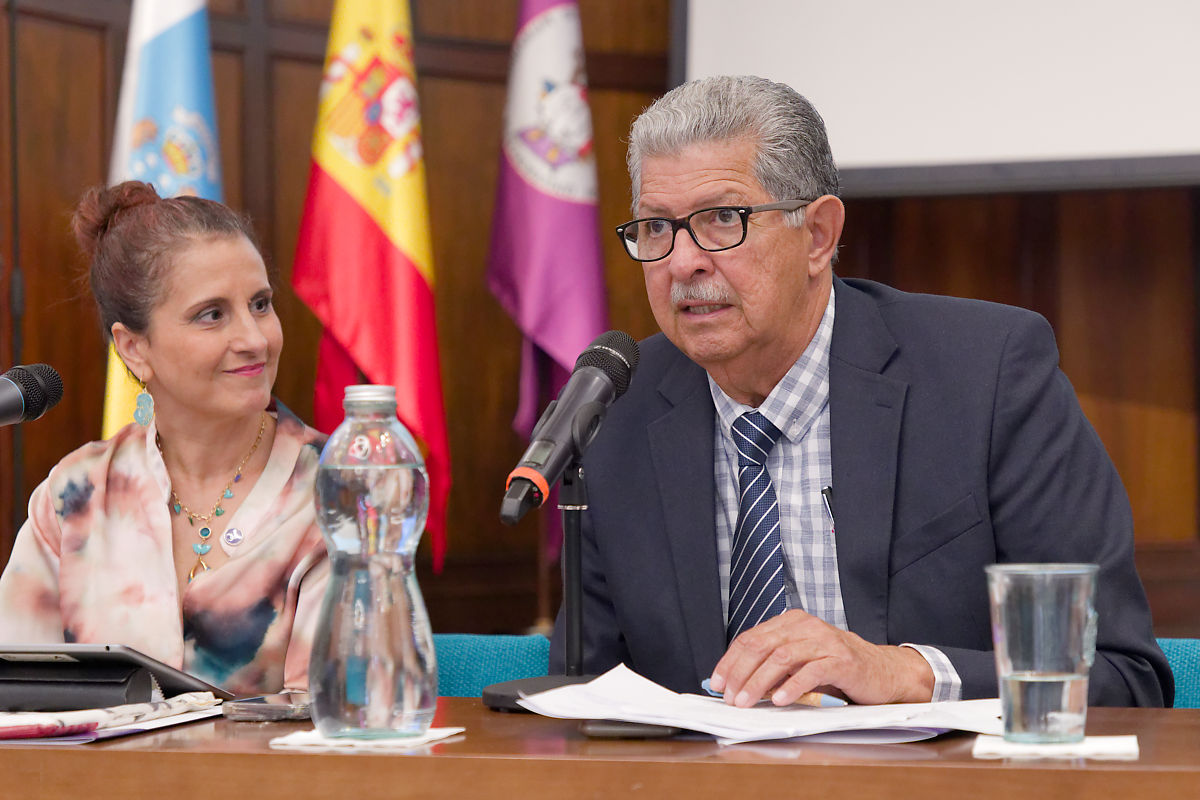
Isabel León and Javier Gaitán Morán.
, The former rector of the Autonomous University of Baja California Sur (Mexico) was the first to speak, offering his 42 years of experience in management, teaching, and research at his institution. He explained that while his state has no heritage cities, it does have three World Heritage sites: the Gulf of California, which stretches 1,300 kilometers; a rock art area known as El Gran Mural in the Sierra San Francisco; and the Gray Whale Sanctuary. In addition, there are eleven natural areas protected under Mexican law.
He reflected that heritage fosters a sense of belonging and identity among citizens, and therefore there are numerous reasons to promote appreciation for this cultural and natural heritage, as well as the need for its conservation, among both local residents and visitors. According to the expert, whether communal ownership is the best approach to conservation is debatable because, ultimately, “what belongs to everyone belongs to no one.” Fortunately, collaborations between institutions, including universities, are becoming more prevalent to ensure that this legacy is properly transmitted.
She then detailed how the university can work to promote heritage through courses, research projects, and the institution's own management, all with a transdisciplinary approach. She emphasized the importance of launching programs focused on the interpretation of cultural and natural heritage, which she considers crucial because this interpretation combines various areas of knowledge that enhance the value of this resource. She also highlighted the creation of partnerships and university outreach initiatives.
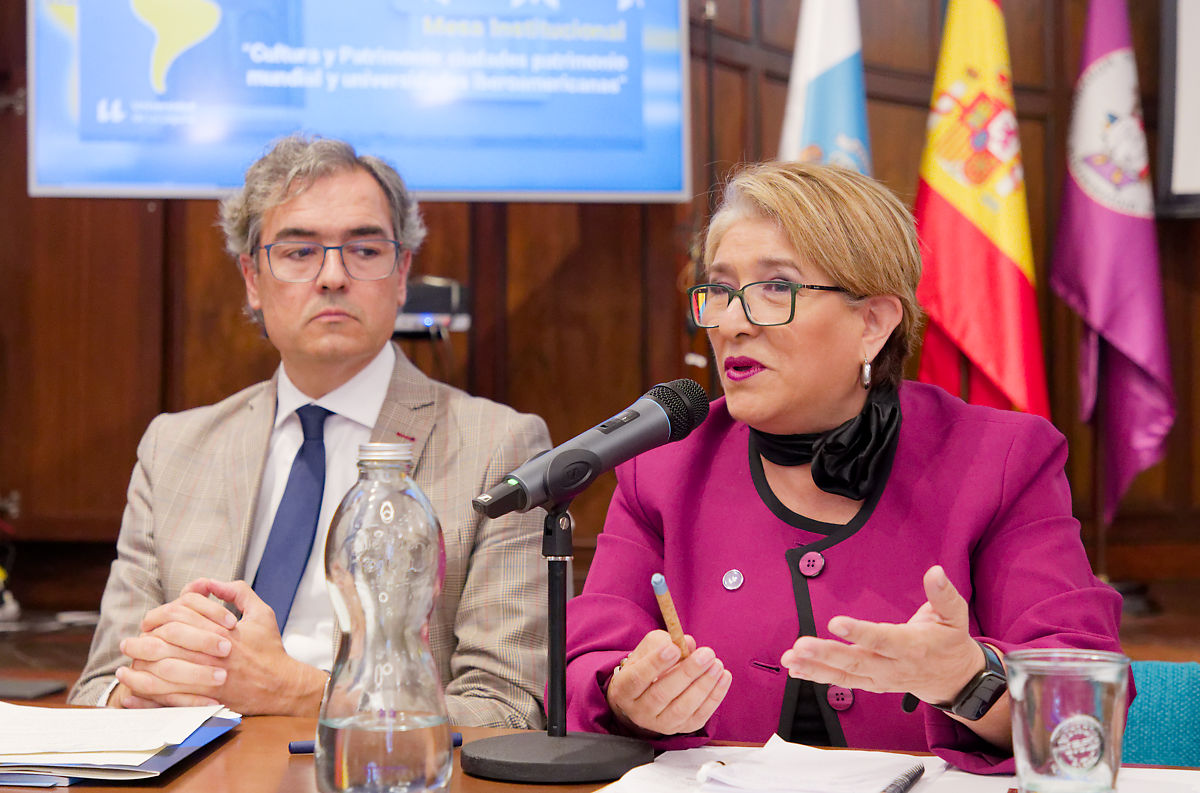
Moisés Morera and Elida Julia Castillo García.
A, Vice Dean of the Faculty of Education, Galileo University (Guatemala), explained how the universities of her country have organized themselves in a technical forum that works towards the rescue and valorization of heritage, with internal and external actions and in contact with the ministries of culture and education, to see how to introduce content on heritage protection into training programs, from primary to university levels.
Participating in that forum are the University of San Carlos, the only public university, and five private universities, including his own. Internally, his technical work involves ensuring the quality of these educational programs. He mentioned the four UNESCO World Heritage sites in his country: the City of Antigua, the Tak'alik Ab'aj National Archaeological Park, the Quiriguá Archaeological Park and Ruins, and Tikal National Park.
The speaker also presented the creation of a new network of researchers in heritage and tourism, with representatives from the six Guatemalan universities, three Mexican universities, two geoparks in Italy and one in Portugal, and the University of La Laguna itself. In her opinion, academic institutions must change their teaching methods and emphasize values education to “enhance that empathetic connection with communities.”.
Moisés Morera, programming director of Casa de América, praised the programming of Campus América and related it to the ordinary activity of his entity, whose main difference is that it takes place throughout the year and not only in a specific period, like the campus, and also addresses the political and business aspects, in addition to the academic, scientific and cultural ones.
Therefore, he considered it appropriate to strengthen the relationship established between Campus America and Cas America, and ventured to suggest, as an idea to explore in the medium term, the creation of an institutional chair focused on Ibero-America, which would allow the campus itself to be more stable and deepen its activities throughout the year.
During the debate, Morera explained that the Canary Islands are often described as a bridge between Europe and America, but he isn't entirely convinced by this metaphor because "no one stays on the bridge." In his opinion, the Canary Islands should be a "base" in this intercontinental relationship, a more stable and welcoming entity, and for this reason he suggested a new metaphor: that of the "shared mirror," which doesn't simply reflect America but is part of the image itself, because the islands are an intrinsic part of the Ibero-American space, having experienced the same migratory and social processes.
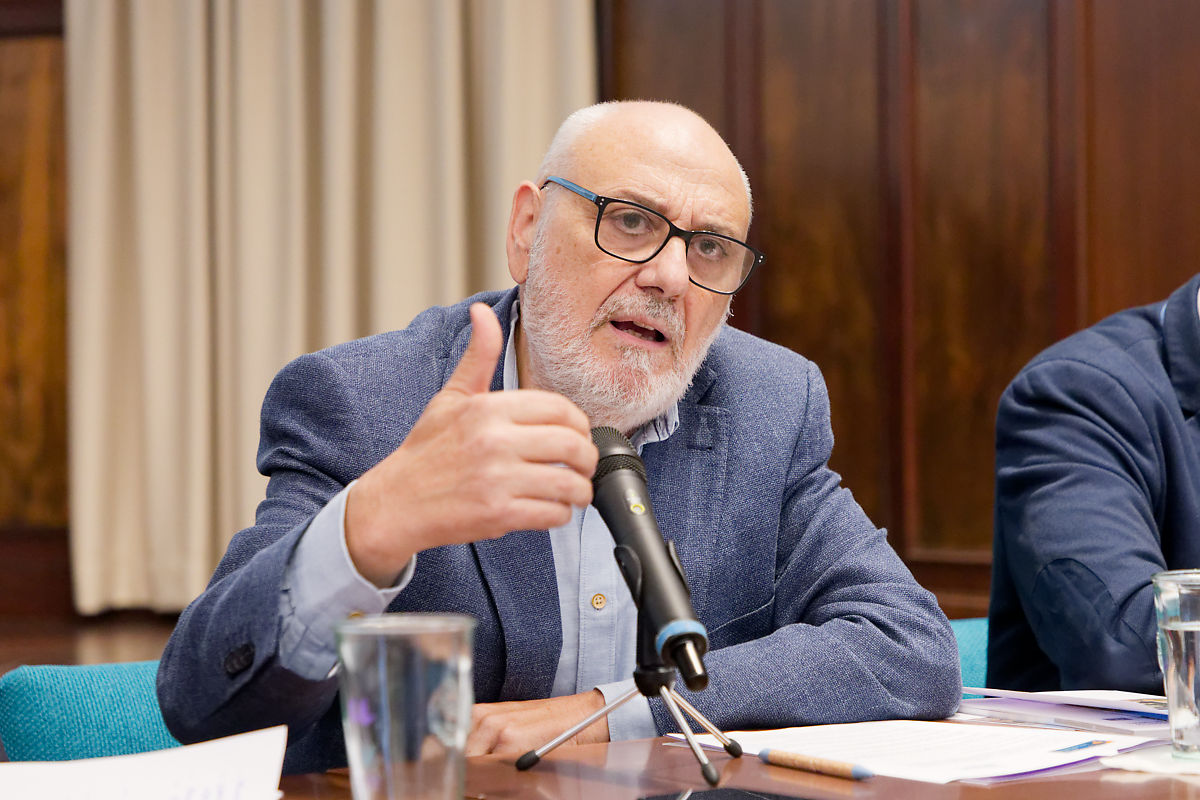
Juan Carlos Molina Gaitán
Finally, Juan Carlos Molina Gaitán, president of the ICOMOS Spain National Committee, noted that this Campus America has changed his perspective on certain issues. For example, until now he had always believed in the idea of preserving heritage for future generations. However, the intervention of a Mexican speaker during the working sessions of these days has made him understand that it is necessary to focus on protection in the “now,” to facilitate the enjoyment of this heritage by the contemporary population, who will later bequeath it to subsequent generations.,
In his opinion, it is “imperative” that universities provide heritage training “from the very beginning of the process,” so that those who will be carrying out the training possess this knowledge and are able to transmit it to their students. He also emphasized the need to identify the heritage values of each territory because this will allow for the definition of criteria for intervention and management of that natural and cultural legacy.

 Spanish
 English
 French