
The Ecuadorian writer, academic and politician Raúl Vallejo Corral was the guest speaker to close the fourth edition of Campus America which, on this occasion, has been dedicated to his country. In a presentation rich in examples from Ecuadorian literature and historical references, the author highlighted the deep-rooted racism that, since its founding in 1830, runs through the country like “an open wound that oozes racism and aporophobia.”.
Thus, he cited as an example the recent death, just a week ago, of Baltazar Uscha, the last “ice harvester” who brought down blocks of ice from the top of the Chimborazo volcano to sell them in the Riobamba market, which was received on social networks with great displays of sadness and solidarity that the speaker did not hesitate to describe as “posturing”, because these affectionate manifestations contrast with the generalized disdain that in his country is dedicated to the indigenous population.
During her presentation, Vallejo recounted the numerous Indigenous uprisings against Creole landowners, initially, and later against contemporary governments—a historical constant in her country even before its founding. There are accounts of the brutality with which these popular uprisings were repressed from the early 19th century onward, and they persist to this day, almost always with the issue of land ownership and the rights of Indigenous communities as a backdrop. For example, the most recent uprising occurred in 2019, and after a harsh crackdown, those responsible were granted amnesty in 2022.
Thus, Vallejo bluntly explained that, although Ecuador's 2008 Constitution enshrines the plurinational nature of the state and recognizes indigenous culture, this legal commitment has not translated into daily life. "As long as the indigenous person is considered folklore, anything goes; but when they manifest themselves as a political subject, they become dangerous.".
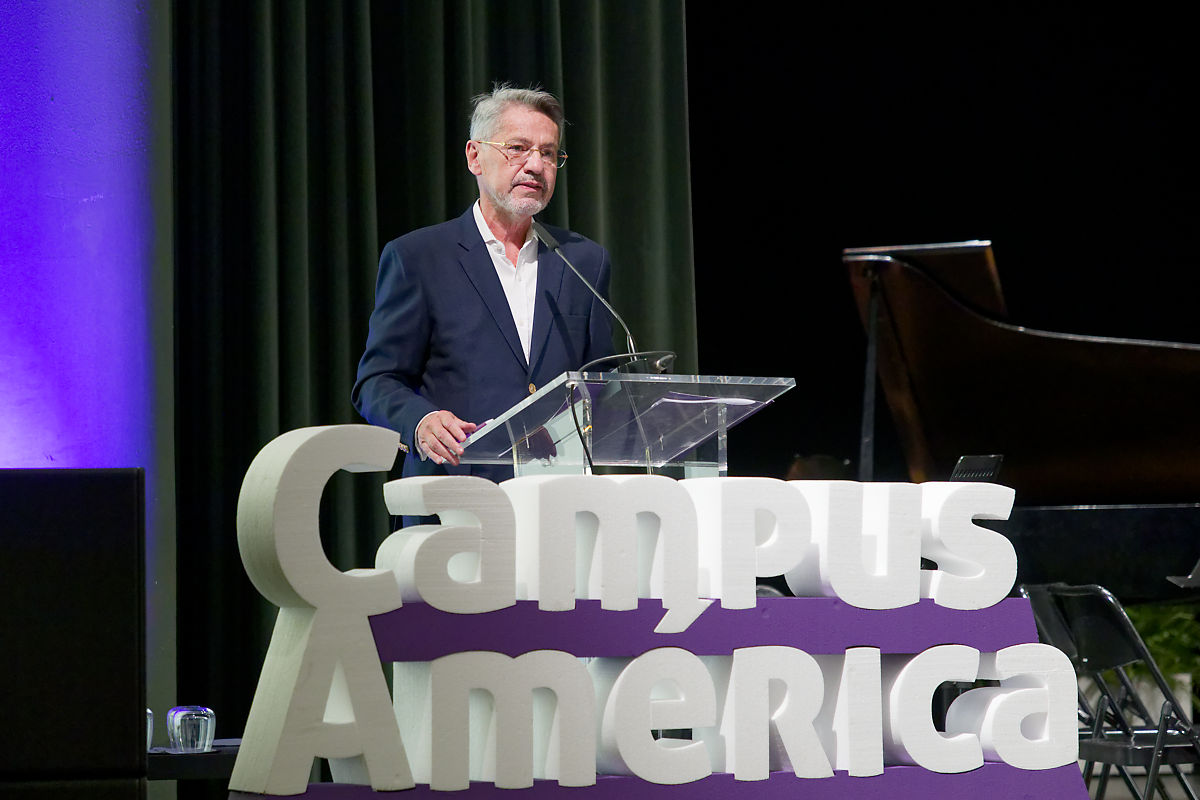
Raúl Vallejo.
The situation is therefore nothing new, and its denunciation has solid backing, such as that of James A. Robinson, one of this year's Nobel Prize winners in Economics, who pointed out in a recent interview that poverty and inequality are rooted in colonialism and the exploitation of indigenous peoples. This, as Vallejo reflected, is not far removed from what Guamán Poma de Ayla said approximately five centuries earlier in his famous letter to Philip III, in which he reminded the monarch that "Spain is nothing without the Indian.".
As an example of Ecuador's turbulent relationship with its indigenous past, Vallejo reflected at the beginning of his presentation that the elegy "Atahualpa Huañui," one of the seminal works of Ecuadorian literature, is written in Quechua by an author who had likely grown up between the two cultures. And yet, despite the fact that the Inca language was highly developed at the time of the Spanish conquest, its use did not become widespread as a marker of identity and remains largely unknown to the majority of the country's inhabitants, relegated to indigenous populations. He also pointed out, as a telling detail, that when independence was achieved, the new state was not named Cuzco, as might seem logical, but Ecuador, in reference to a geographical fact.
Throughout the speech, he quoted writers from different eras, such as Juan León Mera, Juan Montalvo, and Jorge Icaza, who, in their works from different periods and with disparate aesthetics like Romanticism and Indigenism, captured the hardships of the indigenous population with varying degrees of commitment. Even more tragic was the case of the poet Dolores Veintimilla, who dared to call for the abolition of the death penalty after the execution of the indigenous man Tiburcio Lucero. The harassment she endured, including homilies and pamphlets against her, was so intense that she ultimately committed suicide in 1857.
Vallejo's speech, in short, brought together the dual political and literary dimensions that have characterized his own intellectual and personal trajectory. His address was also a lesson on Ecuadorian literary tradition, a historical overview of the discrimination against Indigenous peoples, and a plea for his country to finally address the necessary reconciliation between the state and Indigenous communities.
Concert and closing of Campus America 2024
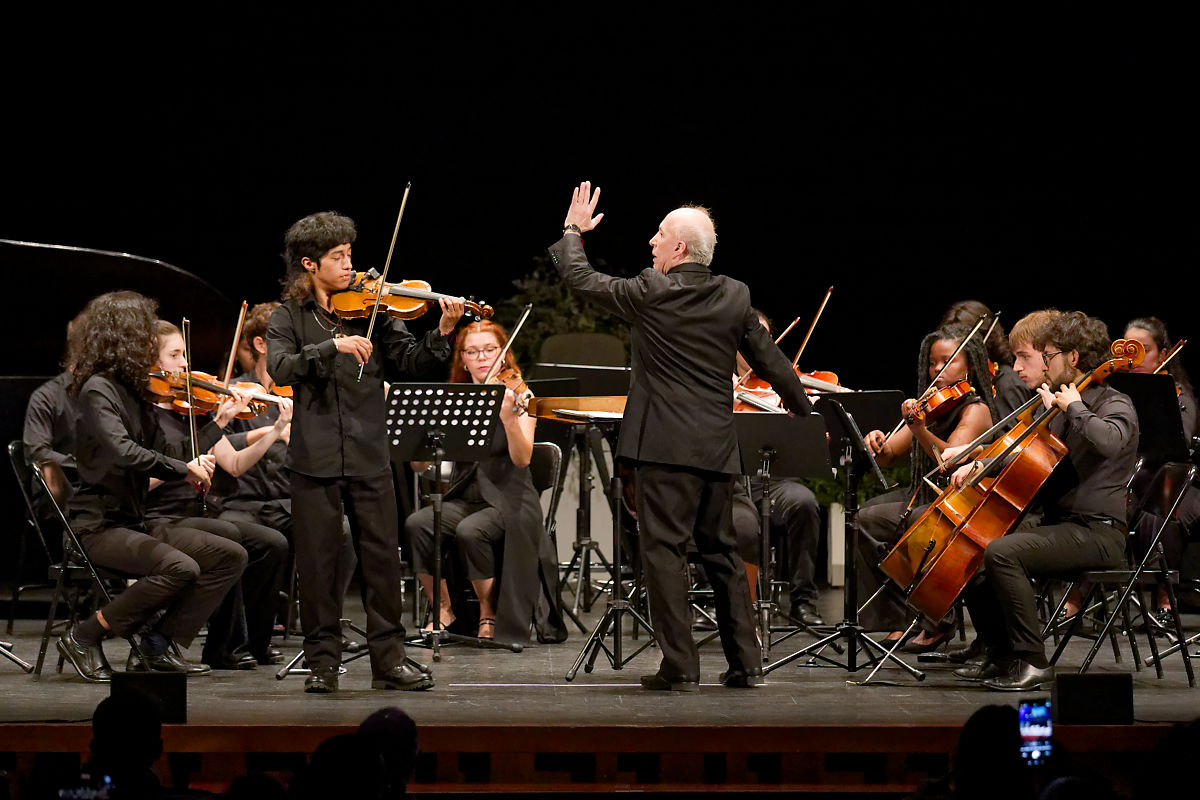
The Ecuadorian director Patricio Aizaga.
Following Vallejo's intervention, the chamber orchestra of the Higher Conservatory of Music of the Canary Islands, conducted by Roberto Pia and featuring solo violinist Saulo Cuesta, filled the stage to perform pieces by Vivaldi and Mozart.
To represent Ecuador, Patricio Aizaga, director of the Ecuador Youth Symphony Orchestra, also participated as a guest conductor. Some of its musicians had also traveled to Tenerife and joined their Canarian counterparts to perform pieces inspired by Ecuadorian tradition, with the support of dancer Gabriela Alonzo and soprano Isadora Delgado.
Finally, the rector of the University of La Laguna, Francisco García, and the vice-rector of Internationalization and Communication, Inmaculada González, took to the stage to close these two weeks of intense work in the scientific, academic and cultural field.
The rector recalled that the motto of this edition of Campus America, “a sea of shared knowledge”, could not be more fitting because, paraphrasing the words spoken by the lexicographer Dolores Corbella at the opening of the event, the Atlantic is a bridge that unites both shores.
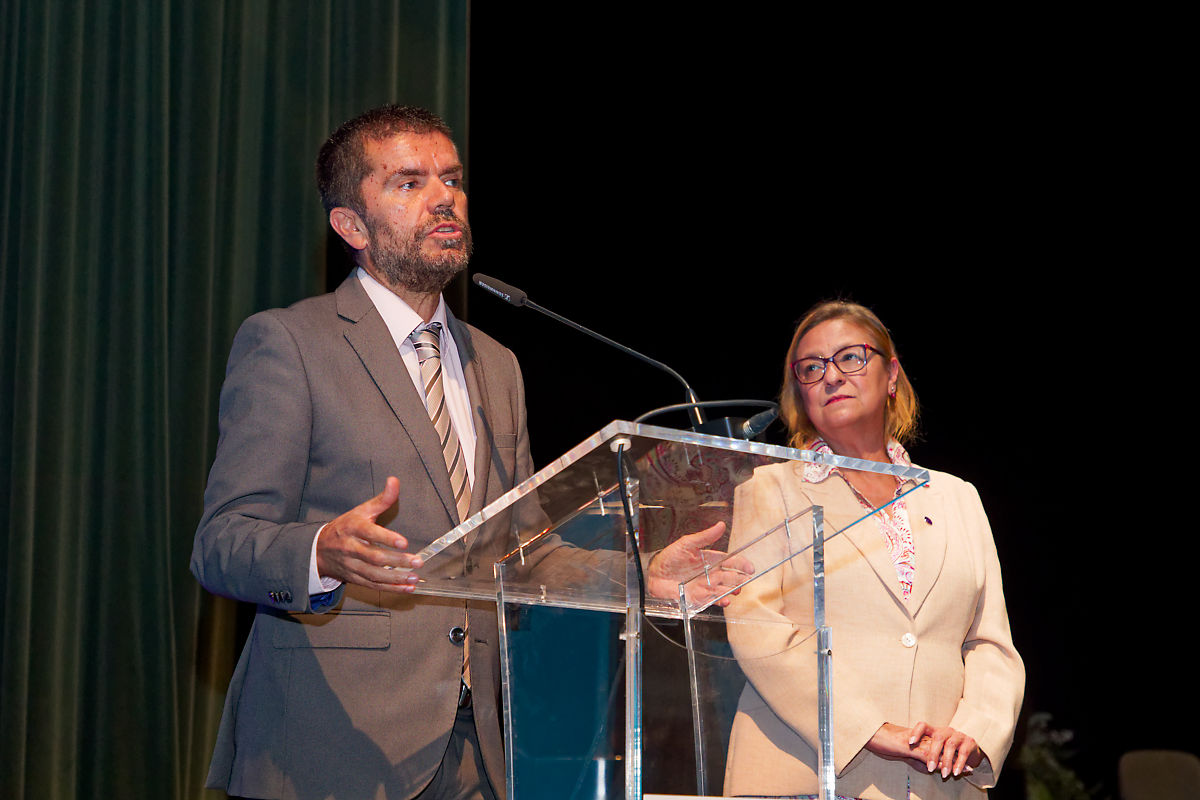
Francisco García and Inmaculada González.
For Garcia, this campus is an example of the need to strengthen relations with the Americas, and therefore, although the event formally concludes today, he advocated for continued work on the themes that have been central to the scientific seminars and institutional roundtables, in order to leverage the networks that have been created and continue building knowledge. He emphasized the significant work that has been done in the academic sphere and the promising projects that have already emerged, such as the creation of an inter-university chair with the support of Casa América. “Therefore, today we are closing Campus América, but we are not ending it.”.
For her part, the vice-rector recalled the staggering figures that exemplify the scale acquired by Campus America 2024: 186 speakers from 17 countries and 50 universities, and some 2,000 people from both sides of the Atlantic who have participated in person or remotely in the 27 proposed seminars.
González noted that the seminars have demonstrated that, through collaborative work, it is possible to change the world, and highlighted the variety and relevance of the topics addressed, including the transformational processes of Ibero-American universities themselves in order to better serve society. And, of course, it has also served to learn more about Ecuador: “If we already loved it, now we love it even more,” he concluded.

 Spanish
 English
 French