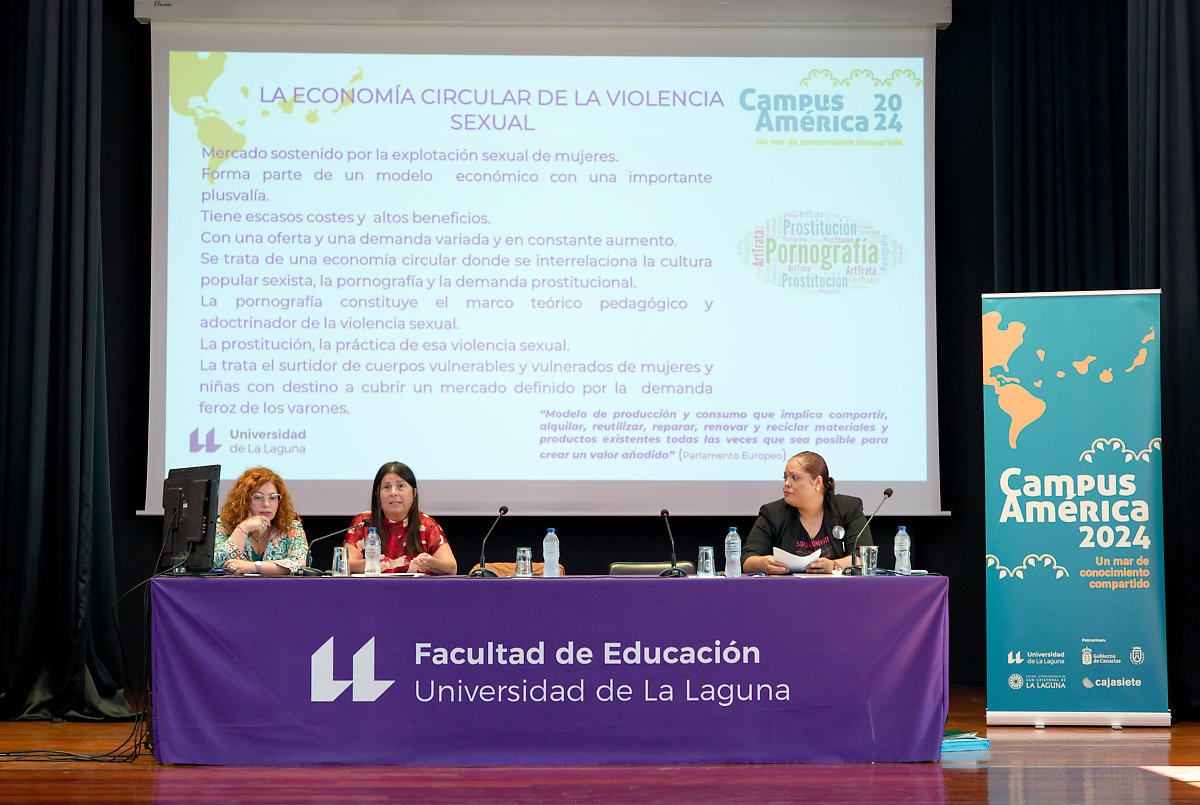
The seminar of Campus America titled “Fleeing the fire only to fall into the embers. Women and girls victims of sex trafficking”"has analyzed the characteristics of prostitution and trafficking of women, defined by the sociologist from the University of La Laguna and co-director of the seminar Esther Torrado, as a true “circular sexual economy” that feeds on various byproducts such as pornography and preys especially on vulnerable groups, which, as the academic pointed out, is a euphemism for “impoverished women”.
The seminar is co-directed by Esperanza Ceballos, The current dean of the Faculty of Education, and the director of the Canary Islands Institute for Equality, Ana Brito, participated in its opening. Also participating in this first day of the seminar were Brazilian activist Kamila Ferreira, researcher Sara García Cuesta from the University of Valladolid, and Begoña Vera Guanche, communications officer for the Daniela project and the Vivas Association.
Torrado was the first speaker, delivering a presentation that offered a comprehensive analysis of the prostitution sector based on her research over the past few years. The expert defined prostitution as a "scum market sustained by a sexual politics and a circular economy of sexual violence," using "scum" in its literal sense of something "belonging to low and vile people," always referring to pimps and clients, never alluding to the women in prostitution, who are their victims.
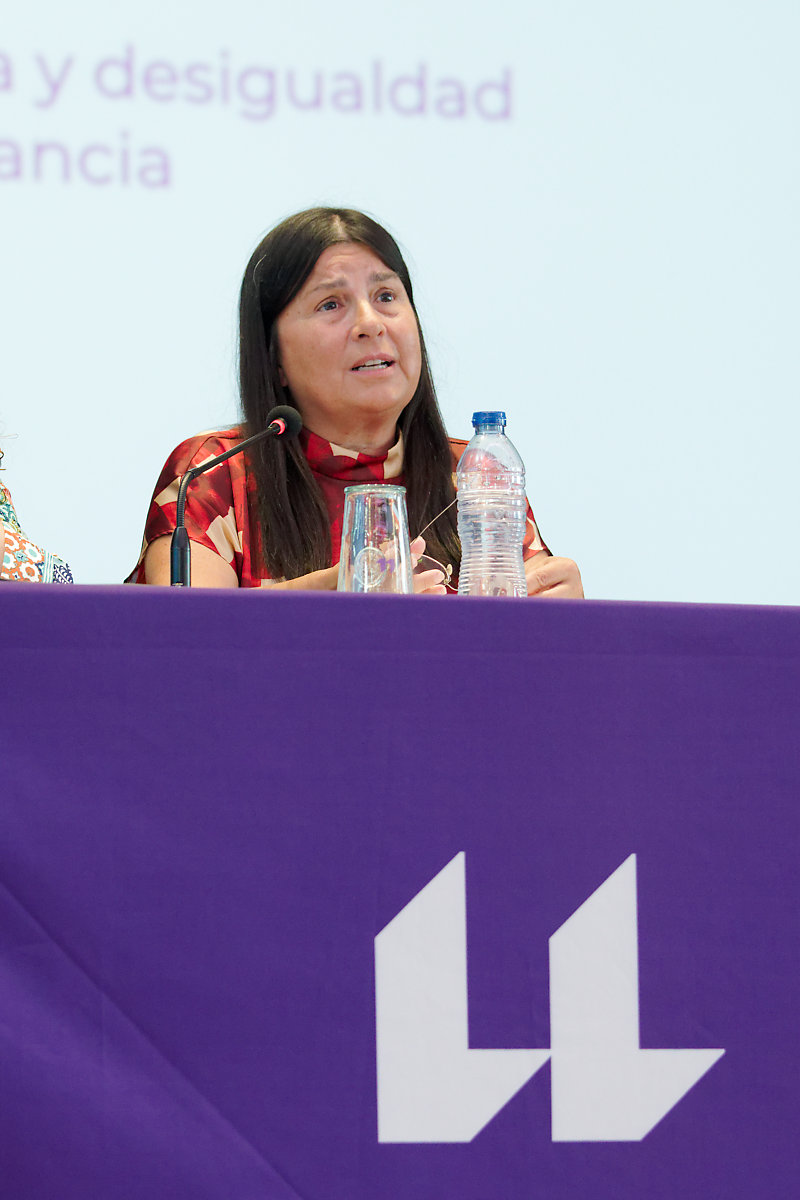
Esther Torrado.
While the term “circular economy” has positive connotations, in the case of the sex industry, it's quite the opposite. Previously an almost artisanal sector, with the advent of the neoliberal market, it's now globalized, with numerous vested interests and intermediaries. Many of its byproducts are traded on the stock exchange; large sums of capital are invested in saunas and sex robots; it thrives on the objectification and hypersexualization of vulnerable women and girls; and it uses pornography as a tool to normalize these practices. “This economic model has low costs and high profits because trafficking and exploiting women out of need or coercion is easier than trafficking drugs and weapons.”.
Like any industry, there's a "prostitution marketing" that raises the sector's profile to make it appealing, and this has led to the creation of a neolanguage with terms and concepts that seek to normalize it, alluding to the idea of a false sexual libertarianism. These justifying ideas have even permeated academia, where Torrado denounces the existence of studies that separate prostitution from trafficking, when the evidence shows that both are interrelated activities.
Myths also proliferate that try to socially condone the consumers of this market, such as the "needy whoremonger", who must let off steam or else he loses control; the "supportive" one, who believes that, thanks to him, the prostituted women subsist; or the archetype of the "happy" prostitute, which serves to reduce the guilt of the one who uses her.
Torrado denounced the laxity in identifying victims of trafficking and warned that increased socioeconomic inequalities would lead to a rise in trafficking and the recruitment of women. She also criticized the patriarchal view of sexuality, migration policies lacking a gender perspective, the insufficient resources to assist trafficking victims, and the absence of a legal framework: “Although the Canary Islands Parliament declared itself abolitionist, we are still waiting for them to pass the law.”.
A survivor's story
Brazilian Kamila Ferreira is the author of the book "Spain, the European Thailand," a title that alludes to the fact that, after Thailand and Puerto Rico, Spain is the third country in the world that consumes the most prostitution. She is also a victim of trafficking, having spent thirty years as a prostitute in several countries. Fortunately, she has managed to escape that world and is now an activist.
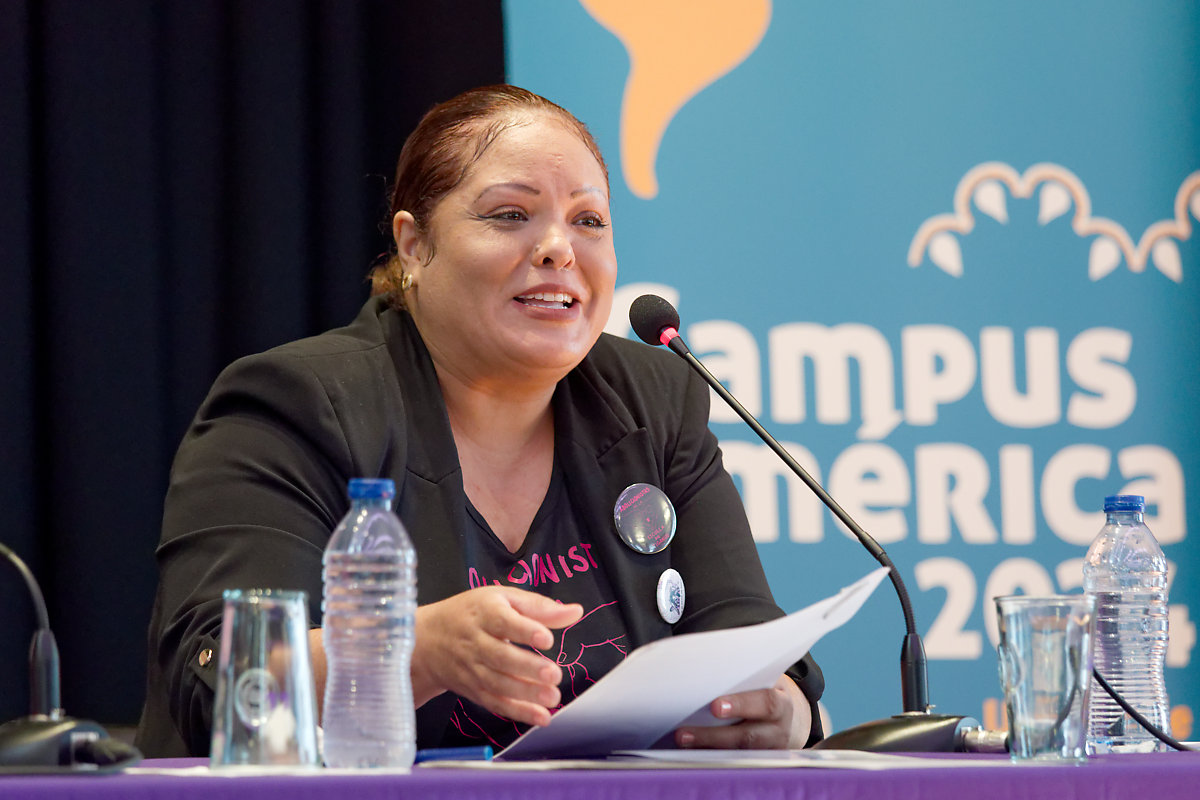
Kamila Ferreira.
Hers was a harrowing testimony that detailed the terrible moments she had experienced since childhood. She recalled that her first sexual abuser was her own brother, when he was 17 and she was only 3. Because of this, she felt safer on the street than at home, despite living in the second most dangerous favela in Brazil. And yet, despite the starkness of her testimony and the occasional use of crude and unusual vocabulary in a university setting, Ferreira specified that she was being gentle because wealthy, white Europe “is not ready to hear the truth.”.
At 14, she was given to a family who supposedly would employ her as a nanny, but her real destination was a luxurious brothel in a colonial-style house. At 17, she arrived in Valencia with false papers after a journey through Chile and Mexico. What followed was a long period confined to clubs, where she lost track of time and the decades.
In her account, she explained how drugs are a fundamental element of that world, as is witchcraft, and that there is a very pronounced racism, such that Black women of African descent who are prostituted suffer a double punishment, as they are victims of racist abuse even from other women. Indeed, in the underworld of trafficking, not all women are equal, and there is a hierarchy of preferences whose apex, according to the speaker, is the Aryan woman.
After escaping the prostitution system, Ferreira suffers from post-traumatic stress more severe than that of soldiers who have seen combat, a common condition among other trafficking victims that sometimes causes her mind to go blank. Despite undergoing psychological and psychiatric treatment, she can't sleep more than two hours a night, distrusts everyone, experiences mood swings, and has an inner feeling that "something" is missing, but she can't put into words what it is: these are the consequences of having been a prostitute.

 Spanish
 English
 French