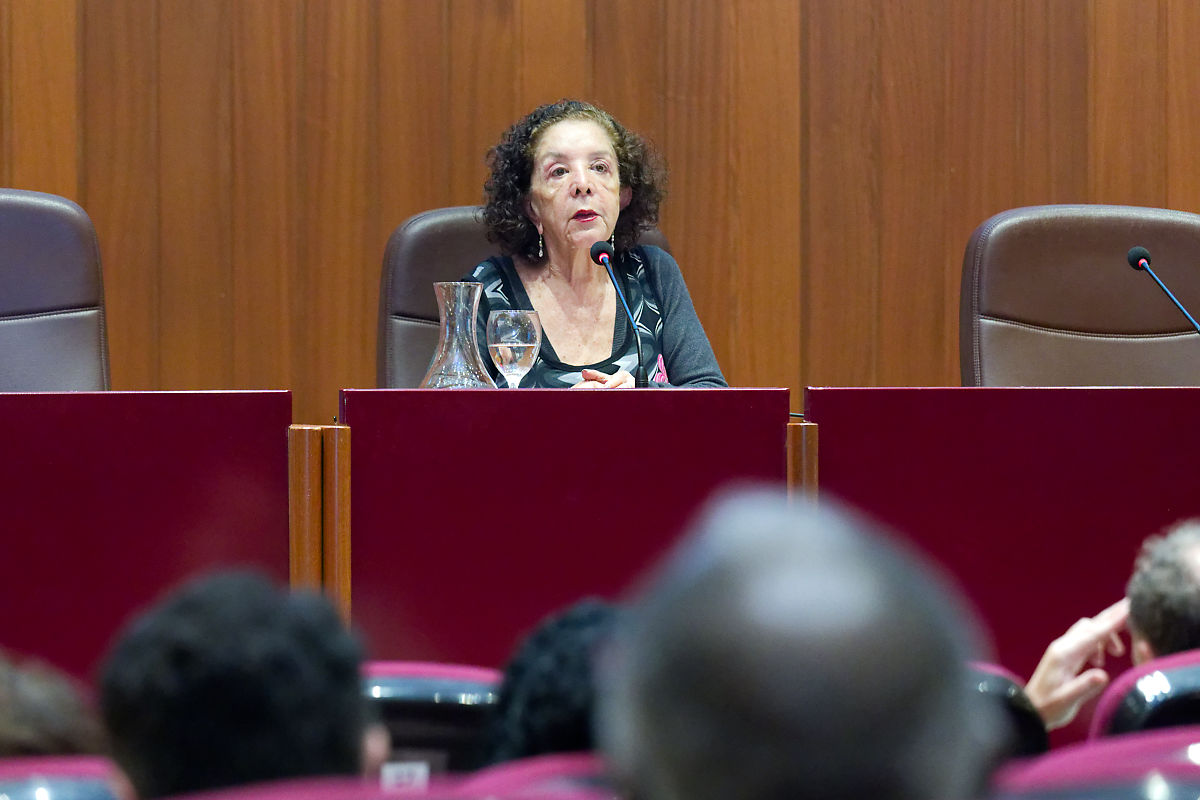
The research group of Critical Pedagogy, next to the Laboratory of Education and New Technologies (Edullab), both from the University of La Laguna, are hosting the nineteenth edition of EUTIC International Congress, This year's event, held at this academic center, addresses the challenges of information and communication technologies from an interdisciplinary perspective, emphasizing their social responsibility in building a new kind of citizenship. The theme chosen for this edition is 'Digital Generations: Complexity, Controversies, and Challenges'.
The president of the organizing committee is Professor María Lourdes González Luis, who introduced the members of the opening panel of this event, which will run until Wednesday the 23rd and includes three plenary lectures, 35 presentations, and two symposia. This event addresses topics related to pedagogy, democracy, and current and future educational scenarios, as well as more technical topics focusing on artificial intelligence, computer science, and robotics applied to education.
The congress is supported by an international partnership of Portuguese, French, and Greek universities, as well as the Spanish University of La Laguna. Lise Vieira, its director, spoke about the characteristics of this network, praising the open spirit of this scientific event, its multidisciplinary nature, and its capacity to strengthen academic ties with laboratories in Latin America. Last year's conference took place in Bordeaux, and next year's will be held in Tunis. The commitment to scientific production from a human perspective and its critical capacity underlies this initiative.
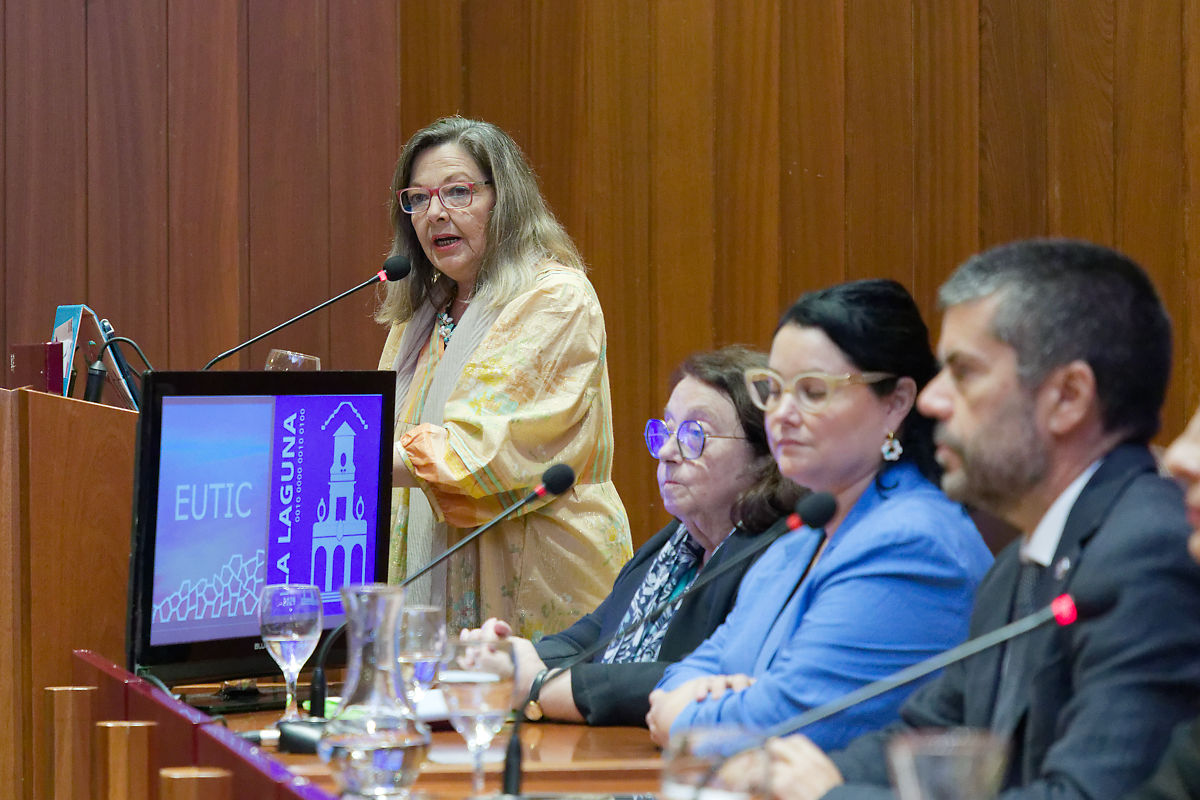
Lourdes González Luis, standing, president of the organizing committee.
Manuel Area, director of Edullab, stated that this unit has been working on research and teaching related to educational technologies for 25 years, since before the internet had entered people's daily lives. “We had a very naive view of the arrival of digital technology, and now we are beginning to see its downsides, its omnipresence, and the socioeconomic constraints it entails.” Patricia León, director of Diversity and Equality for the Tenerife Island Council, the entity that funds the congress, described this event as “a space for reflection and collaborative work” on different areas impacted by technology, which, she said, is a priority for the Island Council. “Only in this way can we provide effective solutions for society.”.
For her part, National Deputy Cristina Valido, also present at the opening ceremony, indicated that conferences like this one make the university a pioneer, enhancing its international prestige and creating cutting-edge spaces, “at a time when knowledge becomes outdated in a short time,” given the omnipotence of social media. “We must reclaim intellectualism in a world where heroes and heroines are fundamentally linked to the physical,” Valido added.
The Rector of the University of La Laguna, Francisco García, maintained that public universities should continue to be spaces for debating major societal issues. “The evolution of ICTs also has positive and unstoppable consequences,” he noted. “We are living in the age of 'likes,' in a world that is moving at breakneck speed, and there is a risk of oversimplifying when evaluating certain phenomena,‘ added the Rector, who said he was proud that these debates are taking place within the public institution. ’Islands are like small continents where certain actions can be tested before being implemented on the mainland,” and their tricontinental location makes them even more suitable, he pointed out.
Neither 'technophobia' nor 'technophilia': a critical view
Magaldy Téllez, from the Simón Rodríguez National Experimental University From Venezuela, she was in charge of delivering the opening lecture. The researcher opted for a critical stance toward technophobia and technophilia. “Technologies are accelerating and massifying everything related to cyberculture, causing a profound erosion of public space as a fundamental axis of democratic life, in addition to a clear disaffection toward politics,” the professor stated at the beginning of her address.
“The digital face of neoliberalism produces a radical reordering of how we perceive ourselves,” stated the researcher, who believes these technologies must be analyzed as devices linked to the production of subjectivities. ”These technologies are not automatons, but rather a direct product of neoliberalism, which aspires to control individual and collective life.‘ In this scenario of instantaneous human action, the fetishization of the digital machine and its commodities is prioritized as absolute truth, she added.
According to the PhD in Social Sciences, algorithms have a social and political character, and in fact, user profile definitions are created from a huge mass of data that are
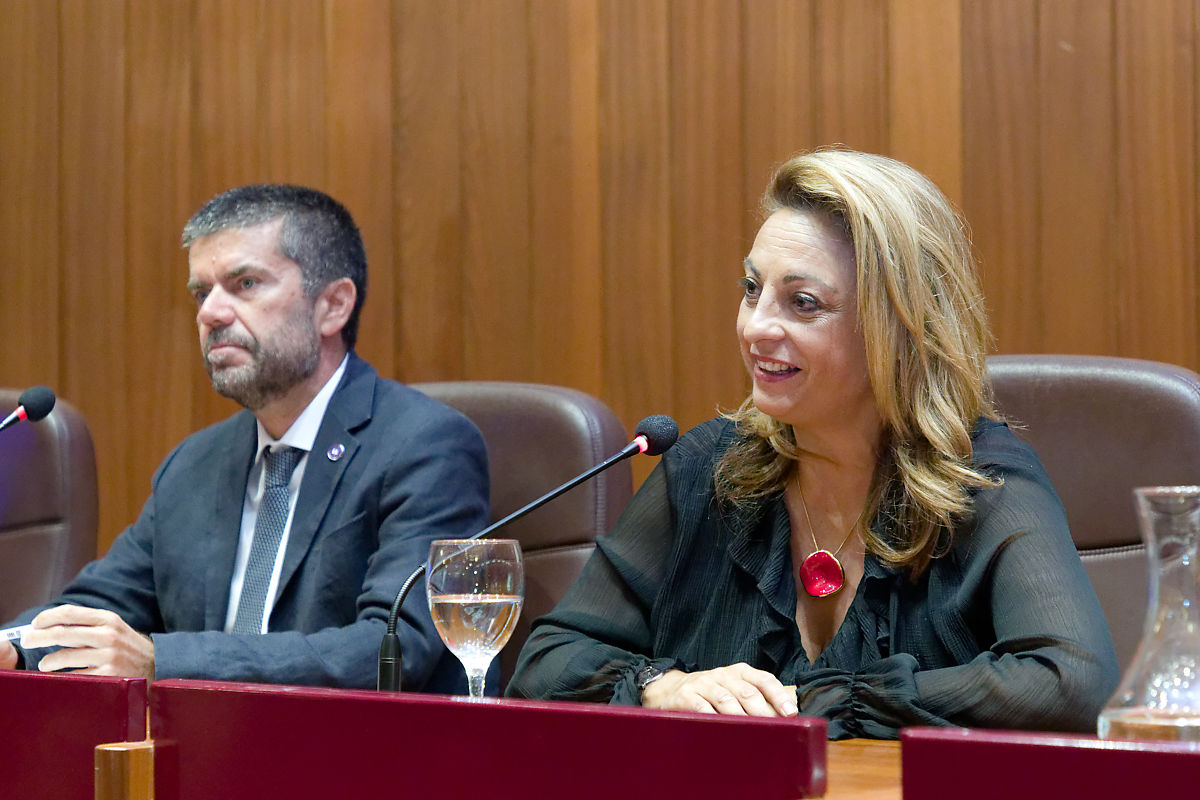
The rector and the parliamentarian Cristina Valido, at the beginning of the session.
previously discussed. “The aim is to predict behaviors, and also to guide them towards certain social and economic interests, turning us into consumers of sensations and productions within cybernetic capitalism.”.
Téllez argued that we are witnessing “cultural mutations,” with the “delocalization” of hereditary practices within what is known as video culture, which in fact constitutes a new cultural condition. “These new control mechanisms belong to neocapitalism, so that the product can be sold and marketed. Thus, the family, the school, the army, and the factory are not the primary institutions, but rather malleable entities of a company that seeks the profit of its shareholders,” stated the coordinator of the research line on ethics, politics, and education at the Latin American university.
According to the researcher, we live in a world of communication where “we are both too interactive and too static, where staying connected is practically a legal requirement.” In this context, and driven by the demand for spectacle, those who don't respond to direct communication, to constant video presence, are disregarded. “Because of this dependence on social media, a sense of alienation from others arises. It's a time of decline for the public sphere, one of the defining features of modernity.”.
Building the common
The mediatization of politics is another phenomenon of our time, in which the role of citizen is being displaced by that of consumer. “The collapse of the modern public imaginary and the monopolization of television viewing are what unleash the struggle to generate trends.‘ In response, the researcher advocated for a new construction of the commons, ’because the commons do not pre-exist,” she explained. “It is about building community without adhering to the identifying logic of conforming to pre-existing norms. It is about recreating the dimension of the public sphere; that is why the notion of public space refers to a symbolic space centered around matters of common interest.”.
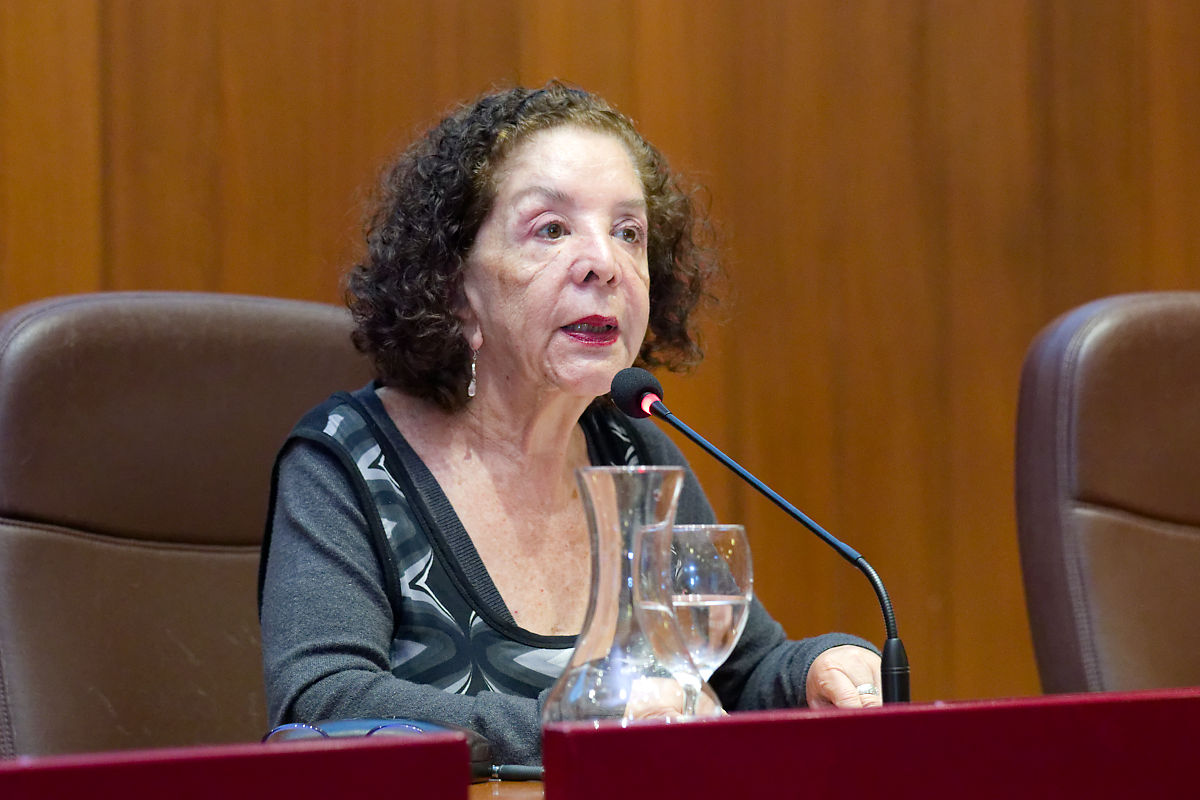 “It’s not just about talking to others, but about talking and listening with others, about exposing oneself to others,” added Téllez, a firm believer in the value of plurality and in upholding the right to dissent. “Social spaces are made up of power structures, constituting asymmetrical relationships of command and obedience,” and for this reason, she advocated conceiving of the social sphere as “spaces for resistance strategies, creating interstices of public dissent.”.
Turning our attention to social spaces means abandoning the state-centric model. “It’s about establishing a political framework for different types of social participation and recognizing new ways of doing politics,” without falling into monologic and totalitarian projects. “We could consider the thesis of the depolarization of societies, seeking pluralistic spaces. The construction of public spaces is related to how disagreements unfold, reclaiming public space as a shared construction of the common good. It’s a place where citizenship is created, conceived as a new art of living together,” he concluded.

 Spanish
 English
 French