The journal Physical Review Letters of the American Physical Society (APS), one of the most influential in the field of physics, has selected a article on nanomagnets as an “Editors” Suggestion,” a privilege enjoyed by only one-sixth of published works, with explicit mention in Physics Magazine. One of its authors is Fernando Delgado Acosta, from the Institute of Advanced Studies in Atomic, Molecular and Photonic Physics of the University of La Laguna, together with scientists from Delft University of Technology (Netherlands) and the Center for Quantum Nanoscience in Seoul (South Korea).
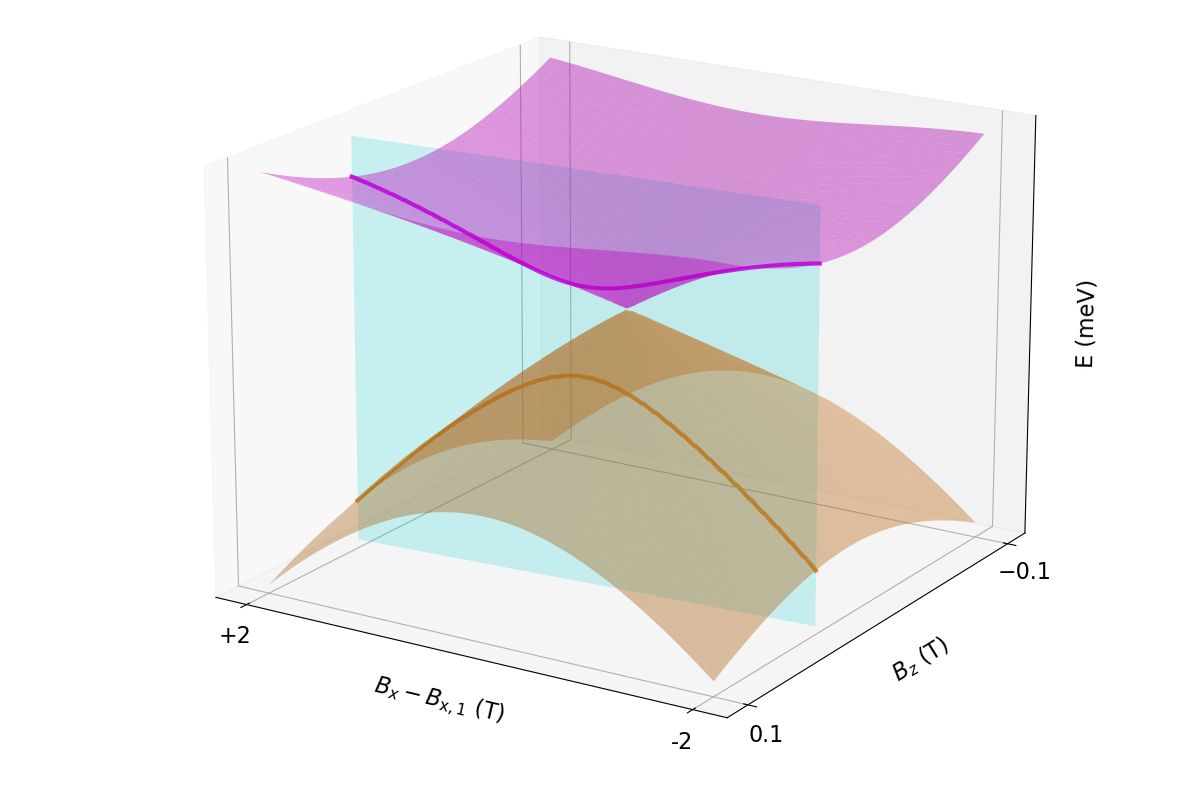
With a touch of humor, the British physicist and mathematician Michael Berry dubbed the non-accidental degeneracies (a term used to describe points of equal energy) between two states that appear in a wide variety of quantum systems as “diabolical points.” It was a nod to the Italian word “diavolo”, due to the similarity between the energy surfaces corresponding to these states in a three-dimensional parameter space, and the children's toy diabolo, whose two opposite conical halves are joined at a narrow neck.
Although the effects of these devilish points have been observed in a wide variety of physical systems, until now it had not been possible to study them in a single isolated quantum system, but rather through indirect measurements in which averaged information is obtained, a process during which some of the data obtained from these millions of small systems studied simultaneously is irretrievably lost, especially the data associated with quantum interference phenomena.
The authors have succeeded in creating and individually manipulating nanomagnets composed of just a few iron atoms, and have demonstrated the presence of diabolic spots. Specifically, lead author Robbie Elbertse, from the Dutch university, and his collaborators showed how, by preparing a particular state of these nanomagnets, their lifetime can increase up to a thousandfold as they approach a diabolic spot. This extreme sensitivity of the observed lifetimes to minute variations in the magnetic field in a given orientation suggests potential future applications such as extremely small, high-precision magnetic sensors.
Using atomic manipulation techniques with a scanning tunneling microscope (STM) under ultra-high vacuum and low temperature conditions, the authors of this work constructed chains of a few iron atoms on a crystalline surface. They then observed the formation of an antiferromagnetic pattern—a structure in which the magnetic moments align in such a way that their directions alternate. In other words, nearest neighbors always have their magnetic moments pointing in opposite directions.
However, these nanomagnets do not obey the laws of classical physics, but rather the principles of quantum mechanics, which include, among other things, states that bear no resemblance to a "classical" image. In particular, there are states corresponding to the superposition of two completely opposite classical states.
In general, the system's state oscillates rapidly between these two superposition-like states: the lower-energy ground state and the first excited state. Thus, if one were to attempt to store data in the polarity of the magnetic moment, where a detector would give a binary "north" or "south" response, it would be observed that when the system is interrogated (by taking a measurement), the response would constantly switch between north and south, thus preventing its use as a form of data storage.
In the case of the iron atoms in this experiment, when their energy levels are studied in relation to two perpendicular components of a magnetic field, they exhibit a structure reminiscent of a diabolo: one cone pointing upwards, corresponding to the ground state, while the other cone pointing downwards corresponds to the first excited state. At their junction, the diabolic point, the two states are degenerate.
The research team behind this study demonstrated that it is possible to manipulate the state of these iron atom chains so that they occupy one of these well-known diabolic points. The most significant consequence is that the residence times in each state can be greatly extended, even by a factor of a thousand.

 Spanish
 English
 French