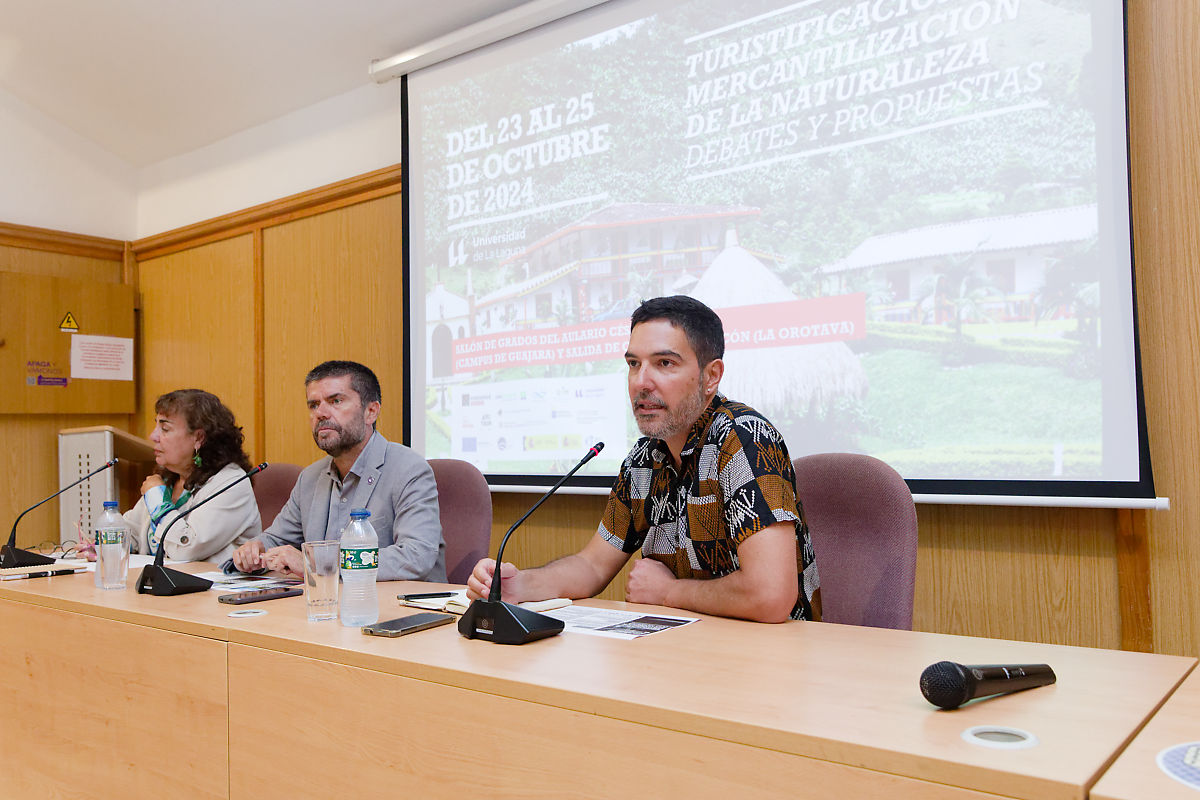
The seminar “Touristification and commodification of nature. Debates and proposals”The forum brings together national and international experts from today, Wednesday, October 23, until the 25th, to reflect on the processes of appropriation of nature by tourism-related initiatives, which foster situations of social inequality and strain the environment. This forum, which stems from the European research project “Disputed territories”, has been coordinated by Alejandro Armas Díaz, from the Department of Geography and History of the University of La Laguna.
Over two days, various presentations will be given showcasing specific cases of overtourism in diverse territories such as the Mar Menor in Spain, the islands of the Paraná Delta in Argentina, and rural areas in Colombia. Historical periods will also be addressed, such as the Economic Command of the Canary Islands during the Franco dictatorship, which marked the beginning of mass tourism; and alternatives such as degrowth in tourism and the possibility of recognizing the rights of nature in the Canary Islands will be proposed.
The Rector of the University of La Laguna, Francisco García, opened the seminar by acknowledging that tourism is undoubtedly a key economic activity for the Canary Islands because it generates well-being and economic development. However, he also emphasized that it has other consequences that generate discontent and, as has been seen recently, have mobilized broad sectors of society to express their dissatisfaction. Therefore, he considered that “the time and place could not be more appropriate” for holding this debate.
García emphasized the need to create spaces for reflection like this one in an era where, “according to some, the truth matters little.” This forum fulfills one of the missions of the public university: the development of critical, specialized, and multidisciplinary debates to generate high-quality knowledge and combat mass manipulation.
Another authority present at the inauguration was the director of the Institute of Agricultural Research (ICIA), Carmen Jaizme, who spoke about her area of scientific specialization, the soil, and warned of the dangers involved in its degradation, as it is a resource that takes thousands of years to generate and can be destroyed in a very short time.
He advocated for an interdisciplinary approach to soil management that connects environmental and agricultural perspectives, which are often considered separately despite their close relationship. Therefore, he argued for a stronger link between science and policy, so that scientific findings do not remain merely as reports without subsequent development into legislation or concrete measures; and also for moving beyond simply addressing current problems and adopting a proactive approach to prevent future issues.
Alejandro Armas, for his part, briefly presented the topics covered by the seminar and the invited speakers, and expressed his solidarity with Argentina, given the significant budget cuts currently affecting the country's universities and research. Regarding the seminar's theme, he welcomed the fact that the term "touristification," which has been used in specialized forums for some years, has now entered the public consciousness, as it describes a reality that is encroaching on areas such as housing and nature.
Before the inauguration, Armas explained that the seminar, which has the support of the Vice-Rectorate for Research and Transfer, is part of the “Territories in Dispute” project, but comes from much earlier, thanks to a network of research groups that work on similar issues, which could be included in the ecosocial reflection on the tourism phenomenon.
Regarding the recent citizen protests against the tourism model, Díaz reflected that, while they may seem like something very new, they are actually the result of long and sustained work by various groups that have actively fought for causes related to the environment or the tourism model. “There has been discontent for many years: the protest against the La Tejita hotel began in 2015; and those concerning the port of Granadilla date back to 2009.”.
Therefore, he believes it is more of a “reactivation” of these causes, fueled by the situation of tourist rentals, “which is a trigger in this process of dispossessing people of the ability to live in the neighborhoods where they had built their lives. They are evicted because they can no longer afford the rent, and there are people who cannot even work in certain employment areas because they cannot find anywhere to live, which creates mobility problems. It is a combination of things that end up affecting daily life.».
In his opinion, he believes it is inevitable that the Canary Islands will continue to rely on tourism, but it must do so differently, and efforts must continue to diversify the economy. He cites as an example a study by David Ramos, a researcher at the University of Salamanca originally from La Palma, who analyzed how the islands recovered from the Covid-19 crisis. The study pointed out that La Palma recovered more quickly than others precisely because it has a more diversified economy and is not as dependent on tourism.
It's a complex problem that also affects the world of employment, since tourism generates precarious jobs, especially for women. In her opinion, it needs to be rethought, and she points out that there are already initiatives proposing alternatives such as tourism cooperatives and certain management models based on a more harmonious experience with nature, rather than an exploitative relationship. "There are ways that are more respectful of working conditions and less damaging to natural spaces.".

 Spanish
 English
 French