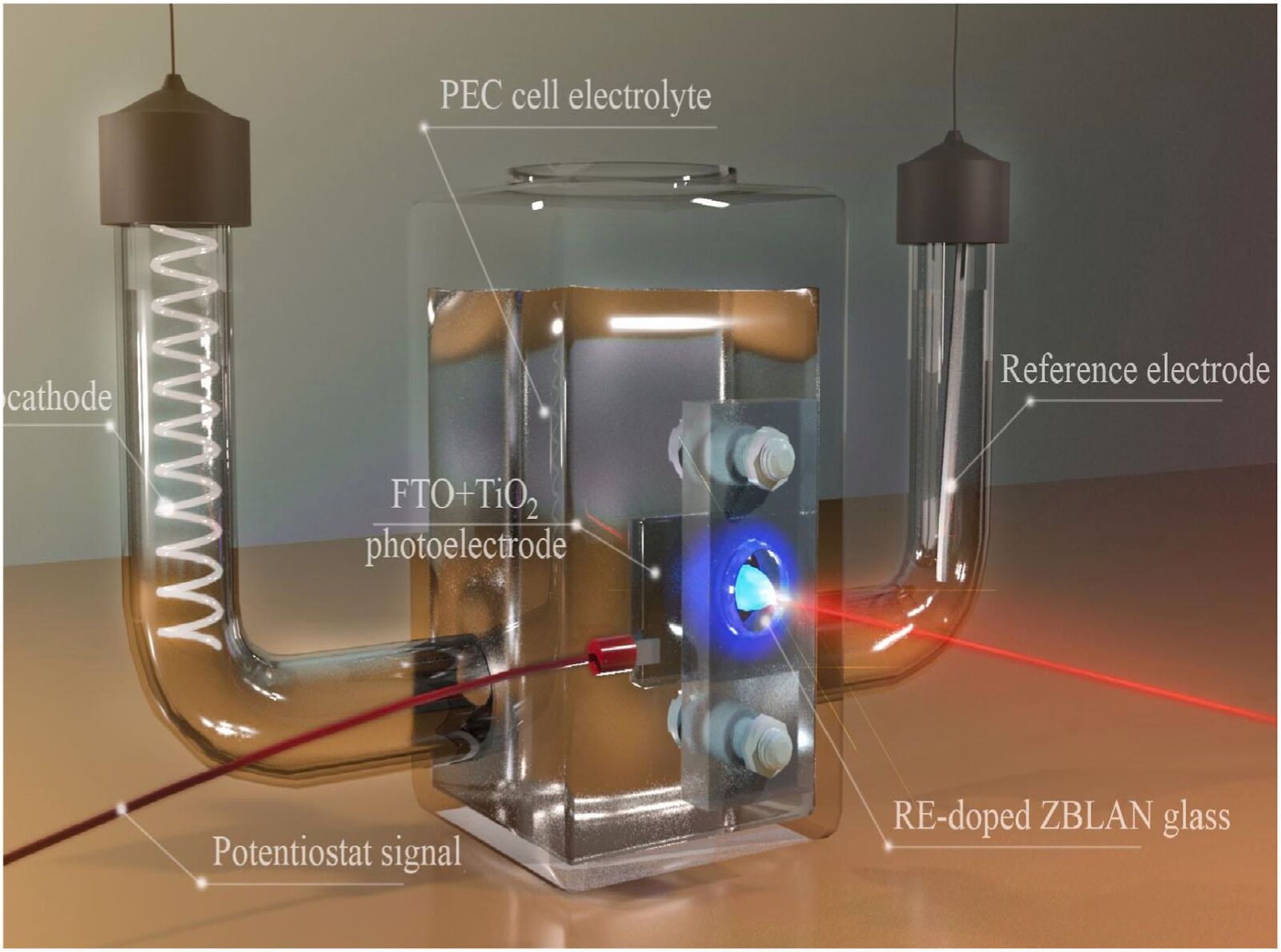
The international specialized magazine Journal of Power Sources, from the publisher Elsevier, has just published a research article from the University of La Laguna on the use of luminescent materials doped with 'rare earths' for their application in the photoelectrochemical generation of green hydrogen.
The article highlights the unique use of low-cost infrared energy as a means to improve the efficiency of solar energy capture, as well as in indoor applications in photocatalysis and the generation of sustainable fuels. The journal, ranked ninth in its category in the Journal Citation Reports, describes the research as "a compelling and groundbreaking example and proof of concept, and an important contribution to the state of the art in the utilization of solar energy.".
The publication also concludes that the results presented “support the exploitation of low-power infrared sources for photocatalytic applications” and adds that it opens the door to the development of new, low-cost, and more efficient elements, in which infrared light can be the main source of energy.
In detail, the work presents a purely photonic approach, improving the efficiency of commercial titanium oxide photocatalysts by using rare-earth-doped materials capable of converting infrared energy into UV and visible light. The results presented, which improve green hydrogen production, optimize the pioneering design of the original photoelectrochemical cell published fifty years ago by Fujishima and Honda as a first step toward artificial photosynthesis.
This opens avenues, the publication highlights, for better use of solar radiation, specifically the sun's long infrared tail which concentrates more than half of the incident energy that reaches us, and this will result in increased efficiency from solar panels to, as in the case of this work, the generation of green hydrogen by photocatalysis.
The work has been directed and coordinated by the professor from the Department of Physics Jorge Méndez, next to Pedro Esparza y Emma Borges, from the Department of Chemistry and Chemical Engineering and Pharmaceutical Technology, respectively. All of this within the framework of the MAGEC-REEsearch project, Materials for Advanced Energy Generation and exploration of “rare earths” in the Canary Islands, funded by the Canary Agency for Research, Innovation and the Information Society and the Ministry of Science and Innovation.
Furthermore, the research is a collaborative effort with Amador Menéndez and Ana Belén García from the IDONIAL Technology Center in Asturias, and with international collaboration from Professor Charles Buddin of the University of Texas at Austin. This research forms part of the doctoral theses of Miguel Medina and Sheila Torres, as well as the researcher's postdoctoral work. Pablo Acosta.
The article also highlights the use of 'rare earth' chemical elements, with their environmental applications in the field of solar fuel generation, and the critical importance of these strategic metals for industry and renewable energies, as emphasized by the European Union with its recently approved Critical Raw Materials Law.
The line of work of the article is situated in an interdisciplinary collaboration in the fields of photonics, materials science and photo-electrochemistry initiated 12 years ago by the research group also with the impetus and participation of the outstanding researcher Juan Carlos Ruiz Morales, deceased in 2017 and to whom the authors of the work pay tribute with this publication.

 Spanish
 English
 French