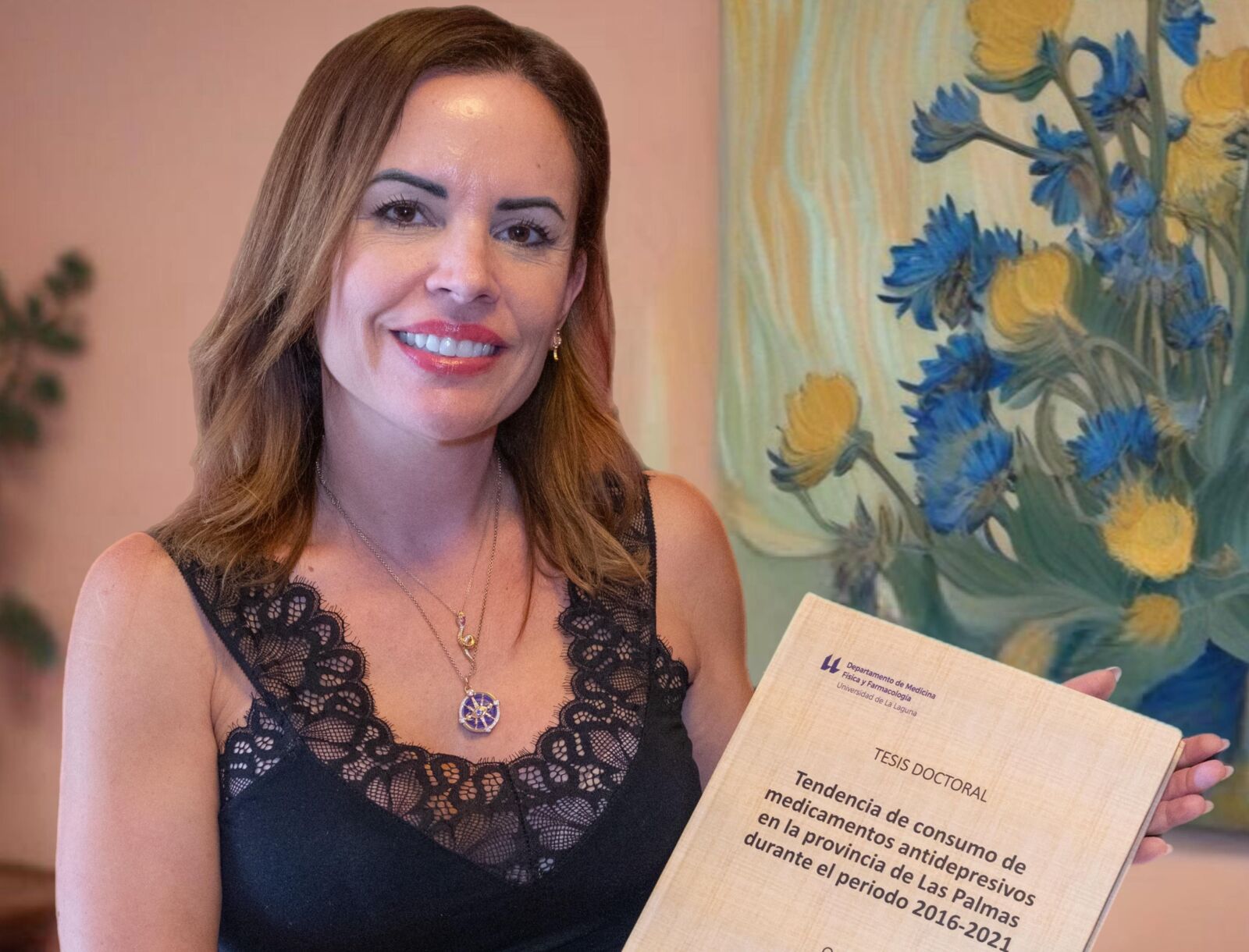
From 2016 to 2021, an increase of 32.8% in antidepressant consumption was observed in the province of Las Palmas. This is one of the conclusions drawn from the doctoral thesis defended at the Faculty of Pharmacy of the University of La Laguna by Ana Vanessa Moreno Galván, under the supervision of professors Alexis Oliva Martín and Sandra Dévora Gutiérrez.
The objective of the thesis was to carry out a retrospective and descriptive observational study of the use of antidepressant medications in the province mentioned, also addressing other purposes such as the development of an aggregated database from the raw sales data of medications obtained from wholesalers.
Understanding the distribution of antidepressant consumption in different geographical areas and determining the distribution of the different therapeutic subgroups of antidepressants according to the anatomical-chemical-therapeutic classification were also the objectives of this scientific work, as well as establishing whether the consumption of antidepressants in these areas may be related to sociodemographic variables (aging rate and population density), economic variables (income per person per year) and level of urbanity (rural and urban area).
The researcher points out that drug utilization studies are a fundamental part of the discipline known as Drug Epidemiology. They began to develop in the 1960s, when the pharmaceutical industry expressed the need to obtain data on drug use in order to monitor the performance of its products, while also serving as a basis for marketing and defining areas for the development and research of future drugs.
This doctoral thesis, defended at the University of La Laguna, studied the antidepressant medications authorized and marketed in Spain up to December 31, 2020. Antidepressants are included in the therapeutic group N06A according to the ATC classification and, within this, are classified into five therapeutic subgroups: Non-selective monoamine reuptake inhibitors or tricyclic antidepressants (N06AA), selective serotonin reuptake inhibitors (N06AB), non-selective monoamine oxidase inhibitors (N06AF), selective monoamine oxidase type A inhibitors (N06AG) and other antidepressants (N06AX).
The aggregated database developed in this study is based on a methodology that allows the aggregation of drug data regardless of dose and pharmaceutical form, and the comparison of drug utilization data in a standardized way in the selected geographical areas, especially in isolated places such as the one analyzed in this study.
Thus, in all the geographical areas analyzed, the results show that the most frequently dispensed classes of antidepressants were selective serotonin reuptake inhibitors (SSRIs) and other antidepressants, while the dispensing of non-selective monoamine reuptake inhibitors or tricyclic antidepressants (MCAs) remains stable or is declining. This pattern is comparable to studies conducted in other European countries.
The lowest dose, the fewest units per package, and the generic version (if there is no brand name) are the best-selling presentations in all the geographical areas analyzed. The proposed statistical model allows us to understand the variation in the RDD (Reduced Daily Dose) during the study period at different levels. Thus, Lanzarote and Fuerteventura show the same pattern, while Gran Canaria exhibits differences.
However, this pattern does not change during the study period. The inclusion of sociodemographic and economic factors in the model is not a determining factor in this analysis within the geographical areas examined, and at the municipal level, the researcher continues, similar results are obtained, but with greater variability due to the inherent heterogeneity of the data.
Each island, municipality, or district—in the case of Gran Canaria—has its own ranking of the most commonly used antidepressants, always adhering to current guidelines for the treatment of depression. In the case studied here, factors such as the aging rate, socioeconomic status, population density, level of urbanization, and access to healthcare services help explain antidepressant dispensing rates and prescribing patterns on each island and its municipalities individually. However, these conclusions cannot be extrapolated to other European provinces or countries due to the different sociodemographic, cultural, and economic characteristics of each geographic area, as noted in the doctoral thesis.
Currently, Moreno Galván works as an assistant pharmacist in a pharmacy in Tenerife and, thanks to the Official College of Pharmacists, collaborates with the mental health and healthy lifestyle group of the Tenerife Island Council's Department of Education for Prevention, Employment, Education, and Youth. Her doctorate has allowed her to teach various courses on the appropriate use of antidepressants, she says. She also continues to publish in scientific journals with Alexis Oliva.
Consultation for reading doctoral theses
The Doctoral School and Postgraduate StudiesThe University of La Laguna has launched a system to check upcoming doctoral thesis defenses at the academic center. On the designated website, you can find information on which doctoral theses will be defended soon, including the candidate, the field of study, the location, time, title, and supervisor(s).
Furthermore, in this other link The repository includes theses defended from October 2023 to the end of November 2024, totaling 180.

 Spanish
 English
 French