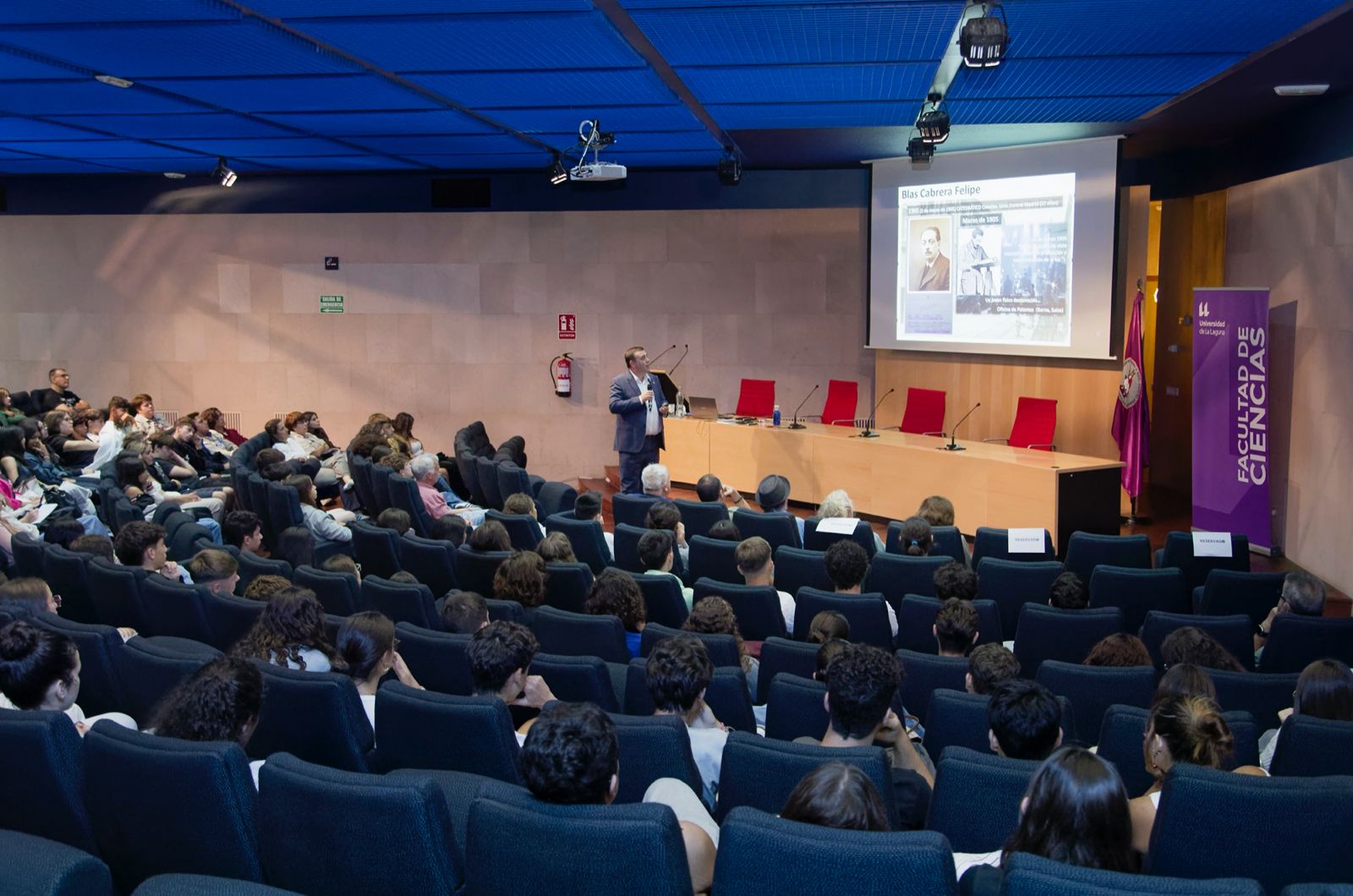
The life and work of the Canarian physicist Blas Cabrera Felipe was the central theme of a presentation given yesterday, November 6th, in the Aula Magna (Great Hall) named after the renowned scientist at the Faculty of Sciences of the University of La Laguna. The presentation was given to students from various schools in Tenerife. This activity kicked off the Science and Innovation Weeks in the Canary Islands, promoted by the Regional Ministry of Universities, Science, Innovation and Culture of the Government of the Canary Islands, through the Canary Agency for Research, Innovation and the Information Society.
In the first part of the activity, Professor Jorge Méndez, from the Department of Physics and the person in charge of the event, gave an informative talk that explored the history of Blas Cabrera Felipe, a native of the Canary Islands, not only as the father of Spanish physics but also as one of the forerunners of quantum physics in the field of magnetism. Cabrera initiated physics research in Spain, and his work transcended borders, as he was part of the elite of European science in the first half of the 20th century, belonging to that unique group alongside his colleagues Albert Einstein, Marie Curie, Niels Bohr, Erwin Schrödinger, and other great scientists at the Solvay Conferences.
The talk reviewed his life from his beginnings in La Laguna, his consolidation in Madrid, his international acclaim, and his unjust exile in Mexico after the Spanish Civil War. It also summarized the milestones achieved in the last two years in the effort to redress and recover the memory and legacy of Blas Cabrera: from the historic repatriation of his remains from Mexico to La Laguna, to the recovery of unpublished manuscripts, and the renaming of the Blas Cabrera Institute of Physical Chemistry at the CSIC headquarters in Madrid.
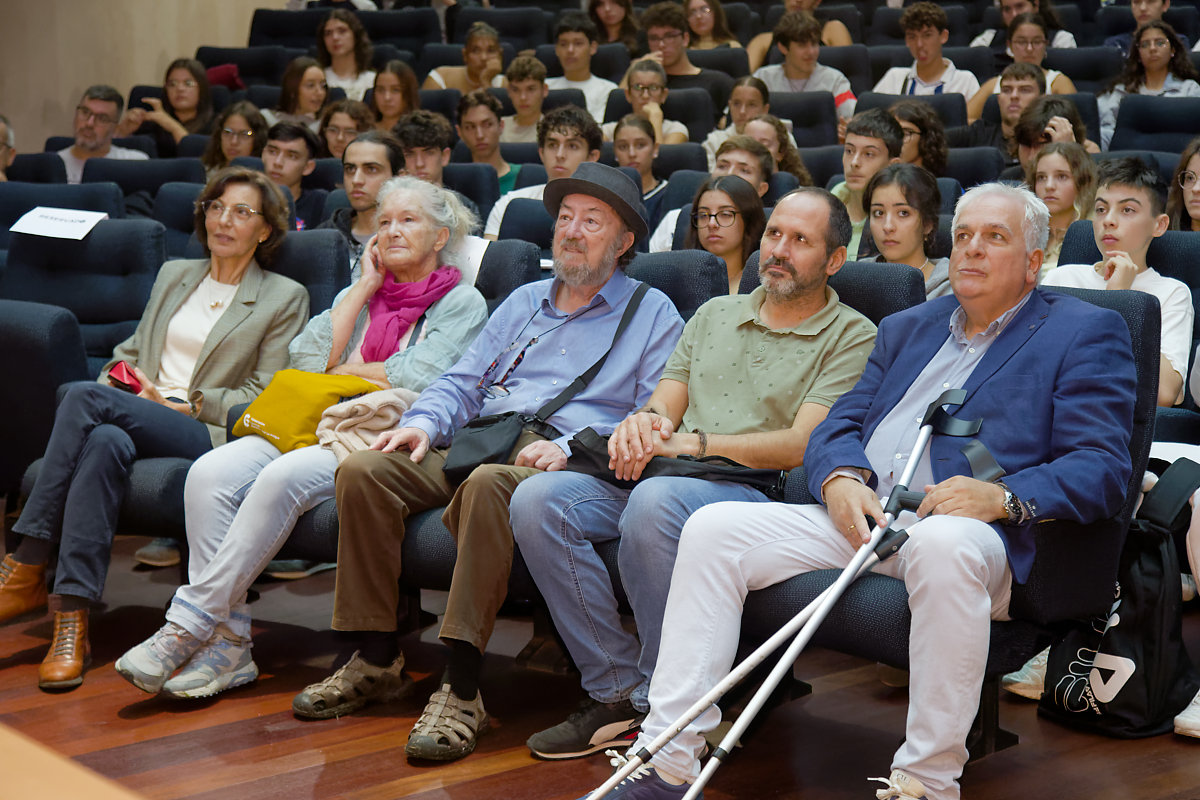
From left to right, the ten Science students, accompanied by Blas Cabrera's two grandchildren, along with other family members.
The event was attended by students who filled the Aula Magna to capacity, coming from the following schools: IES Mencey Acaymo in Güímar, IES Dr. Antonio González González (Tejina), Mayco School, IES La Laboral in La Laguna, IES La Victoria, and IES Nicolás Estévez Borges in Icod de Los Vinos. The students also had the opportunity to participate in live demonstrations and small experiments related to Blas Cabrera's research and most significant scientific contributions, specifically in the study of the chemical elements known as 'rare earth elements,' which are vital for their applications in all the technology that surrounds us.
The activity was completed, by the screenwriter and director Raúl Jiménez Pastor, with the screening of a preview of the educational and scientific documentary about this universal canary that is in production with the support of the La Laguna City Council, the General Directorate of Heritage and the Vice-Ministry of the Presidency of the Government of the Canary Islands.
The event, which was also attended by the Dean of Sciences at the University of La Laguna, María del Mar Afonso, had the added value of featuring two of Blas Cabrera's grandchildren, Luis Blas Cabrera and Luisa Cabrera, with whom the students exchanged experiences and questions. The activity will be repeated on November 13th and 14th in La Palma and Lanzarote, respectively. More information and registration can be found at the following link. link.

 Spanish
 English
 French