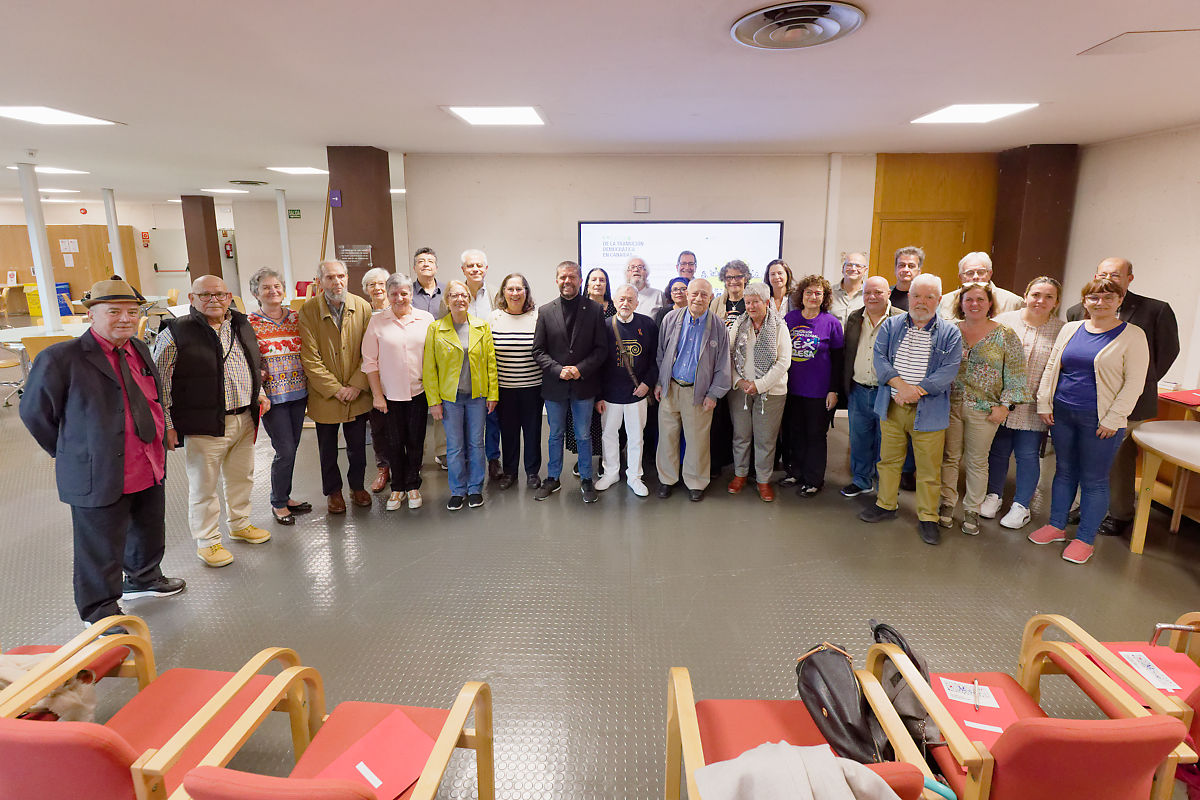
The Archive of the Democratic Transition in the Canary Islands is a project spearheaded by the Library Service and the Departments of Geography and History and of Sociology and Anthropology at the University of La Laguna. It has been developing since the first donation in 1991 from Professor José Luis Escohotado. Since then, the university has amassed bibliographic, audiovisual, and documentary materials donated by individuals and civil and political organizations. The project is supported by the Government of the Canary Islands through its Directorate General of Heritage, and its support was further strengthened today, November 20th, with the signing of several donation agreements that had been pending.
The Rector of the University of La Laguna, Francisco García, stated that today's event went beyond mere administrative procedures and represented a genuine recognition of the signatories, not only for their generosity in donating documents, but also because these documents exemplify their social and political commitment during the very complex times of late Francoism and the Transition. He noted that this archive will allow people who did not live through that era, as is his own case, to access the key events that took place during that time.
For the rector, it is essential to keep that era in mind because it is important “not to forget and not to repeat the mistakes of the past” in “dark” times like the present, in which “academic and scientific rigor must compete against hoaxes and disinformation.” He also noted that this is a difficult time for public universities due to the financial constraints they are facing.
For her part, Francisca Rivero, coordinator of the archive project at the Library Service, explained the details of the work carried out and noted the significance of holding the event today, November 20, exactly 49 years after the death of dictator Francisco Franco. She also emphasized the importance of recognizing the work of the individuals and groups who, from underground, opposed the regime and later contributed to building the current democracy.
Rivero also thanked the individuals and groups who donated for their contributions: “Some of them are large-scale and others more modest, but all are very important to be able to put together that great puzzle that was the Transition.”.
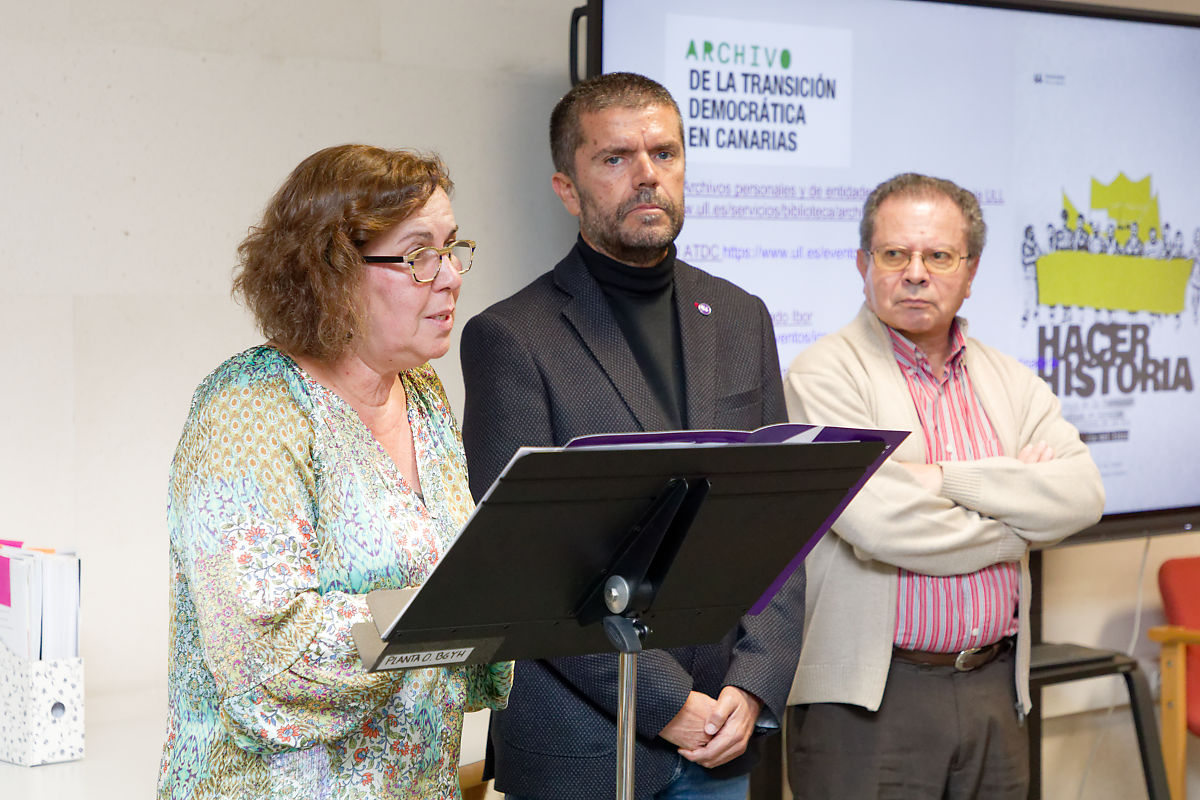
The archive coordinator, Francisca Rivero; the rector, Francisco García; and the director of the Library Service, Gonzalo Rey.
Donation signature
Until now, the donation deeds of the Harimaguada Collective (April 2021), María Dolores Pelayo (June 2022), and the family of Antonio Cubillo (July 2023) had been signed. Today's event served to finalize the signing of the remaining donation deeds that, for various reasons, had not yet been formalized, as well as the contracts for the transfer of rights to the University of La Laguna, which were still pending signature. Approximately thirty people were invited to attend, either representing themselves or various organizations.
Of particular note is the presence of Rosa Burgos López, author of several works on the summary of the murder of student Javier Fernández Quesada on the university campus in 1977, who traveled from Malaga specifically to attend this event and deliver the collection of documents gathered around her investigation.
Also present were other people who, with their donations, have contributed to enriching this Archive of the Democratic Transition in the Canary Islands: José Luis Escohotado Ibor, Manuel Julián Ayala Armas, María Pilar Villarmín Chamorro (representing Domingo Méndez Rodríguez), Domingo Garí Montllor Hayek, Juan Manuel Cabrera Sánchez, Gregorio Albardíaz García-Portillo, Elisa Sagaseta de Ilurdoz López, Francisco Aguilar Topham, Fernando Sabaté Bel, José Antonio Guadarrama San Luis and Francisco Osorio Acevedo, Juan Jesús Arteaga Lorenzo, Jaime Bethencourt Rodríguez, Marta Jiménez Jaén, Celsa Fariña Mesa, Sebastián Álvarez Cambreleng and Rosa de Lima María Acebes Ginovés.
Representatives from various donor entities also attended: Fermín Delgado García and Carmen Pérez Nuñez (Archive of the Communist Unification Party of the Canary Islands (PUCC) and of the Revolutionary Communist League (LCR); Ángeles Arbona Illada (Feminist Coordinator of Tenerife); José Isidoro Hernández Morín (Candidacy of the Unity of the Workers of Guía de Isora (CUT); María Dolores González Díaz (Harimaguada Collective); and José Miguel Melo Alonso (Party of the Canarian Revolution).
Those individuals who have yet to sign the required documents and who, for various reasons, were unable to attend today's event, will receive the corresponding minutes, signed by the rector, by mail so they can complete the signing process. This includes Agustín Millares Cantero, Alberto Mell López González, Ana Peña Méndez, Ana Tejera Expósito, Benita López Peñate, Enrique Reina Betancor, Ignacio Moreno Alberto (Canary Islands Student Union), José Armando Armengol Martín, María Dolores Pelayo Duque, Miguel Llorca Linares, Miguel Sánchez Gutiérrez, Néstor Mesa Felipe, Miguel Salas Bacallado, and Sergio Millares Cantero, whose commitment to the project was also acknowledged during the event.
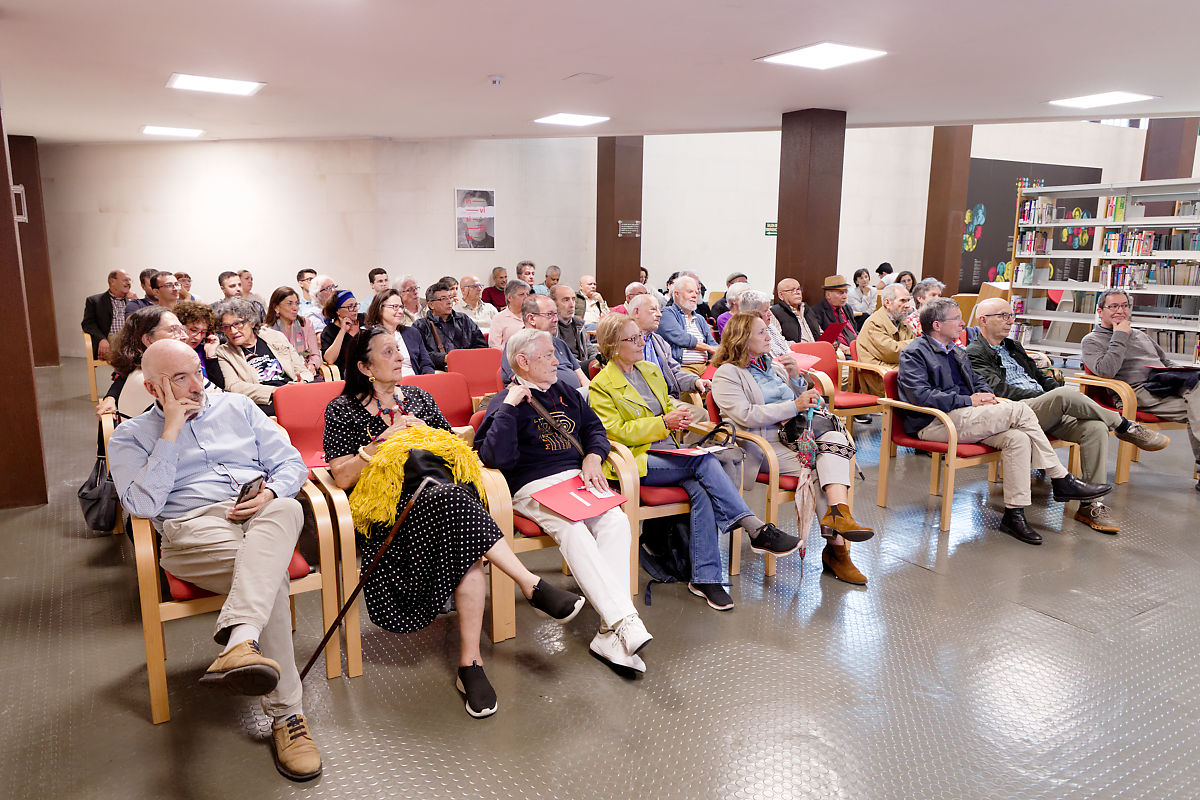 Archive of the Democratic Transition in the Canary Islands
The Transition Archive collects, organizes, preserves, and disseminates documentation produced by political, trade union, and social organizations during the Franco regime, the transition to democracy, and the consolidation of democracy. Since many of these organizations have disappeared, the archives come from private donations.
The documentation received is meticulously processed by the team of professionals at the University Library Service, with each collection treated individually. One of the main means of disseminating this heritage, which chronicles a crucial period in contemporary Spanish history, is the creation of a website that allows for its consultation. This is a very delicate and ambitious undertaking, given the large volume of documentation involved, but it is well underway. In fact, a preview of this online portal, which will be available before the end of 2024, was presented at today's event.
Another means of disseminating the archive was the large exhibition Held to mark World Book Day on April 23rd, the exhibition attracted some 400 visitors through guided or individual tours. Its success was such that it was extended for almost four and a half months on the ground floor of the General and Humanities Library. The exhibition showcased part of the collection donated to the archive, featuring documents from the late Franco regime, the Transition to democracy, and the consolidation of democracy—a period marked by significant political, social, labor, and cultural activity in the Canary Islands.

 Spanish
 English
 French