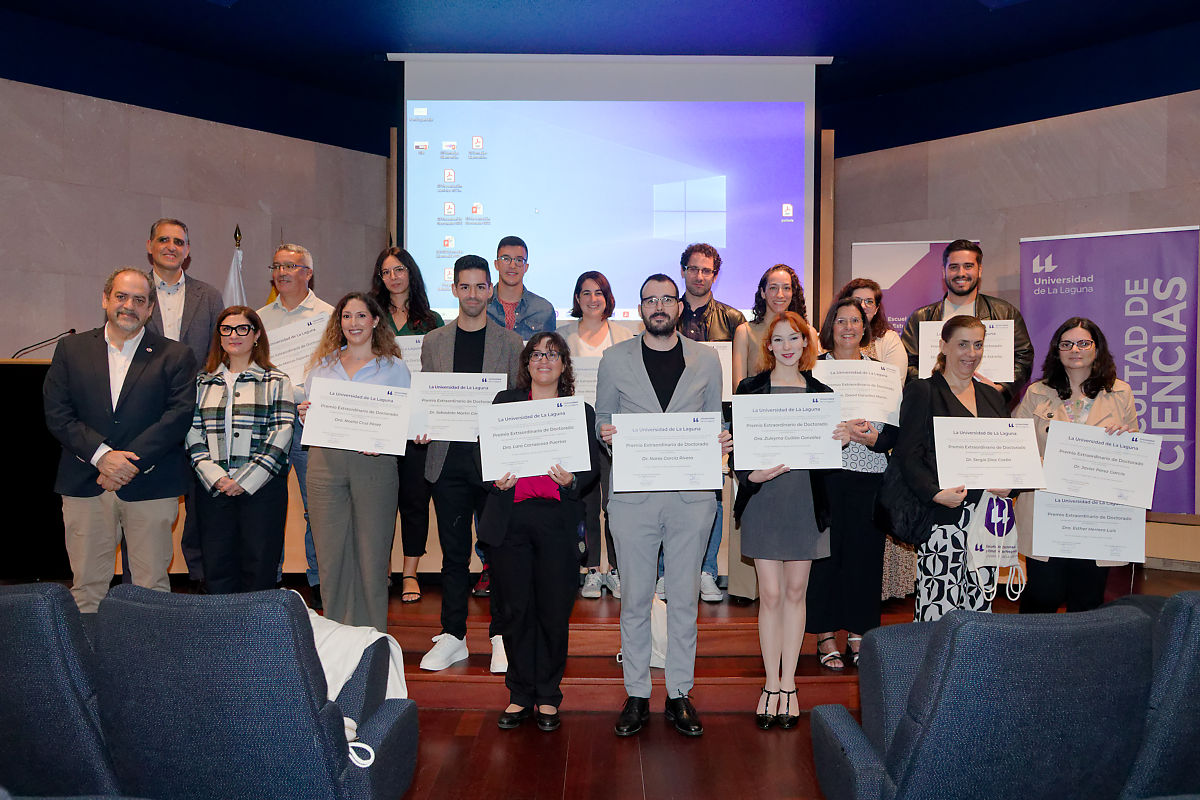
The School of Doctoral and Postgraduate Studies The University of La Laguna organized a welcome session today, Tuesday, November 26, for students beginning their doctoral studies this academic year 2024-25. Around 70 people attended the meeting, held in the Blas Cabrera Felipe Auditorium of the Faculty of Sciences, to receive guidance on administrative and training matters related to the initial stages of preparing their theses.
The university's rector, Francisco García, emphasized the importance of doctoral programs, stating that they are the defining characteristic of public universities. “Our commitment to research and the generation of knowledge, not just its dissemination, is what sets us apart from other institutions. It goes beyond the frontiers of knowledge to contribute value to society. And in the Canary Islands, 100% of doctoral theses are produced at its two public universities.” He identified future challenges as improving internationalization and promoting industrial doctorates that more directly address the needs of the productive sector.
García addressed the incoming doctoral students, congratulating them on their decision but also warning them that they are doing so at a particularly challenging time for the university and for science. “Academic rigor must compete in the media landscape with misinformation. If scientific knowledge has always been important, it is even more so now.” Therefore, he concluded with a message that directly appealed to their sense of responsibility: “What you are about to do is very important not only for yourselves, but for this university and society in general. Work rigorously, because a large part of our future depends on it.”.
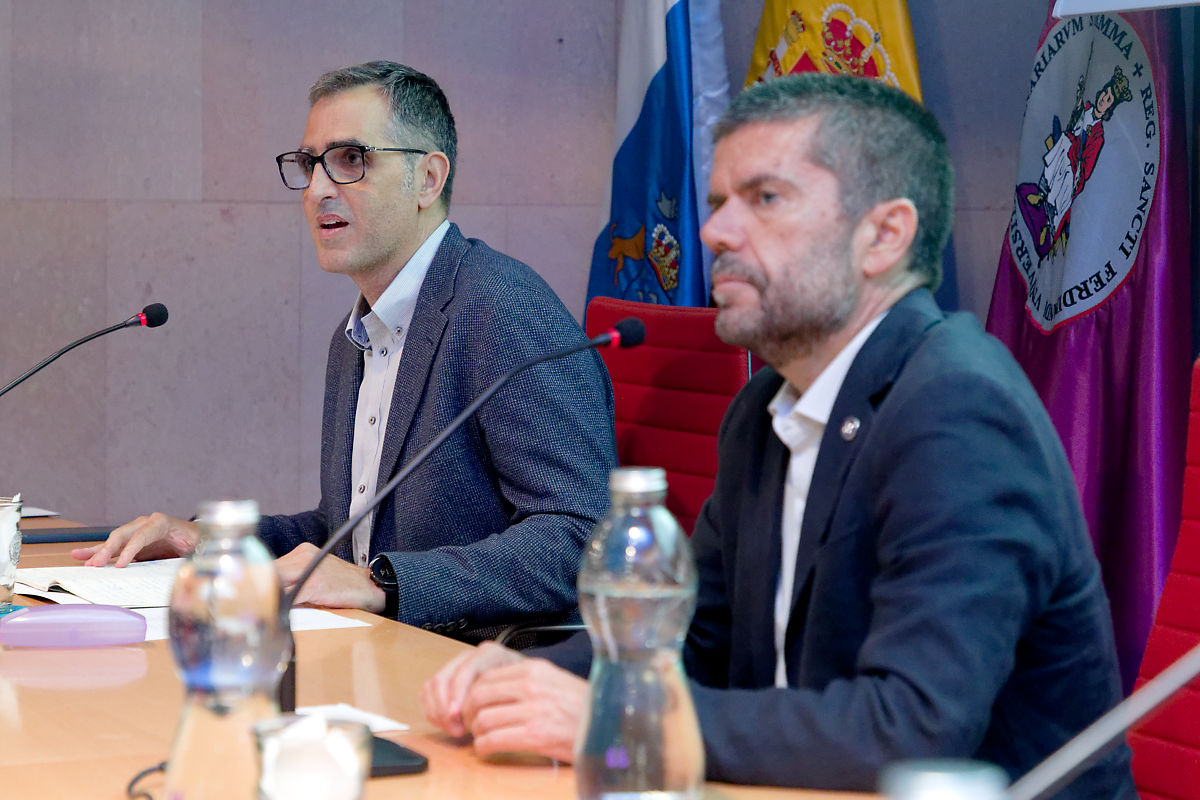
Gustavo Marrero and Francisco García.
For his part, the director of the School of Doctoral Studies and Postgraduate Studies, Gustavo Marrero, explained that the doctorate is divided into four fundamental phases: the beginning during the first year, which is the moment in which the audience of this event found themselves; the development of the works: the final touches and review, "which is quite tedious"; and the reading, which in turn opens a new postdoctoral stage.
She explained that this first phase is crucial because it's where the objectives and work plan are defined, the supervisor is chosen, and the training plan is finalized. It's also the stage where students need to read more, attend seminars as observers, and try to talk as much as possible with senior doctoral students—an experience Marrero recommended to all young people starting their doctoral studies.
The session continued with a round of very short presentations, approximately ten minutes each, in which different people explained specific aspects of the doctoral program. Sara Darias, the Deputy Director of Doctoral Studies at the organizing school, focused on explaining the characteristics of three special types of doctoral programs and the requirements for each: a doctorate with international distinction, a doctorate with international joint supervision, and an industrial doctorate.
For her part, the Deputy Director of Quality and Training, Etelvina de las Casas, outlined the courses in the training plan offered by the university for new doctoral students. Unlike the plans for each individual doctoral program, this training is optional, but highly recommended because it includes instruction on skills that will be necessary during the preparation of the thesis, such as the use of certain computer tools, the optimal use of the resources offered by the library, and even psychological tools to overcome stressful situations and intrusive thoughts.
For his part, the school's International Mobility Coordinator, Alejandro Armas, provided some insights into mobility within the Erasmus+ Program. Following this, there were also presentations on various institutional services that can be of great help to doctoral students during their research: the Information and Guidance Service, ICT resources, the Library Service, and meeting and support spaces.
Extraordinary awards
The session ended with the presentation of the extraordinary doctoral awards for the 2021-22 and 2022-23 academic years, the resolutions of which had been postponed for various reasons; in fact, those for the second year have not yet been endorsed by the Governing Council, but they were announced nonetheless because this procedure is imminent.
Thus, in the 2021-22 academic year, the winners were, in the field of Architecture and Engineering, Ricardo Oliva García; in Arts and Humanities, Alberto Ismael García Aguilar, Francisco de Borja Moreno Candel and Ricardo Marcos Fajardo Hernández; in Health Sciences, Esther Herrera Luis, Ernesto Martín Núñez, David González Martín, Martín Antúnez García, Ana María Perdomo Ramírez and Luis García Hernández -Abad; in Social Sciences and Law, Sebastián Martín Gómez, Oswaldo Ledesma González and Noelia Cruz Pérez; and in Sciences, Valeriia Liakh, Borja Toledo Padrón, Adrián Gutiérrez Serpa and Julien Christophe Piquet.
Regarding the 2022-23 academic year, the award winners were, in Arts and Humanities, Zuleyma Guillén González, Jared Carballo Pérez and Narés García Rivero; in Engineering and Architecture, Elisabet Segredo Morales; in Health Sciences, Javier Pérez García, Carlos Javier Betencourth Estrella, Romina Cabrera Rodríguez and Génesis Palacio Cortés; in Social and Legal Sciences, Laura Rodríguez Gómez, Anthea Gara Santos Álvarez, Lara Carrascosa Puertas and Laura Ionita Ionita; and in Sciences, Jorge Otero Santos, Sergio Díaz Coello, Priscila López Rojas and Manuel Alejandro Marrero Arteaga.

 Spanish
 English
 French