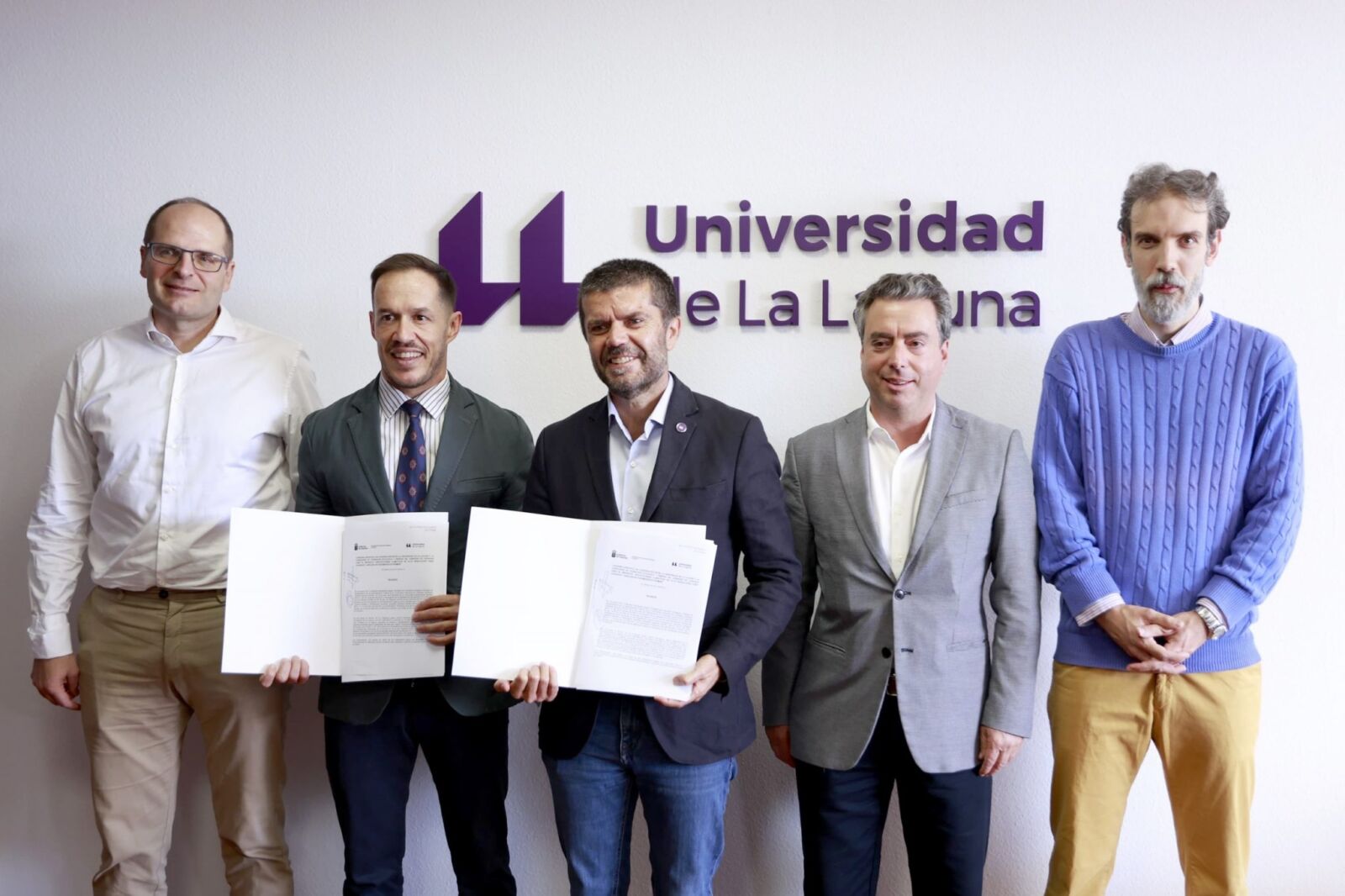
The Ministry of Ecological Transition and Energy of the Government of the Canary Islands, led by Mariano H. Zapata, and the University of La Laguna have signed a cooperation agreement whereby the Earth and Atmosphere Observation Group (GOTA) The project “High-resolution climate projections for the Canary Islands and analysis of extreme phenomena” will be carried out, with a budget of 731,014 euros and until the year 2028.
In this way, the regional government and the public university seal the agreement to work together on the adaptation of the islands to climate change, "generating scientific information that allows us to increase knowledge about the climatological changes that are occurring and will occur in the archipelago and, with this, configure a more resilient territory," the councilor explained. With this agreement, he stressed, “we are continuing the work we have been doing with the research group and the University of La Laguna since 2020, modernizing the projects and including cutting-edge elements, and making a significant investment in science.”.
For his part, the rector of the University of La Laguna, Francisco Javier García, maintained that in these adverse times the value of science is increasingly crucial. “A challenge as monumental as the one we face with climate change can only be addressed through scientific knowledge and rigor, which is what we dedicate ourselves to at the public university.”.
With the aim of increasing the archipelago's resilience to new climatic circumstances, the project will focus particularly on studying the evolution, throughout the 21st century, of extreme phenomena associated with precipitation, droughts, heat waves, wind, radiation, etc., developing climate projections with a resolution appropriate to the particularities of island territories such as the Canary Islands, which are also at the forefront of this type of island studies.
A task that, as Zapata explained, “is absolutely necessary to be able to address the analysis of the impacts of climate change, which requires a powerful computing capacity (high-performance computing, HPC) as well as highly specialized human resources.”.
Thus, the latest scientific advances will be incorporated which, together with those already obtained, “will help to predict more accurately the future evolution of the climate in the Canary Islands, reducing the uncertainties associated with this type of data and more precisely defining the possible future evolution of the climate in the archipelago,” he explained.
Furthermore, with the aim of helping the world's islands advance in their adaptation, the Canary Islands will develop a pioneering proposal to be included in the CORDEX project (Coordinated Regional Climate Downscaling Experiment).
An international study proposes a series of regions (domains) that cover the main inhabited areas on the planet, in such a way as to provide a common framework for the intercomparison of results, but in which island regions are left out (or very close to) these domains, making it very difficult to obtain high-resolution climate data for these regions.
Therefore, “it is of enormous interest that projections for the Canary Islands, and in general for island systems, form part of the scientific objectives of this global project,” which investigates regional climate phenomena, evaluates and improves regional climate downscaling models and techniques, produces coordinated sets of downscaled regional projections worldwide, and promotes communication and knowledge exchange with users of regional climate information.

 Spanish
 English
 French