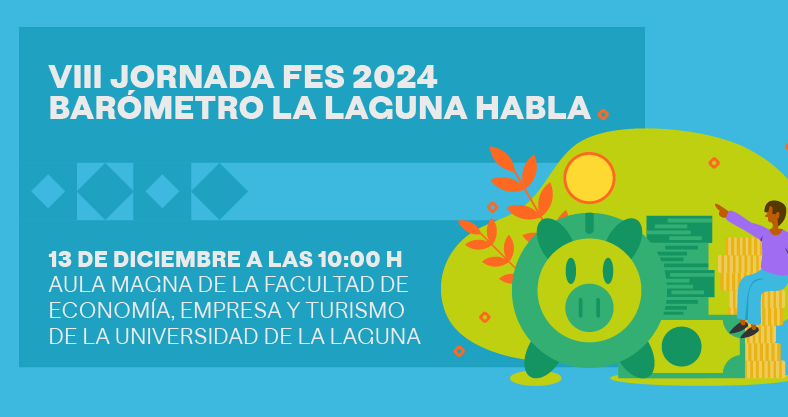
The La Laguna City Council, through its Economic and Social Forum and in collaboration with the University of La Laguna, has published a second edition of the La Laguna Barometer, a sociological study of the municipality originally presented in 2023. The data has been updated this year through a series of meetings in the six districts of La Laguna with various social stakeholders to identify current citizen concerns. The presentation of this document will take place this Friday, December 13th, at 10:00 AM in the Aula Magna of the Faculty of Economics, Business, and Tourism. The study was directed by Professor Serafín Corral, Chair of Applied Economics in Natural Resources, along with Professor Manuel González de la Rosa. The research team also includes contracted researchers Emilio Bernal and José Manuel Vázquez.
The director of the Economic and Social Forum, Jordi Bercedo, says that this is a pioneering study in the Canary Islands, and probably in Spain, "which we didn't want to be stuck at a specific moment, but rather to be progressively updated to have a real-time picture of how La Laguna is evolving.".
Serafín Corral, a professor at the University of La Laguna and in charge of updating the Barometer, explains that the work carried out with civil society has yielded a series of results in various areas, including housing, the economy, society, education, health, and mobility. These conclusions have already been shared with political representatives of the City Council and members of the Economic and Social Forum, and will be presented publicly this week.
Serafín Corral explains that the Barometer is the result of work with civil society through workshops and participatory processes. «This update allows us to delve much deeper into the results obtained previously and clarify some points. There are issues ranging from concerns about recovering the municipality's public spaces and services and infrastructure to much more sensitive matters such as youth employment.”.
Another relevant element, according to Professor Corral, is the heterogeneity of the municipality's districts, which have their own particular and distinct concerns, although there are some connecting threads such as employment, community centers, and public services. "Issues such as agriculture and the revival of traditional activities, tourism and gentrification, housing problems, and the displacement of residents to other areas are also important elements," he comments.
(Note provided).

 Spanish
 English
 French