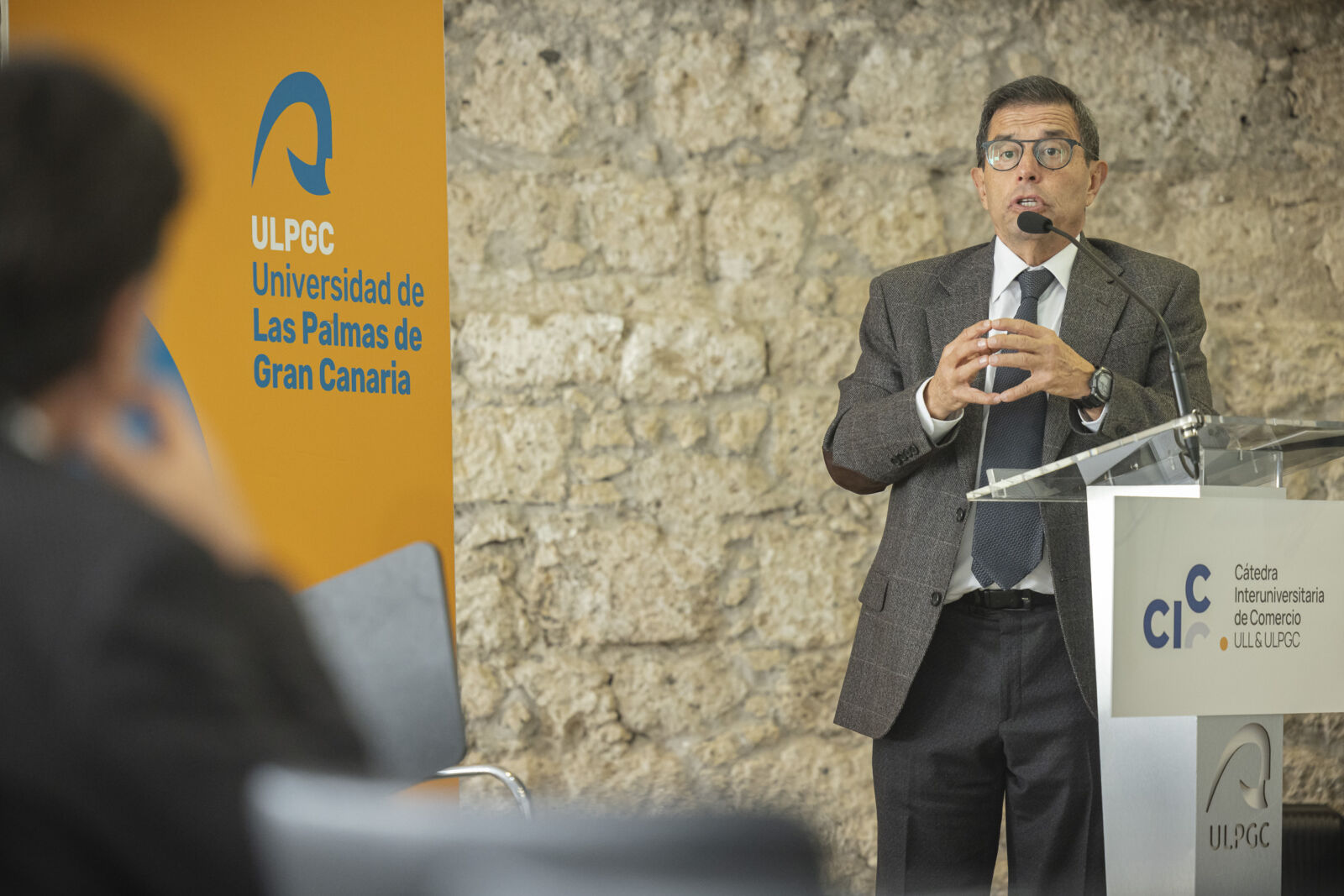
The University of Las Palmas de Gran Canaria (ULPGC) hosted the National Meeting of University Chairs of Commerce this Thursday, an event organized by the Inter-University Chair of Commerce of the Canary Islands, in which the University of La Laguna participates, with the aim of opening communication channels to create a network of university chairs of commerce.
The Director General of Trade and Consumer Affairs of the Government of the Canary Islands, David Mille, together with the Rector of the University of Las Palmas de Gran Canaria, Lluís Serra and Ángel Carmelo Chinea Martín, Vice Dean of Institutional Relations of the Faculty of Economics, Business and Tourism of the University of La Laguna, were in charge of inaugurating this day that has brought together representatives of several Spanish universities to exchange experiences and good practices of each of the chairs, that is, to create a forum for dialogue in which successful pedagogical approaches, innovative methodologies and solutions to the current challenges they face in the teaching of commerce have been shared.
David Mille stated that the joint collaboration of all university chairs of commerce "will serve not only to exchange experiences and significant projects between regions but also to enable the sector to face current challenges together, such as digitalization, innovation, and training. Sharing challenges will contribute to our collective success," he declared.
For his part, Lluís Serra explained that "the creation of this chair is much more than a simple administrative act; it is a declaration of intent, a commitment to the future." Trade has become a fundamental driver of economic growth and social development, especially in this region. "Here, research, innovation, and entrepreneurship will be fostered, generating ideas that will transform markets and benefit our communities," he asserted.
Ángel Carmelo Chinea emphasized the key role of university chairs in strengthening ties between public universities, businesses, and institutions. He highlighted that, in addition to creating spaces for training and research, they also foster debate and reflection on regional challenges and trends of change. According to Chinea, these chairs act as vehicles for knowledge transfer and dissemination, promoting socioeconomic and technological innovation, which allows universities to be fully engaged in the society they serve. He also stressed that this commitment to regional development is especially relevant in a sector as strategic as commerce, which plays a major role in job creation in the Canary Islands.
Furthermore, the Vice President of the Canary Islands and Minister of Economy, Industry, Commerce, and the Self-Employed, Manuel Domínguez, participated via videoconference to express his support for the purpose of this meeting. He stated that "this national meeting of university chairs will undoubtedly serve as a forum for dialogue and analysis on commercial activity." He added, "Sharing different proposals and approaches on the future direction of the commercial sector is essential if we want to boost this activity, which drives regional economies and creates jobs.".
Following the inauguration, presentations were given by the Chairs of Commerce from the universities of Malaga, La Rioja, Valladolid, Alcalá de Henares and the Polytechnic University of Valencia, who shared their best practices and innovative methodologies, allowing them to exchange new ideas and strengthen connections between the participating universities.
What is the Inter-University Chair of Commerce
The Inter-University Chair of Commerce is a collaborative initiative between the two public universities of the Canary Islands and the Government of the Canary Islands to enhance knowledge of the archipelago's commercial sector. Its primary purpose is to promote training, conduct research on commercial activity and related services, and disseminate information about this activity as a driver of value creation and socioeconomic development.
It aims to be a space for analysis, reflection, and debate where businesses, professionals, public administrations, and academics can participate. It is located across the two universities in the Canary Islands in a coordinated manner, making it the only inter-university initiative of its kind in Spain, in order to gain a broad perspective of the reality it seeks to serve and thus enrich its technical and scientific contributions.
(Note and photo provided).

 Spanish
 English
 French