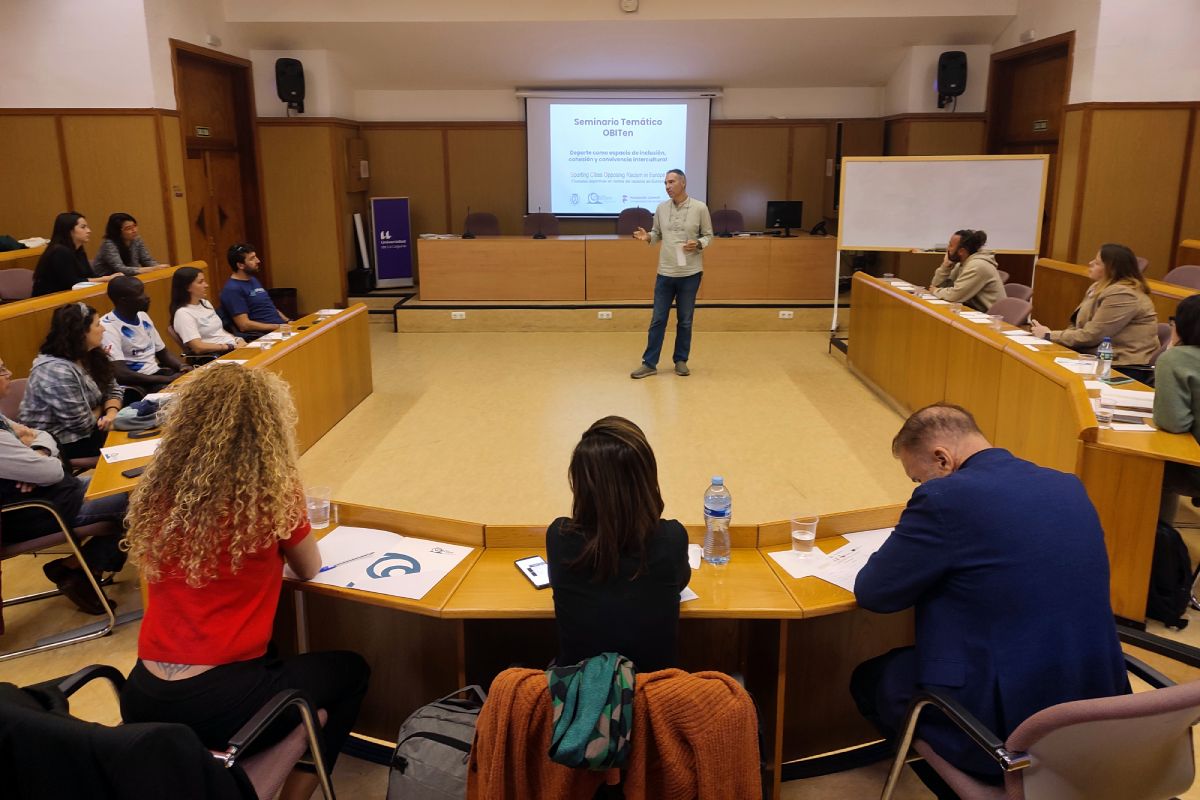
The Tenerife Immigration Observatory (OBITenThe European Project, promoted in collaboration between the University of La Laguna and the Tenerife Island Council, held the seminar “Sport as a Space for Inclusion, Cohesion, and Intercultural Coexistence” on December 18th. This event, held in the Lecture Hall of the César Manrique General Lecture Hall on the Guajara Campus, brought together key stakeholders who have worked with the organization within the framework of the European Project. SCORE for more than two years.
The seminar coincided with the official closing of the European SCORE Project, led by the Spanish Observatory on Racism and Xenophobia of the Ministry of Inclusion, Social Security and Migration (OBERAXEThis project, funded by the European Union, has involved thirteen partner organizations from six European countries (Spain, Ireland, Greece, Sweden, Austria and France) and has focused on combating racism in the sporting field.
During the seminar, Vicente Zapata, academic director of OBITen, emphasized the importance of sport as an ideal space for promoting a more just and inclusive society, both within and through athletic practice. He also highlighted the novelty of having a basic manual that can help to understand sport as an important tool for building more cohesive societies.
The OBITen team presented some of the achievements made within the framework of the European project, including the creation of an interactive map of good practices in 20 European countries, which includes 12 experiences from Tenerife and others from Gran Canaria and El Hierro; a communication plan culminating in a campaign against racism, which highlighted the transformative role of sports ambassadors; and the development of the “Basic Manual for the fight against racism in sport” with recommendations for local authorities.
The seminar was attended by Younnouse Diop, former player of Club Deportivo Tenerife and coach of Campus Sansofe, who was an ambassador of the SCORE Project along with Gift Monday, player of Unión Deportiva Costa Adeje and of the Nigerian women's national team; and Juan Diego Amador, a mountaineer from Tenerife of international renown.
The forum was also a space to reflect on shared experiences and challenges of the entities participating in SCORE, since an embryonic network of organizations has been articulated that have carried out joint activities, among which 'Deportízate' and 'intercultural walks' stand out.
Begoña López, director of the Sports Service at the University of La Laguna, shared her institution's and her team's commitment to inclusion and intercultural coexistence, highlighting the experience of incorporating young migrants from projects like the Sansofe Campus and the Las Raíces Camp into sporting activities such as the Rector's Trophy football tournament. This initiative has created spaces for interaction between the university community and newly arrived young people, with very positive results.
Superacció Canarias, represented by its director, Aroa Sancho, highlighted the need to improve coordination between the different sports entities to optimize the available spaces and their use, emphasizing that sport has a positive impact on inclusion and on building values among young people.
Also participating in the seminar was a member of the Educating Through Training project team from the Social Innovation Lab at the University of La Laguna, in collaboration with the Tenerife Island Council. Nayra Perea shared her experience of over three years promoting values such as equality, respect, and the inclusion of people with disabilities in grassroots sports. She also highlighted the growing need for local sports clubs to receive support for the inclusion of young migrants, who face administrative barriers that limit their participation.
Miguel González, head of the Environment area of the Tenerife Island Mountaineering Federation (FIMT), the physical activity with the highest number of female members and the second highest, after football, for men on the island of Tenerife, stressed the importance of working on values of respect and care for the environment, using positive role models to promote commitment among young people.
Noemí Martínez, representing the European University and the Official College of Graduates in Physical Education of the Canary Islands (COFEL), presented at the seminar a European project that begins focused on sport and the Ukrainian refugee population on the island, as well as a pilot experience aimed at demonstrating the social and well-being benefits of the continued practice of sport in young migrants.
Pelayo Larraona, a physical activity technician at the Las Raíces humanitarian reception facility managed by ACCEM, shared the positive impact that the participation of newly arrived young migrants in sports initiatives such as the Rector's Trophy of the University of La Laguna has had, contributing significantly to the emotional well-being of young migrants, and therefore stressed the importance of continuing to promote this type of collaboration.
The seminar concluded with a debate that addressed the lack of accessible sports infrastructure and the need to promote networking between public and private entities. Among the most noteworthy proposals was the creation of a working group, starting in January 2025, to identify new initiatives that position sport as a key tool. 'Tenerife Lives Diversity' appears to be an ideal framework for continuing the work facilitated by SCORE.

 Spanish
 English
 French