The Blas Cabrera Felipe Auditorium of the Faculty of Sciences hosted the start of the Educational Innovation Conference From the University of La Laguna, a proposal from the Vice-Rectorate for Teaching to address between today, January 20th and tomorrow, January 21st, new ways of approaching learning systems, which must be increasingly connected with the current moment and with the students' own experiences and expectations.
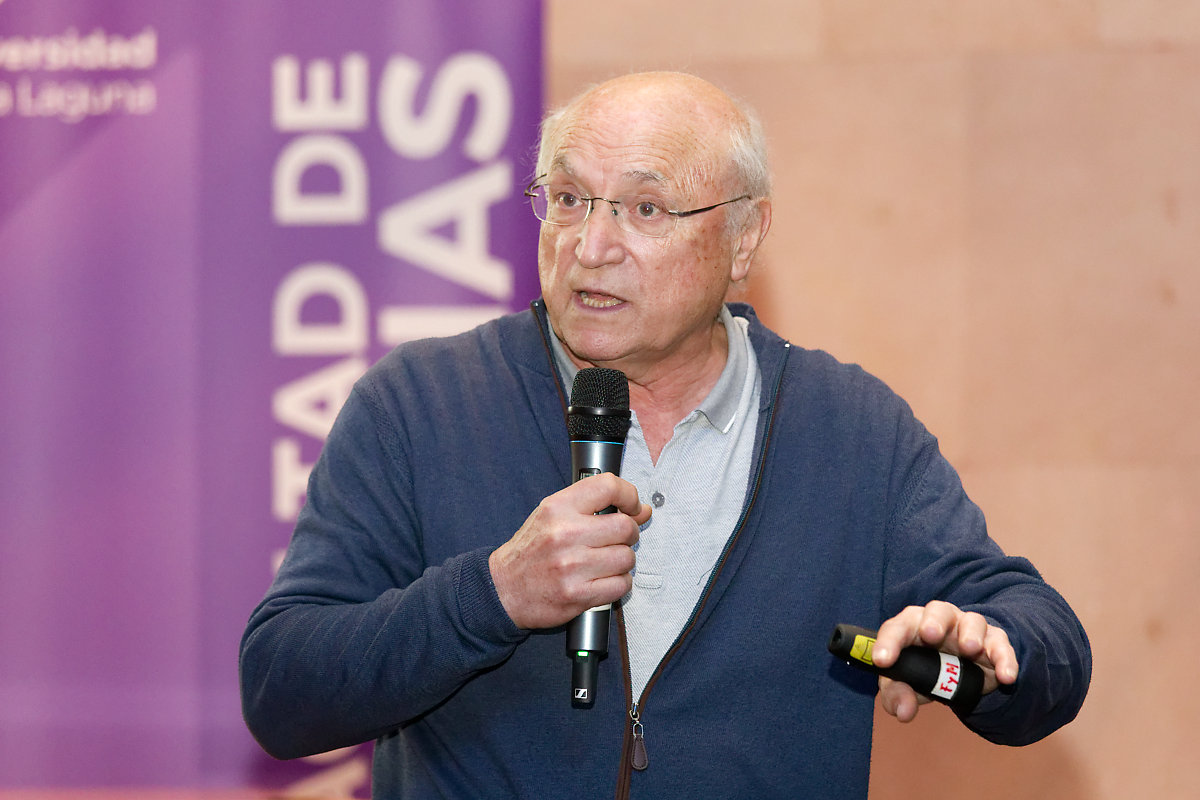
Francisco Imbernón, Professor Emeritus of Didactics and School Organization at the University of Barcelona, delivered the opening lecture at this event, which has also garnered significant interest from the academic community with the presentation of over sixty papers and the participation of 200 faculty members. The expert focused his presentation on ways to rethink best practices in university teaching. “Faculty members must create alternatives for change, without waiting for university administrations to dictate what needs to be done,” he stated at the beginning of his address.
“Innovation is about constantly rethinking ourselves, analyzing what we're doing,” he continued. In teaching, he said, it's about capturing students' attention, making them enjoy what they learn. “We shouldn't demonize lecture-based methodologies,” he argued, “because the oral transmission of knowledge must continue.” The point is to optimize them and make them more collaborative. Imbernón pointed out that in teaching and innovation, “there's no one-size-fits-all approach,” meaning there's no single way to do things. The innovative person transforms the activity of that innovation and makes it their own. “At the university, we need new, innovative role models in our context.”.
“Sometimes university students are blind to knowledge; we are unable to see beyond our own limitations.” The expert explained the concept of constructive or educational alignment, which consists of using the same teaching and learning activities and the same assessment systems, resulting in the same old outcome: learning by memorization. “If the goal is to achieve specific competencies, the ways of teaching and assessing must change,” the professor pointed out.
A class needs varied resources, examples, experiences, and individual and group tasks; it can't be the same thing all the time, "so that teaching doesn't become an administrative act," thus avoiding redundancies, he said. Added to this is the fact that current research indicates that young people maintain their attention span for only fifteen minutes. Therefore, the usual approach until now has been to learn by filling short-term memory to pass the exam and then forgetting it, as Gibbs already pointed out in 2005. "The goal is to acquire deep and relevant knowledge," Imbernón noted.
In the 21st century, the basic principles of innovation are based on students who have transitioned from being objects of instruction to subjects of learning. Furthermore, university faculty must always create spaces for dialogue and participation, striving to teach and learn through active experimentation. Moreover, the relationship between faculty and students shapes the content, implying greater accessibility for them. "Our working method is part of the academic content, so we must teach and learn vicariously," that is, through imitation.
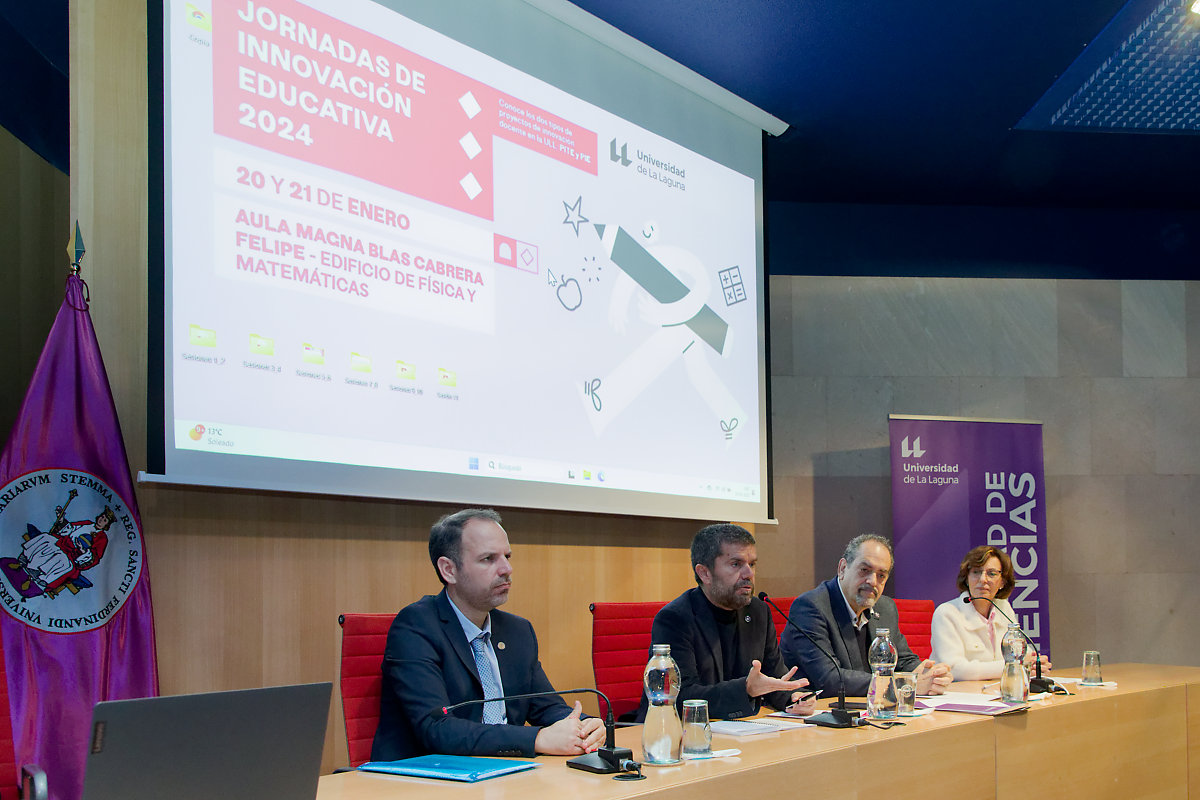
A moment from the opening ceremony.
More practical teaching
The rector of the academic institution, Francisco García, stated at the opening ceremony that the institution is working to provide a “more useful, more practical, and more collaborative” teaching experience. He maintained that these spaces are essential as a tool for interacting with colleagues. “If we work together, we will go further. Inter-university collaboration is here to stay; the two public universities must work hand in hand, also innovating in teaching,” he said, referring to the recent joint call for educational innovation projects. ”We must continue to strengthen teaching that is linked to society in order to address its challenges and strive to meet them,” he added, while simultaneously fostering greater student autonomy.
The Vice-Rector for Teaching, José Manuel García, pointed out that the university has been running projects and calls for proposals of this nature for over ten years. The latest initiative has resulted in the launch of 91 projects at this academic center this academic year.
For his part, the Director of Educational Innovation at ULPGC, Eduardo Quevedo, also referred to this joint collaboration in the field, which involves the introduction of 18 projects across both institutions this academic year. The Dean of Sciences, María del Mar Afonso, who hosted the session, pointed out that these workshops are necessary to adapt to social, academic, and technological changes. She argued that educational innovation fosters change by placing students at the heart of the system.

 Spanish
 English
 French