The Gumersindo Trujillo Cultural Chair of Autonomic and Constitutional Studies has reissued, through the Publications Department From the University of La Laguna, the book "The ministerial endorsement", written by the historic professor of this house, Gonzalo Cáceres Crosa in 1934.
This reissue, overseen by the Chair's director, Professor of Constitutional Law Antonio Domínguez Vila, has been produced in facsimile format, and allows us to recover and disseminate an outstanding work by a historic professor of the University of La Laguna, still cited today in current studies on the countersignature of the King's acts.
The Ministerial Endorsement, written by Gonzalo Cáceres Crosa, was originally published by the González Posada Institute of Public Law at the Central University (now Complutense University of Madrid) in 1934, when its author was in Germany on a scholarship from the Junta de Ampliación de Estudios (Board for the Extension of Studies), a fact evidenced by the extensive German bibliography used. However, the personality and work of this forgotten constitutional scholar from Tenerife remain unknown to contemporary constitutionalists, and especially to those who teach and research this legal discipline in the Canary Islands.
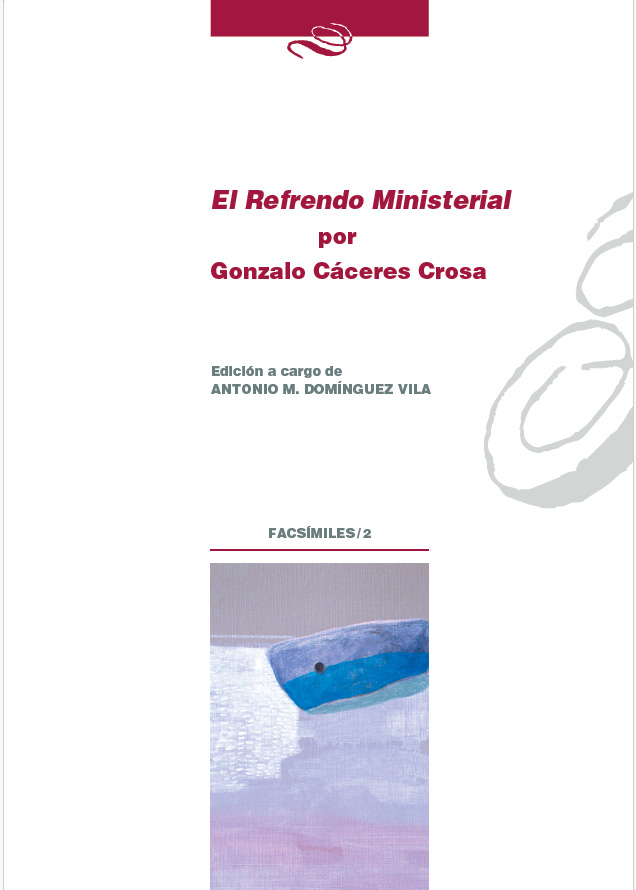 The Ministerial Countersignature addresses the study of the countersignature institution, a characteristic element of the control over the actions of Heads of State, whether monarchical or republican. Professor Cáceres Crosa examines all the characteristics of this institution, namely: its origins, its nature, its functions, and its effects. Likewise, the authors are analyzed who held the power of countersignature in the republican regime of that historical period, as well as the acts of the Presidency that were subject to countersignature.
The first chapter examines the formal and substantive origins of the countersignature, tracing its roots back to medieval monarchies in both continental Europe and England. The second chapter addresses the nature of the countersignature as a certifying formality and the importance of the parties involved, their consent, and its tacit or express nature, as well as its role as a substantive limitation on the will of the head of state, whether monarch or president. To this end, the chapter explains its regulation in 19th- and 20th-century constitutions up to the date of this work. The chapter concludes with an analysis of the effects of nullity or unenforceability resulting from the lack of countersignature on the acts of the head of state, and the jurisdictional mechanisms for addressing such instances in France and the 1931 Spanish Republican Constitution.
Chapter Three analyzes the subjects of countersignature, especially those who can countersign, including ministers, undersecretaries, and the acting government, as well as individual and collective countersignature in the constitutions of the 19th and 20th centuries. Chapter Four examines the acts subject to countersignature in comparative constitutional law, distinguishing between written and oral acts.
Chapter Five delves into the problems posed by the countersignature requirement for acts of the executive branch: promulgation of regulations, appointment and dismissal of ministers, countersignature of appointments and removal of the Prime Minister, and appointment of civil servants. It points out the inconsistency with the democratic principle of the separation of powers that the appointment of judicial officials is carried out by the Minister of Justice, as well as the countersignature requirement for acts concerning the armed forces. Chapter Six addresses the countersignature requirement for acts originating from the legislative branch, the approval of laws, and analyzes the problems posed by the 1931 Republican Constitution regarding the President's legislative veto, as well as the suspension of parliamentary functions and dissolution, and the countersignature requirement for acts of the judiciary.
Finally, in chapter seven he reflects on the suppression of the countersignature in a republican regime, because, in his opinion, a president of the republic subject to the countersignature of his constitutionally attributed acts neither reigns nor governs, and therefore must be responsible for them.
The monograph concludes with an interesting appendix on the European constitutional texts in force at the time of its writing and their regulations on countersignature. Consequently, its republication is of great interest, as this monograph, now out of print, is nevertheless well-known and frequently cited by scholars studying the powers of heads of state, the inviolability and countersignature of their acts, making it valuable for all students of Constitutional Law.

 Spanish
 English
 French