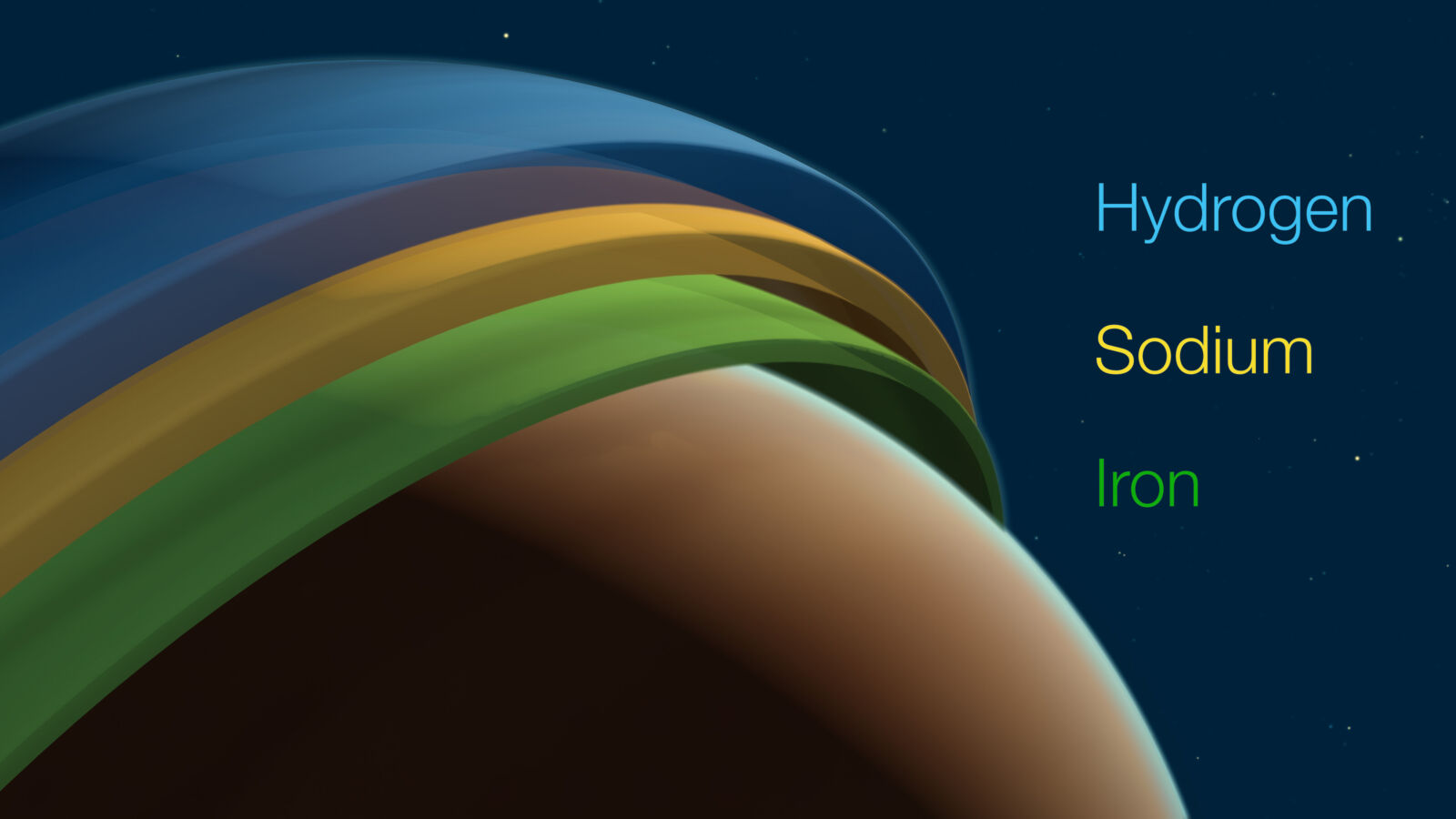
An international team, including researchers from the Canary Islands Institute of Astrophysics and the University of La Laguna, has succeeded in mapping, for the first time, the three-dimensional structure of an exoplanet's atmosphere—that is, a planet located beyond our solar system. This research, published today in Nature, This research has revealed very strong winds that transport chemical elements such as iron and titanium, creating specific weather patterns throughout the planet's atmosphere. This mapping opens the door to more comprehensive and detailed studies of the chemical composition and climate of other planets.
The study was made possible with data obtained from the four telescope units of the Very Large Telescope (VLT) of the European Southern Observatory (ESO) and, specifically, to the instrument ESPRESSO.The planet, WASP-121b (also known as Tylos), is located about 900 light-years away in the constellation Puppis. It is an ultra-hot Jupiter-like planet and a gas giant that orbits so close to its host star that a year there lasts only about 30 Earth hours. Furthermore, one side of the exoplanet always faces the star, resulting in extremely high temperatures, while the other side is much cooler.
IAC researcher Enric Pallé, one of the authors of the study, explains that “for the first time, and thanks to the amazing quality of the data from the ESPRESSO instrument, we are able to measure a complex system of winds at various heights in the atmosphere of an exoplanet. These winds are responsible for redistributing the energy that the star deposits on the permanently illuminated side of the planet throughout its atmosphere.”.
For his part, Alejandro Suárez Mascareño, also a co-author of the study and a researcher at the IAC and the University of La Laguna, points out that “not so long ago, we were completely unaware of the existence of exoplanets. Today, we are able to map their winds. Studies like this are a testament to the impressive technological advances in astrophysical instrumentation, progress in which the Canary Islands have played a fundamental role.”.
It is important to remember the significant contribution of the IAC to this discovery, not only because of the scientific contributions of both Pallé and Suárez Mascareño, but also because the ultra-stable ESPRESSO spectrograph, key to this research, was designed and built with the participation of the Instituto de Astrofísica de Canarias.
Delve deeper into the atmosphere
The team has been able to probe the depths of Tylos's atmosphere and has revealed the presence of distinct winds in separate layers. This has allowed them, for the first time, to create this map of the atmosphere's three-dimensional structure. It is the first time astronomers have been able to study the atmosphere of a planet outside our Solar System with such depth and detail.
“What we discovered was surprising: a jet stream swirls material around the planet’s equator, while a separate flow at lower levels of the atmosphere moves gas from the warmer side to the cooler side. This type of weather has never been seen before on any planet,” says Julia Victoria Seidel, a researcher at the European Southern Observatory (ESO) in Chile and lead author of the study, published today in Nature. The observed jet stream spans half the planet, gaining speed and violently churning the atmosphere high in the sky as it crosses the hot side of Tylos. “Even the strongest hurricanes in the Solar System seem tame compared to those on this exoplanet,” she adds.
(Note and photo provided by the IAC).

 Spanish
 English
 French