A research group from the University of La Laguna has published in the journal Results in Engineering an article This study explores the possibility of generating biogas from slaughterhouse waste, using livestock and poultry materials from two establishments in the municipality of San Cristóbal de La Laguna as a reference. Among other findings, the study estimates that this could generate approximately 201,000 tons of the municipality's energy consumption while simultaneously reducing CO2 emissions.2. The principal investigator is José Aythami Pérez and they also sign the work Karina Elvira Rodríguez, Candela Díaz, Douglas Jimmy Escalante y Laura Díaz, with affiliation to the Department of Chemical Engineering and Pharmaceutical Technology of the academic institution.
Currently, the Canary Islands, due to the statement The designation of the area as a “remote zone” by the regional government constitutes an exception to European legislation regarding waste management. This translates into the permissibility of taking Animal By-products Not Intended for Human Consumption to the landfill (SANDACH), prior pretreatment.
This pretreatment takes place in an intermediate plant where the byproducts are crushed and mixed with quicklime for inertization. These byproducts are classified as special waste because they can transmit diseases from animals to humans and vice versa, and therefore must be managed by an authorized waste management entity.
The main objective of the article was to evaluate the theoretical energy potential that animal by-products can offer in Tenerife, using one of the most mature energy technologies on the market and with the lowest energy consumption required due to its low temperature.
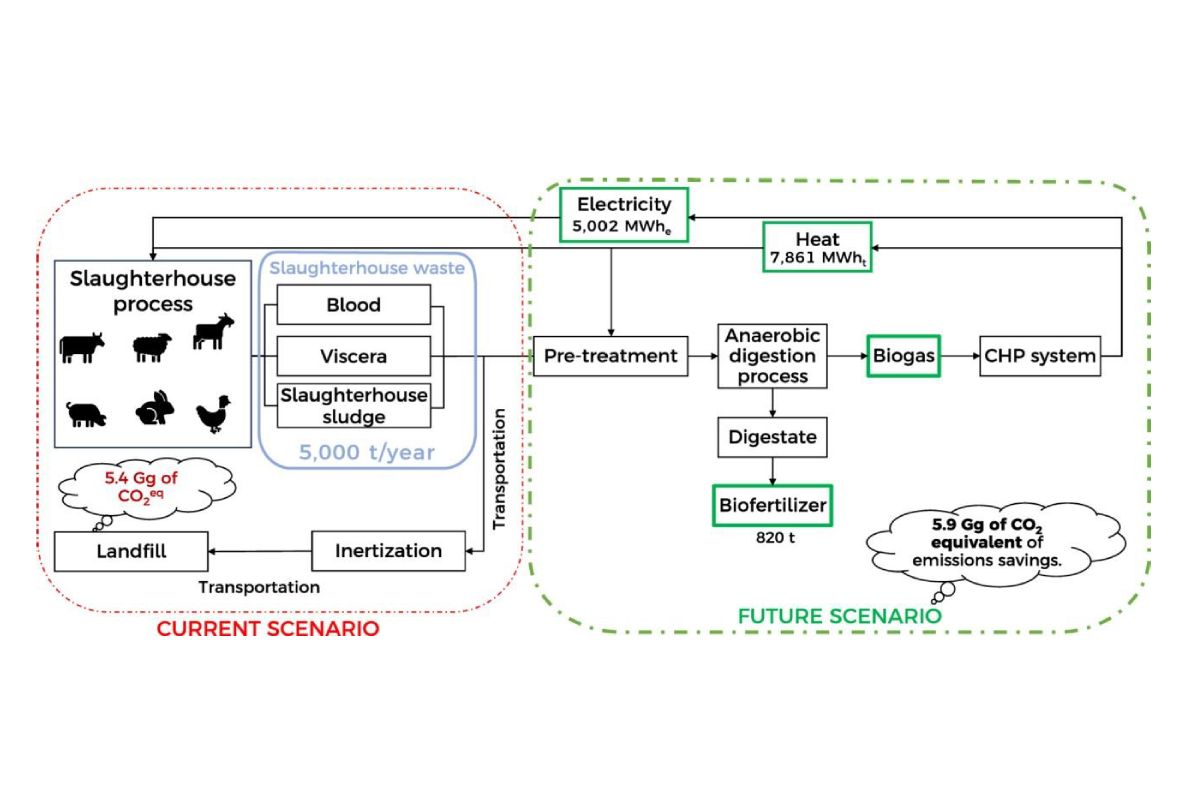
For the development of this article, it was necessary to quantify the animal by-products (ABP) generated by the two main slaughterhouses on the island of Tenerife, where cows, pigs, sheep, goats, rabbits, and chickens are slaughtered. According to data collected by the Government of the Canary Islands, a total of 4.5 million animals were slaughtered (78,813 mammals and 4,450,754 birds), generating an average of 5,000 tons of waste annually.
Different combinations of the various effluents were also analyzed, based on the average monthly waste generation for the period 2017–2021, and the elemental composition of each was examined. Based on these analyses, the potential energy yield was theoretically evaluated, considering the possibility of producing both electrical and thermal energy. Finally, using data from the 2021 Canary Islands Energy Yearbook, the emission savings resulting from energy substitution and the energy capacity of these byproducts were established.
This study has assessed that, in line with the principles of the circular economy, animal by-products (ABP) generated in Tenerife could be used to obtain energy and biofertilizers, saving almost 6 million kilograms of carbon dioxide, and generating 12.86 GWh of energy and 820 tons of more sustainable biofertilizers. This energy contribution would represent 201% of the energy consumed by the industrial sector in the municipality of San Cristóbal de La Laguna.

 Spanish
 English
 French