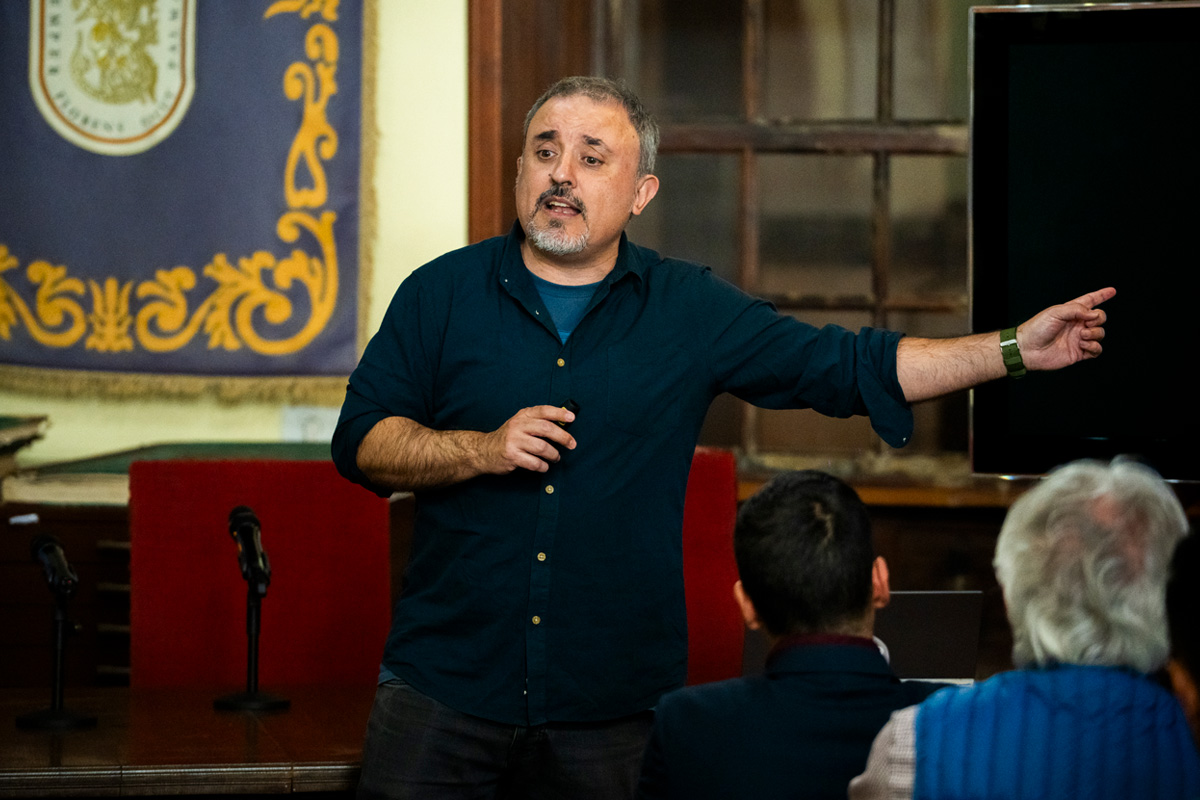
The La Palma Autumn-Winter University It culminated on February 21st with the inspiring lecture by the science journalist and writer Antonio Martínez Ron, titled A Revolutionary Perspective. With it, the speaker traced a journey through the history of science, focusing on the modern era, and how it has changed our way of seeing the world.
The venue chosen for the event was the Royal Cosmological Society of Santa Cruz de La Palma, a building with 142 years of history. As a scientific institution in its origins, its president, Ignacio Pastor Teso, explained that a temporary exhibition had been planned to complement the talk, featuring manuscripts from its own collection dating from the 17th to the 19th centuries.
The Vice-Rector for Culture and University Extension at the University of La Laguna, Isabel León Pérez, and the Councilor for Culture and Education of the La Palma Island Council, Pablo Díaz Cobiella, expressed their gratitude for the journalist's presence. They also emphasized the importance of maintaining this educational project on the "Beautiful Island," strengthening the ties between the La Palma Island Council and the University of La Laguna. Both public entities are working together to begin organizing the next edition.
Abel López Díez, director of the University Extension Secretariat at the academic institution, introduced the speaker, a recipient of the Ondas and Concha García Campoy awards, emphasizing that “talking about science today is more urgent and necessary than ever.” This idea was reinforced in his speech by Martínez Ron, one of the founders of Naukas, the largest science communication platform in Spanish, as well as the Fogonazos blog project.
With over 20 years of experience, the science journalist began his presentation by emphasizing that we live in difficult times for science and knowledge. “The public is very disconnected from what science means, partly due to how the media has portrayed it for so long and partly due to the ever-increasing complexity and specialization of science and technology,” he pointed out, adding: “In these times, when people don't quite understand what science contributes, we've forgotten to explain that the most interesting question science has asked is: what if things aren't exactly as we thought?”.
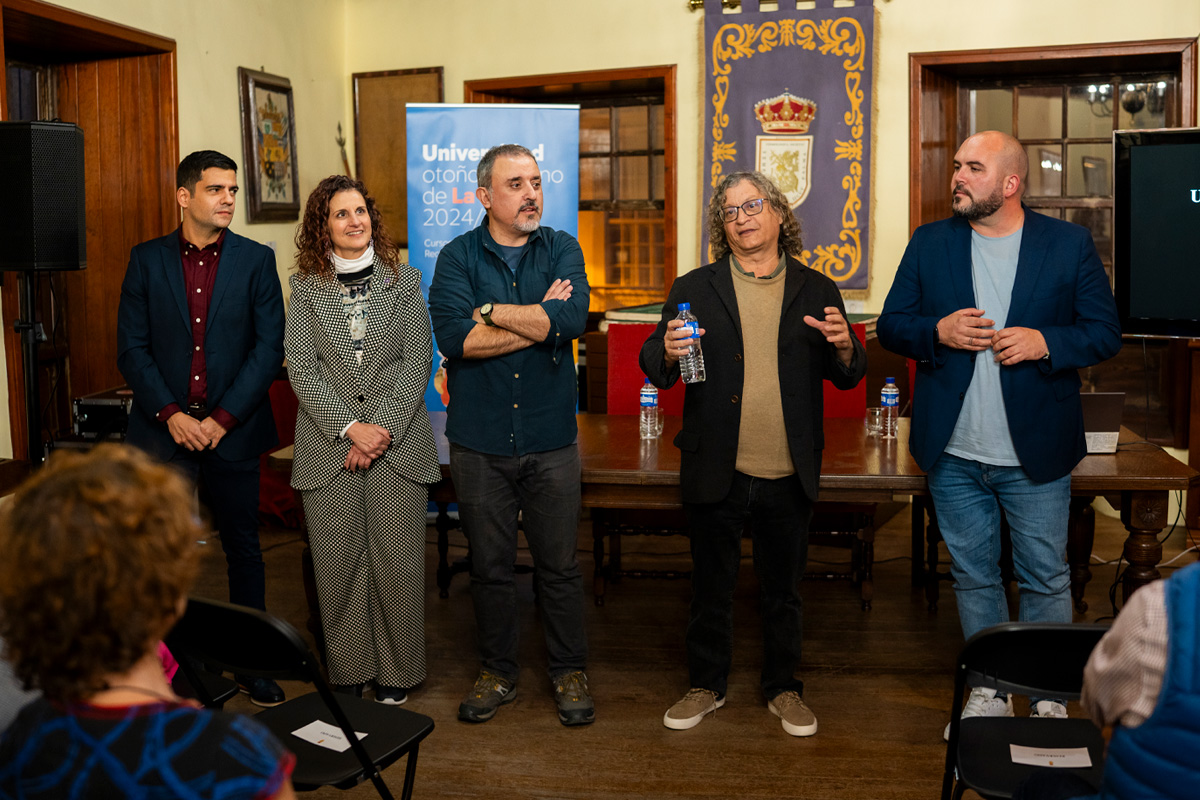
(From left to right) Abel López Díez, director of the University Extension Secretariat of the ULL; Isabel León, vice-rector of Culture and University Extension; Antonio Martínez Ron, journalist; Ignacio Pastor Teso, president of the Royal Cosmological Society of Santa Cruz de La Palma; and Pablo Díaz Cobiella, councilor of Culture and Education of the Cabildo of La Palma.
This question, in his words, is what has led us to great advances, such as vaccines, the design of satellites, and travel to the Moon. Specifically, the famous photograph of the blue marble, taken from Apollo 17 in 1972, “originally showed the Earth with Antarctica at the top, the opposite of the view we have of the world from a Eurocentric perspective,“ he points out. Martínez Ron is the author of the works The naked eye, What do astronauts see when they close their eyes? Dad, where do you plug in the sun? and in 2022 he published Something new in the skies.
Another of the most celebrated moments in the history of science, according to the journalist, current head of Science at elDiario.es and collaborator on the radio programs "Mañana más" (RNE) and "Julia en la onda" (Onda Cero), was when Jacques Charles managed to raise a hot air balloon to more than 1000 meters in 1783. Then, a new point of view was revealed, from above, discovering other ways of perceiving things.
Furthermore, the writer used the example of how, in the 19th century, John Dalton, to whom we owe the discovery of color blindness, revealed that not everyone sees reality in the same way. Martínez Ron linked this to the fact that our prejudices condition how we perceive reality, influencing what we previously thought we knew about it.
In summary, the speaker highlighted several key ideas: that science is not an individual endeavor, but rather a collaborative process of mutually influencing discoveries; that it is not solely the story of white European men, as important female scientists whose discoveries are often overlooked in history books, and that we are ignorant of the knowledge of other cultures and continents. All of this demonstrates that science responds to complex and interconnected processes, from the intricacies of neural networks to the arrangement of galaxies within the cosmic web.
This conference marks the end of a program that, once again, has brought high-quality, specialized training to the people of La Palma, thanks to the commitment of the Island Council and the University of La Laguna. This year, the Autumn-Winter University offered fourteen ECTS-credited courses, as well as workshops, cultural activities, and leisure events, solidifying its position as a leading educational offering on La Palma.

 Spanish
 English
 French