
The construction sector in Europe is characterized by its low level of digitalization—around 11% of total work done—low productivity, and limited innovation, partly due to its composition of small and medium-sized enterprises. This characterization of the sector was provided by a professor of Graphic Expression in Engineering at the University of La Laguna. Norena Martín Dorta, explains the purpose of the day which she has organized together with the postdoctoral researcher Ana Pérez García: to promote digital processes based on standardization, with emphasis on the BIM methodology which is gradually being implemented from Europe and already has a National Plan promoted by the Ministry of Transport and Sustainable Mobility.
This Innovation in the Construction Industry Conference was held today, Wednesday, February 26, in the auditorium of the Technical Architecture and Civil Engineering departments of the Higher Polytechnic School of Engineering. The opening ceremony was presided over by the Vice-Rector for Digital Transformation, Vicente Blanco, who reflected on how technology permeates all professions to improve their quality and facilitate their performance. In his opinion, digital transformation is not only a technological issue, but also a matter of mindset, requiring a change in the way we work by incorporating new tools such as, in the case of construction, the BIM methodology, promoted at the academic institution by Professor Martín Dorta.
The Minister of Public Works, Housing, and Mobility for the Canary Islands Government, Pablo Rodríguez Valido, pointed out that construction is more than just concrete: it transforms reality to achieve greater levels of well-being, whether through homes where families can develop their life projects, or roads that facilitate mobility and economic development. It is, therefore, an “absolutely strategic” sector that can improve and overcome its stagnation through digitalization. The administration supports this process and, in that regard, revealed that work is underway on a decree that will expedite building permits thanks to digitalization.
The Island Councillor for Innovation, Research and Development of the Tenerife Island Council, Juan José Martínez, stated that innovation is no longer optional, as there is no area of society whose paradigm remains unaffected by the "world of data." This represents a paradigm shift that, in the construction industry, is comparable to the introduction of new materials or computer-aided design software. Regarding the adoption of BIM methodology, he explained that the Tenerife Island Council stands out in its implementation, as some rankings indicate, but this is not "meritorious" since it is "an obligation.".
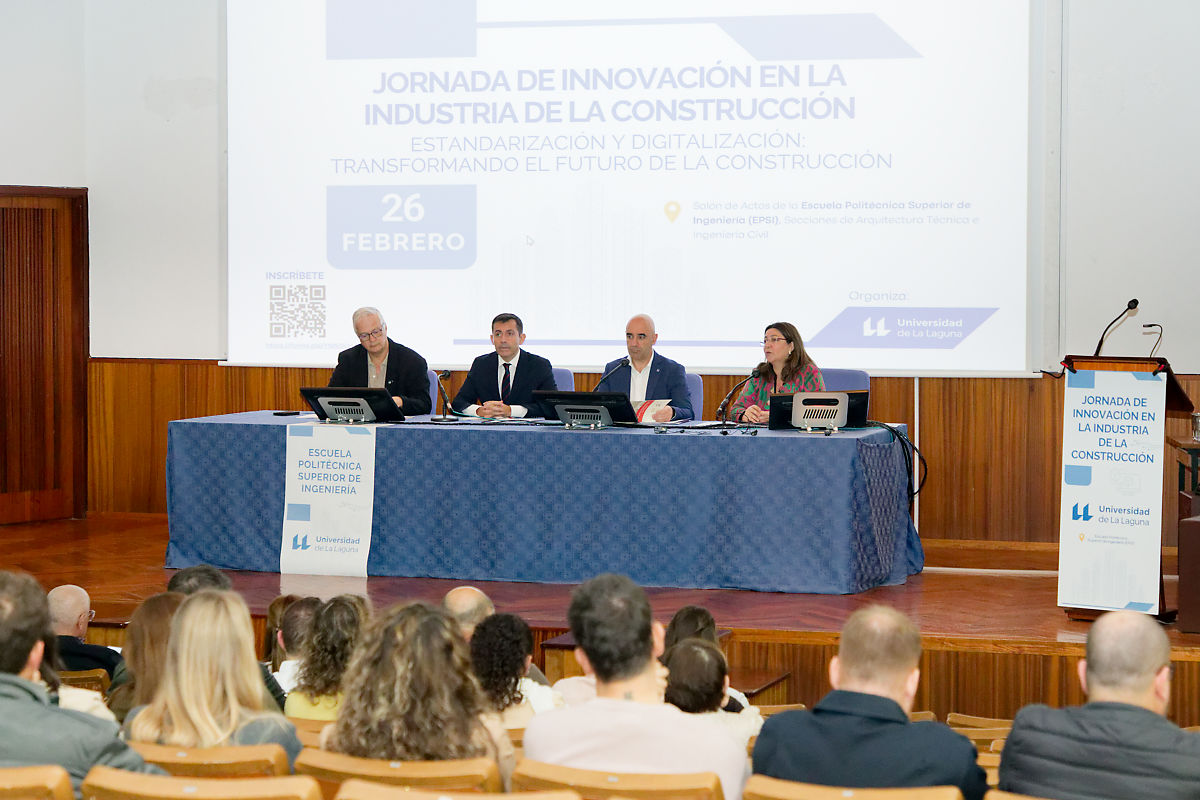
Norena Martín, during the opening panel presentation.
BIM and standardization
During the inauguration, which was also attended by the director of the Higher Polytechnic School of Engineering, Felipe Monzón Peñate, Professor Norena Martín outlined the program for the day. The program included a presentation of the Ministry's BIM Spain Plan; a dissemination of a project by the Madrid City Council for the digitization of urban planning licenses using BIM methodology; two presentations by experts from the Catholic University of Valparaíso and the Center for Numerical Methods of Barcelona focused on extended reality in the field of BIM; and a presentation on the use of Artificial Intelligence in the improvement and optimization of processes in the construction sector.
According to the expert, it is important for the construction industry to recognize that "the world of data must be incorporated into the sector," and for this, it is necessary to have open standards that facilitate interoperability in systems, meaning that they can share information and connect with each other, something that is not possible if each administration and company uses different systems.
In this regard, he emphasized that public administrations must take the lead by adopting these advancements and thus act as a driving force for private entities. He praised the existing National BIM Plan and pointed out that the challenge lies in implementing it across all autonomous communities, a task that is far from easy given the need to reach the municipal level. Therefore, technical staff from all the island's municipalities were invited to these workshops, and a large number attended.
In explaining exactly what BIM methodology is, Martín Dorta summarized it by pointing out that it involves all types of data—geometric, energy, cost, etc.—that allow for the generation of models. The more accurate the models, the better the available information databases, hence the importance of standardization and interconnectivity. Thus, BIM methodology allows for the generation of project simulations before work begins, which avoids errors and problems during the design, construction, and maintenance phases.

 Spanish
 English
 French