
He Social Council The University of La Laguna has launched its annual work plan by presenting the results of a survey on student perceptions of various aspects of the academic institution. 47.41% of those surveyed stated that the quality of teaching they received was good or excellent, 46.71% indicated that it was sufficient, while 5.61% declared it insufficient. In fact, seven out of ten students would enroll at this institution again, a trend that is prevalent across all fields of study.
This study is based on a sample of 750 students, 52.5% female and 47.5% male, with a mean age of 20 years. Of this population, 97.7% are undergraduate students, while 2.3% are postgraduate students. 85% of the sample resides in Tenerife.
Regarding teaching, the most valued aspect by respondents is the faculty's skills and knowledge, with an average overall satisfaction score of 7.12%. Those most critical are in the technical field, while those most satisfied are in the health sciences. Libraries, sports facilities, and cultural offerings are the services most valued and well-known by university students.
Regarding governance, students indicate a need for greater participation. The Student Council is the most familiar to them, while the Social Council is the least known. The majority believe that in-person teaching, supplemented by online learning, is more effective.
More than half of those surveyed would orient their professional career towards the public sector (54.1%), followed by the private sector (25.1%), and, further behind, the self-employed or freelance sector (14.1%). When asked about their personal values, the majority expressed opposition to positions of rejection towards other groups based on their sexual orientation or any other type of discrimination.
The Rector of the University of La Laguna, Francisco García, expressed his satisfaction at the session with the overall results of the barometer, which indicate that 94.1% of students consider the teaching they received to be either good or sufficient, suggesting that this public university is fulfilling its mission. He also added that, as this is the first barometer, adjustments to its design will need to be made for future editions.
In other business, the university's annual report for the 2023 fiscal year was presented at this morning's session. The governing body was also informed of the dismissal of the academic center's manager, María Teresa Covisa, who will be replaced by Lidia Patricia Pereira Saavedra, a career civil servant in the senior administrative corps of the autonomous community and the current comptroller general. The rector explained that this change is due to a new focus for the management team towards a more economic and financial profile, given that the institution will be fully engaged in negotiating a program contract as a stable funding framework for the coming years. This requires greater effort in this area, while also continuing the modernization of the administration, which will be carried out by the same team.
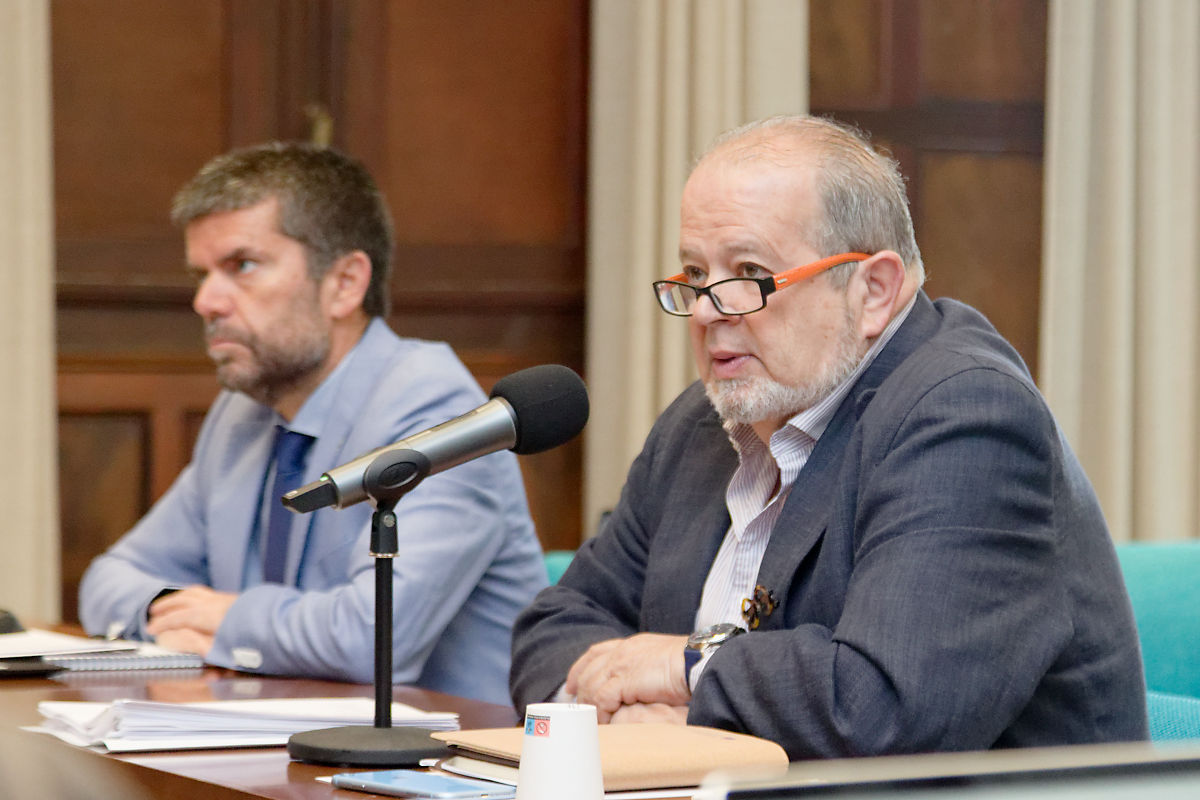
First, Francisco Almeida, president of the collegiate body, accompanied by the rector, Francisco García.
Accommodation centers
Today's meeting also included the presentation of a report on the operation of the University of La Laguna's student accommodation centers, commissioned by a working group of the governing body. While acknowledging their social function for students with limited financial resources, the document advocates for analytical accounting to determine their true scale and, at the same time, reduce the budgetary imbalance affecting them, with the possibility of revising their public prices.
The text proposes a comprehensive renovation of the Parque de las Islas Residence Hall, while also indicating the need to update the disciplinary regulations, which date back to 2010, and its governance system. The document includes the search for external funding sources and agreements with FECAM (the Federation of Municipalities of the Canary Islands), as well as the promotion of public-private partnerships, the refurbishment of closed rooms to make them operational, and an increase in fees to a minimum of 50% of their cost.
The rector pointed out that, indeed, it is necessary to have analytical accounting to know the real costs of this public service - a matter for which the first data could be available during 2026 - a challenge that he intends to address with the new manager, while reviewing these infrastructures and improving their provision, before addressing other issues such as fees, in order to do so in a coordinated and orderly manner.
For his part, the president of the Social Council, Francisco Almeida, added that the support systems must be separate from the service's management itself, so that neither is negatively impacted. He also noted that the condition of the facilities varies from school to school and that most are quite acceptable, while maintaining that more professional management is necessary. In his opinion, it's a matter of gradually changing the culture surrounding this service and progressively implementing measures to improve its efficiency.

 Spanish
 English
 French