
Cybersecurity has become a cross-cutting issue affecting all aspects of daily life. From our personal data to critical infrastructure that provides essential elements, citizens can be vulnerable to cyberattacks.
Given this situation, it is essential to develop increasingly complex techniques to protect information, but also to detect and prevent all types of malicious access. In this field, the application of machine learning (ML) algorithms allows us to anticipate many critical situations, making its study in an academic context fundamental.
Within this line of study, the emerging discipline of quantum computing opens a new and fascinating field of work where the principles of quantum physics are used to provide us with a computing capacity that is difficult to achieve with classical computing.
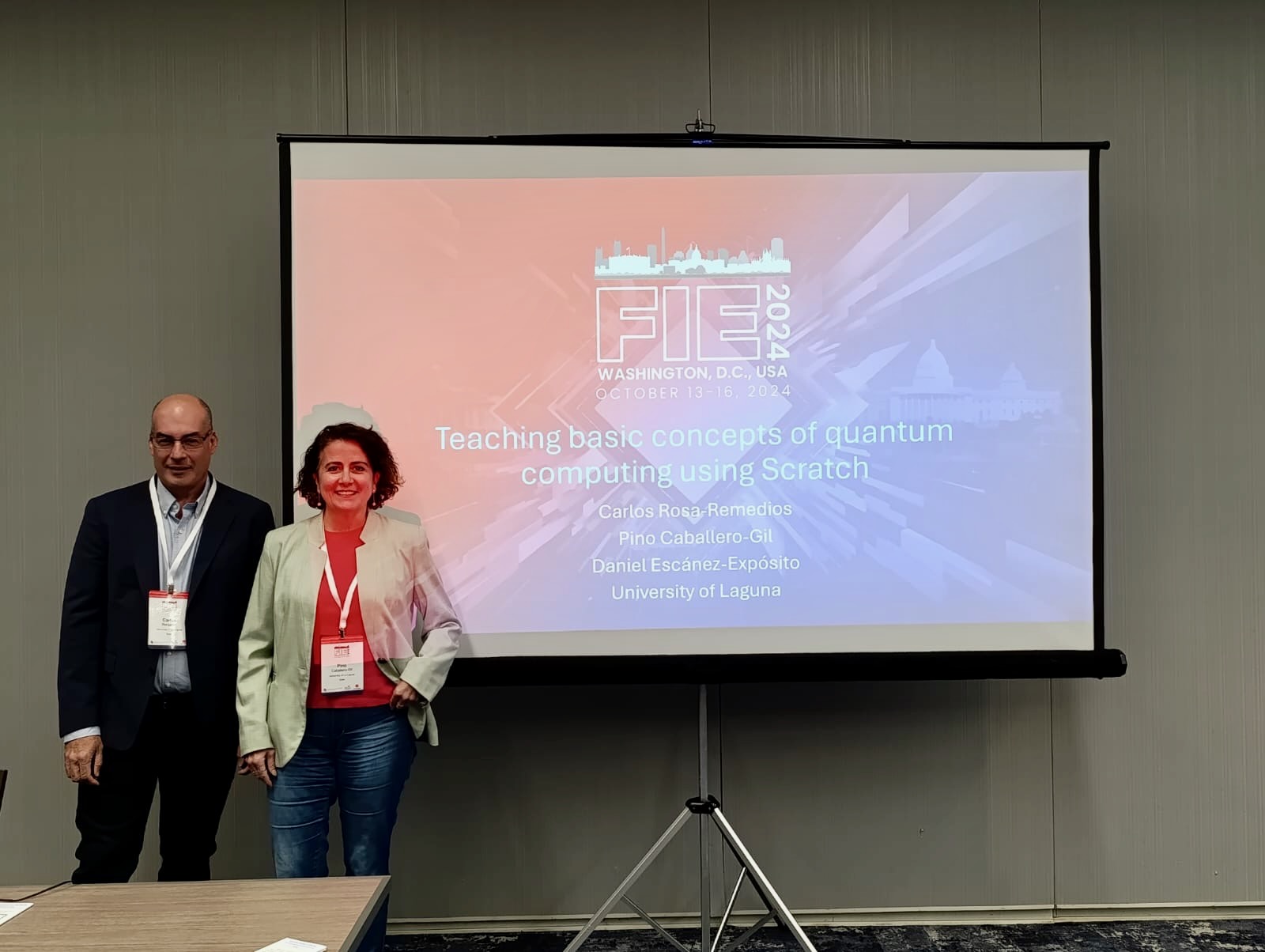
Carlos Rosa and Pino Caballero at a conference in Washington.
The work done and published in the journal Optimization and Engineering, Published by Springer, and signed by the doctoral candidate from the University of La Laguna Carlos Rosa Remedios tutored by the professor Pino Caballero Gil, This starts from this point to explore still little-studied areas, such as transferring traditional machine learning algorithms to the quantum world, analyzing their ability to identify certain cybersecurity attacks.
This involves a laborious process that begins with obtaining a dataset that brings together information about attacks already carried out, where a series of variables, called characteristics, are identified, which allow us to characterize the possible attack against a normal situation, assigning to each set of values a label that tells us whether they correspond to an attack or not.
However, when using quantum computing, this dataset requires special conditions, so it has been necessary to apply different techniques before using it in the quantum world: converting alphanumeric variables to numeric ones, adjusting the number of available features (known as dimensionality adjustment), and controlling the balance (ensuring that we have approximately the same amount of data reflecting an attack as we do reflecting normal situations). To facilitate understanding of the work, a section has been included detailing both the basic principles of quantum computing and the mathematical basis of the different algorithms used later.
Following this process, a meticulous methodology is developed to implement machine learning algorithms in the quantum context (known as Quantum Machine Learning or QML). First, feature mapping is performed, transforming the classical dataset into quantum states using the fundamental unit of work: the qubit. Subsequently, a parameterized quantum circuit, or ansatz, is applied, and an optimization algorithm is used to complete the QML process.
This work analyzes from a quantum point of view three cybersecurity problems, such as the detection of malicious programs (malware) in Android systems, Spam email and Phishing on web pages.
In addition to precisely detailing all the steps and techniques necessary to take a traditional dataset towards the application of QML algorithms, the main focus of study has been to identify the optimal combinations between the algorithms available at each stage of the process.
This has led to a comprehensive comparative analysis of the different combinations of algorithms used in QML, yielding results in some cases that show accuracies approaching those of classical ML algorithms. Considering the evolutionary time of classical algorithms and comparing it to the still relatively new discipline of Quantum Machine Learning, this represents a significant advance that suggests a promising future in this field.
In turn, the architectures of INTEL's x86 processors have been compared with those of ARM processors (in this case, APPLE's SILICON architecture), generally obtaining a noticeable reduction in computing time when using the latter, which opens the door to future lines of work on this architecture.

 Spanish
 English
 French