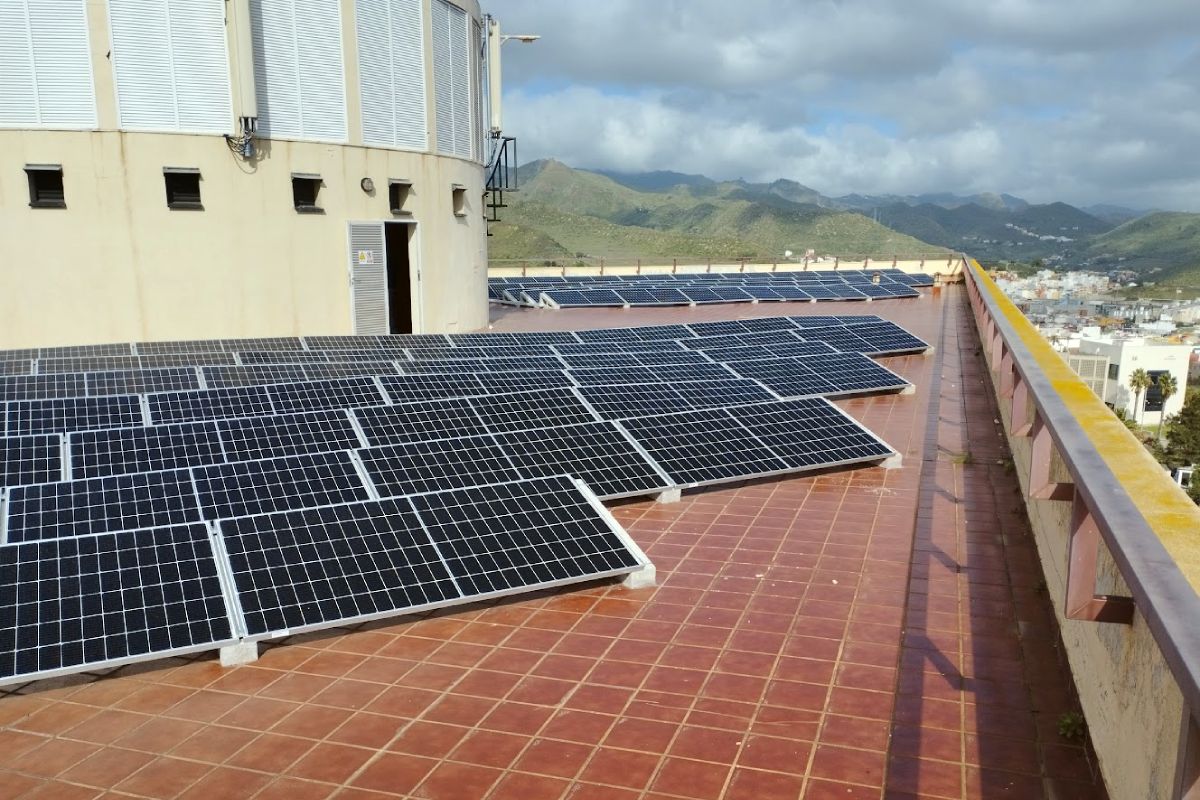
The journal Applied Sciences-Basel has just published an article In this study, researchers from the University of La Laguna explore a renewable energy supply scenario for both the electricity generation and road transport sectors in the isolated system of Tenerife, modeling the island's energy system using the EnergyPLAN software. The results indicate that achieving this would require renewable power almost twenty times greater than the current level and a storage capacity that does not yet exist. The authors of the study are Itziar Santana Méndez, Oscar Garcia Alonso y Benjamin Gonzalez Diaz, from the Department of Industrial Engineering.
The transition to sustainable energy systems is a key challenge facing society. Among the various sectors, road transport stands out as one of the most difficult due to its high energy consumption and infrastructure requirements. In this context, while the adoption of zero-emission vehicles is considered a promising path, the supply of energy through renewable sources remains uncertain, especially in the case of hydrogen.
This work is the first in a line of research focused on evaluating different routes for the decarbonization of land transport, which accounts for 70% of CO2 emissions.2 of the transport sector in the European Union. The island of Tenerife has been taken as a case study, so the results of the analysis can be extrapolated to isolated systems with similar characteristics.
Although the benefits of electrifying transport are clear, the ability to reduce global CO2 emissions2 are closely related to CO intensity2 of the network. Likewise, the integration of these architectures must be studied in detail, since it requires a large deployment of infrastructure for charging and to supply the additional electricity they demand.
This work studies in detail the total decarbonization of light and heavy transport on the island, through the use of battery electric and hydrogen fuel cell vehicles, following the roadmap established by the Canary Islands Energy Transition Plan (PTECan 2030As a specific case, the goal has been set for a fully renewable energy supply without external dependence, achieved through renewable sources supported by thermal generation using internally produced renewable hydrogen. To this end, an energy model of the island has been developed to study how the system's response should be in terms of new renewable capacity and storage to reach the established objective.
Results and recommendations
The results indicate that, although technically feasible, the need for renewable energy capacity deployment would be 6.35 GW, compared to the current 0.33 GW; and for storage, 12.01 GWh, which is practically nonexistent at present. All of this represents a challenge in terms of both economics and time for its deployment.
Based on these results, the research team is working on analyzing alternative routes, including, for example, the importation of energy carriers. All of this work will gather information to later conduct a detailed techno-economic analysis and propose a roadmap that can be useful to the public and private sectors for future energy planning.
In fact, the article concludes with a series of recommendations for public authorities to advance energy decarbonization. The first of these is to reduce energy demand as a primary objective. Although the results demonstrate that a completely self-sufficient energy supply is possible, the amount of renewable energy that needs to be deployed is enormous. This translates into a significant amount of electricity fed into the grid and large energy storage capacities, which could jeopardize the profitability of renewable energy producers.
Another recommendation is to prioritize manageable renewable energy sources. Given the island's limited space, high-enthalpy geothermal resources (which harness geothermal energy found under specific pressure and high-temperature conditions) emerge as the island's main opportunity, requiring government support in terms of financial backing during exploration and potential future exploitation.
Finally, the use of imported energy carriers to support domestic demand is also recommended. In this context, energy carriers such as green fuels could play a key role in transportation. Their high energy density and the fact that they can be used with existing technologies and infrastructure make these renewable fuels an excellent option for reducing the island's renewable energy and storage needs, although the feasibility of this approach requires further study.

 Spanish
 English
 French