
The Social Council of the University of La Laguna has conceived a new series of talks, entitled “Dialogues,” which will address current issues with renowned specialists. first of these meetings It was held yesterday, Thursday, March 6, at the Espacio Mutua Tinerfeña in La Laguna, and addressed the current turbulent world order, marked by the irruption of Donald Trump on the international scene, with Félix Sanz Roldán, director of the National Intelligence Center (CNI) between 2009 and 2019 and, currently, president of the Social Council of the University of Castilla-La Mancha.
Sanz began his remarks by making clear the extreme difficulty of addressing the current shifting international geopolitics: “I can’t offer you a solution as to what the world order will be next month, and I don’t think anyone in the world knows.” In his opinion, what has happened with the arrival of the new occupant of the White House is that “someone has kicked the chessboard, the pieces have gone flying, but fortunately they’ve landed back in. We have to see what we do with those pieces, whether we continue with the same rules or different ones, and whether their capabilities will be the same. It’s a complex situation.”.
Sanz Roldán explained that the ultimate form of world order is one of balance, “where no one does anything that those around them cannot tolerate. Peace is something else entirely.” It is, therefore, a system of rules that international political entities, which are not necessarily exclusively states, decide to adopt in order to achieve a degree of harmony, even though each of these entities may hold very different views. In this context, diplomacy is a fundamental resource.
One characteristic that the former director of the CNI appreciates is that successive world orders have changed at an ever-increasing pace: starting with the Peace of Westphalia (1648), which introduced the ideas of the inviolability of borders and the sovereignty of states, almost two hundred years passed until the Congress of Vienna (1815) established a second world order after the Napoleonic Wars. The third change occurred a century later, with the beginning of the Cold War, and lasted barely 50 years, as the fall of the Berlin Wall imposed a new status quo. The fall of the Twin Towers brought another; the withdrawal of the United States from Afghanistan, yet another; and there was further disruption with the invasion of Ukraine.
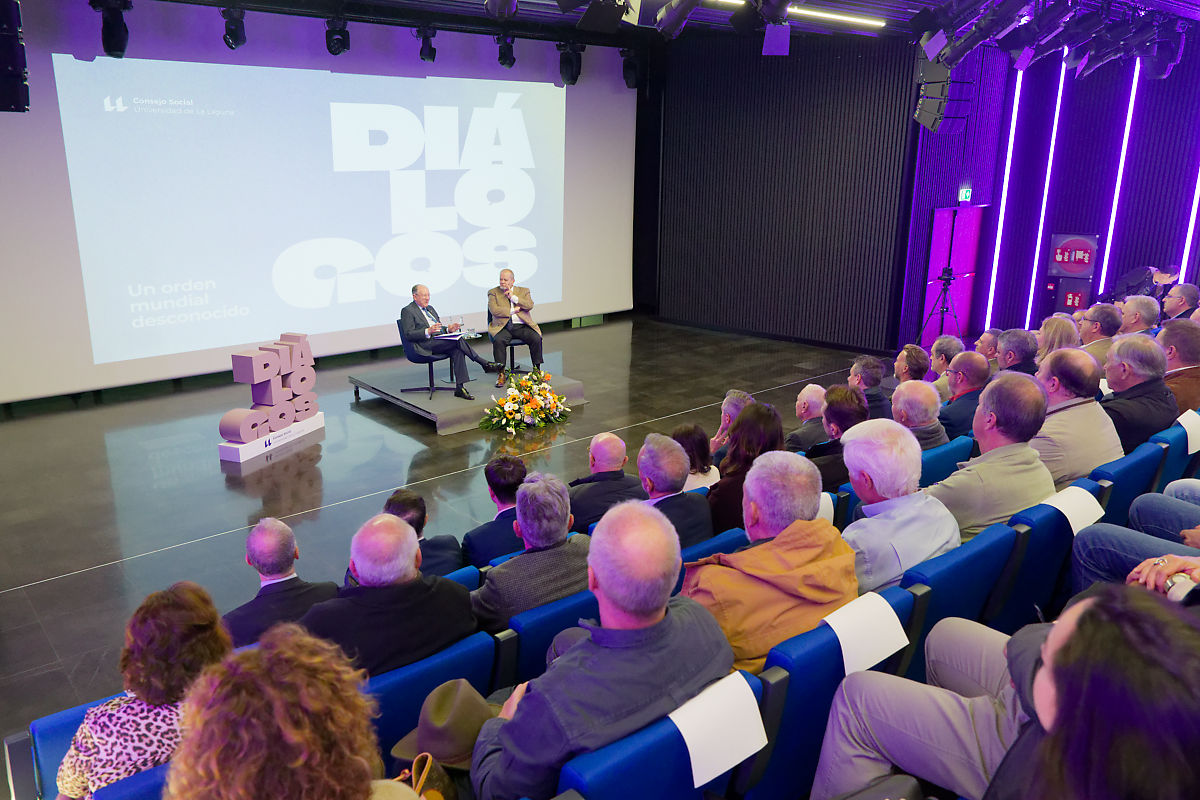 Therefore, according to the expert, January 20, 2025, the start of Trump's second presidency, marked the beginning of a new world order, and given the dizzying pace of change, what will happen next is unpredictable. Until then, the world was defined by a pole of power, which was the United States and was based on its military might; and a pole of influence, represented by China and its soft power; While the remaining countries swung towards one or the other according to their interests. Now two more poles have emerged: Russia, which was a pariah and, “thanks to Trump,” is once again an international player; and the European Union, which has been forced to act at a speed to which it is not accustomed.
Sanz believes that, although the situation seems alarming, hasty decisions should not be made because the truth is that the US is weaker and in four years, with the new presidential elections, the situation could change. And even sooner: in seventeen months it will be the“midterm elections”In which Trump could see his power weakened. “Things have been made easy for China, because not even the US can do without it. Without China, Teslas couldn't be manufactured, since the 40% component comes from the Asian country, and the semiconductor industry also depends on them.”.
In his opinion, the new US president “couldn’t have started worse by shedding four major burdens”: Gaza, Ukraine, Taiwan, and the EU. This is partly because “Trump doesn’t understand economics; he sees the parts but not the whole.” And for this reason, he believes that even domestically he will face opposition regarding the tariffs he will impose on imports; he has already met with automakers who have likely explained to him the importance of countries like Mexico, Canada, and Germany to that industry.
Regarding Russia, he doesn't believe Putin is inclined to negotiate, and Sanz believes they must work to achieve a relationship of mutual trust, while reminding him that "it's no longer an empire." Trump fervently desires the photo op of a handshake with the President of the Russian Federation that would portray him as the architect of peace, but the Eastern European leader is playing hard to get, and therefore the American is putting as much pressure as possible on Ukraine to appease him.
All of this could be good for Europe, because it has been a real wake-up call. On the one hand, it is positive that the United Kingdom, a natural ally of the US, has turned towards Europe. On the other hand, while the Maastricht Treaty (1993) already spoke of creating a common foreign policy that should become a common defense policy and, finally, a common defense, the truth is that no serious steps had been taken to fulfill that commitment. And yet, now there is 800 billion euros for defense on the table.
“Simply providing the money isn’t enough; you have to know what to do with it. It has to be accompanied by a common policy, a strategy, and a defense industry. There’s still a lot to be done, but we’ve started, and that’s something I think Trump didn’t expect.” Furthermore, in his opinion, Europe has something distinctive: values developed over centuries, which are what Europe has always contributed to the international community and which constitute its true strength.

 Spanish
 English
 French