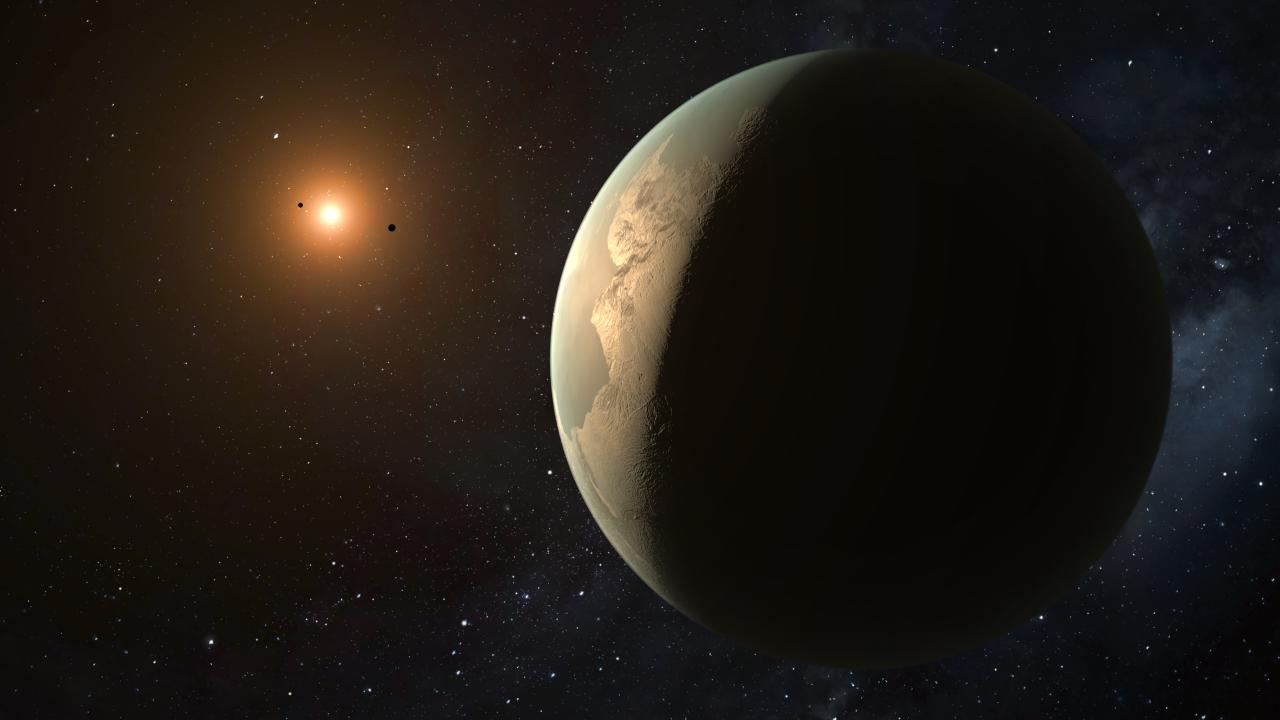
An international team has detected a super-Earth orbiting in the habitable zone of GJ 3998, a nearby red dwarf star located 59 light-years away. The new planet, named GJ 3998 d, is the third planet found in this system. "GJ 3998 d is a welcome addition to the planetary census of our cosmic neighborhood," says Atanas Stefanov, a doctoral student. funded by the "La Caixa" Foundation« at the Institute of Astrophysics of the Canary Islands and the University of La Laguna, and lead author of the study, published in Astronomy & Astrophysics. «This super-Earth appears to be in the habitable zone of one of the stars closest to the Sun. This gives us one more reason to continue searching for habitable planets around us,” he adds.
The newly discovered planet, GJ 3998 d, is a super-Earth with a mass six times that of Earth. It lies within its star's optimistic habitable zone and completes an orbit every 41.8 days. At this distance, GJ 3998 d receives only 20 % more stellar radiation compared to what Earth receives from the Sun. "GJ 3998 is significantly smaller and cooler than the Sun, which shifts the habitable zone closer to the star," explains Alejandro Suárez Mascareño, a researcher at the IAC and co-author of the study. "Although it is certainly different from Earth, if the planet is rocky, it could potentially harbor liquid water on its surface, one of the main requirements for life," notes Jonay I. González Hernández, also a researcher at the IAC and co-author.
The proximity of this system to the Sun makes GJ 3998 d an attractive candidate for atmospheric characterization. "It should be possible to check for the presence of an atmosphere and search for oxygen using the future ANDES spectrograph in it Extremely Large Telescope (ELT) of ESO. GJ 3998 d would also be a good target for the future telescope Exo Life Finder "(ELF) of 50 meters, led by the IAC, which will look for biomarkers in the atmospheres of exoplanets," adds Rafael Rebolo, IAC researcher and co-author of the study.
The discovery is part of the HADES program, an international effort to explore planetary systems around red dwarfs using the telescope Galileo National Telescope (TNG) in the Roque de los Muchachos Observatory, in La Palma.
Red dwarfs are smaller and cooler stars than the Sun and make up almost three-quarters of the stellar population of our galaxy. Their low mass and abundance make them prime targets in the search for low-mass planets. GJ 3998, one of these red dwarfs, has been of particular interest to the community due to its proximity (59 light-years) and its moderate stellar activity. Using the HARPS-N spectrograph Using the TNG telescope, the team was able to detect small oscillations in the star's motion, caused by the gravitational pull of orbiting planets.
A previous study conducted in 2016 The same team had already detected two planets. The presence of an additional signal in the data led to continued observations and a new analysis of the dataset. With three known planets in the system, GJ 3998 once again highlights how common multi-planet systems are. «Planets, particularly low-mass ones, are rarely alone: they prefer company. Often, when we re-examine a system with new measurements and new methods, we find planets that had previously gone unnoticed,» Stefanov concludes.
Nicola Nari, a doctoral student at the University of La Laguna, also participated in this discovery.
(Press release and image provided).

 Spanish
 English
 French