
A new article The article in the journal Nature Human Behaviour has revolutionized the understanding of human behavior and evolution in the Near East with the recent discovery of the Tinshemet Cave archaeological site, located several kilometers from Jerusalem, which marks a significant milestone for the study of Middle Paleolithic communities. The doctoral candidate from the University of La Laguna Pedro García Villa, currently attached to the Laboratory of Micromorphology and Archaeological Biomarkers (AMBI Lab) directed by the researcher Carolina Mallol Duque, Participate in this publication released today, Tuesday, March 11.
During the central years of this prehistoric period, between approximately 130,000 and 80,000 years ago, Neanderthals and the first Homo sapiens who migrated from Africa coexisted in this region. Although it is known that they shared territory and interacted with each other, much remains to be learned about their cultural, symbolic, and funerary differences and similarities.
The discovery of Tinshemet and the comparison of its archaeological record with other sites from the same period (approximately 100,000 years old) has yielded new clues about the lives of these prehistoric communities. The cave contains a rich archaeological record of thousands of stone tools, burned and unburned animal bones, and fragments of ochre, a reddish pigment used in paintings and burials.
However, the most surprising discovery has been the remains of five hominins: two adults in individual graves, a child in an individual grave, and cranial remains of two other individuals. These human remains are still under study, and it is unknown whether they were Neanderthals, Homo sapiens, or even hybrids.
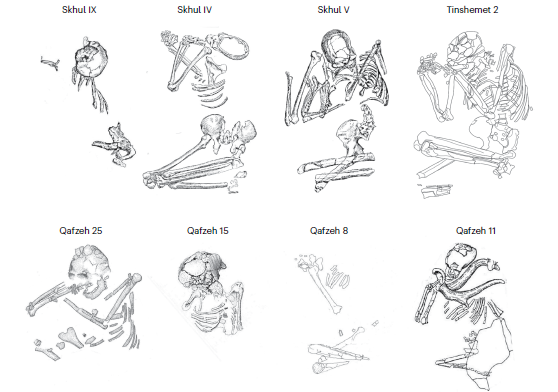
Diagram of the remains studied.
When comparing the archaeological remains of Tinshemet with other equally important sites in the Near East, all with a similar chronology such as Skhul, Qafzeh, Tabun, and Nesher Ramla, numerous similarities emerge in the archaeological record. First, the method of manufacturing the stone tools stands out. These prehistoric communities primarily used flint, a type of sharp stone very abundant in the area. These stone tools exhibit technical homogeneity, as they were made using the same type of knapping technique. These prehistoric communities hunted the same types of animals during this period, notably large ungulates such as bovids, equids, and cervids.
Numerous similarities are also found in the symbolism and treatment of the dead. The use of ochre in burials is particularly noteworthy. At Tinshemet and other significant sites from the same period, ochre was used in burials, often sprinkled on top of the deceased or placed in large chunks beside them. Another element shared by all these sites is the burial method: the dead were laid in the same position, on their right side, regardless of sex, age, or species, as shown in Figure 5 of this article.
All these similarities reflect a surprising cultural uniformity in this specific period of the Middle Paleolithic between human groups of different origins (Neanderthals and Sapiens), a homogeneity that does not exist in the previous and subsequent prehistoric stages, which present a greater variability in material and burial practices.
International research
The study was conducted by a multidisciplinary team from the universities of Jerusalem, Tel Aviv and Haifa, with the support of numerous specialists from institutions in France, England, Italy, Switzerland and the United States.
“My participation in the project is part of the team at the University of Haifa, led by Professor Ruth Shahack-Gross, where we conduct several studies on the processes of site formation and characterization of the sediment surrounding the archaeological remains,” explains García Villa, who adds that this branch of archaeology, called geoarchaeology, studies the interaction of natural processes and human activities, applying methods from geology and soil science to archaeological problems.
This discipline aims to understand how archaeological materials were buried, the composition of the sediment, and the possible alterations suffered by the materials and the surrounding deposit. This work can be complemented by reconstructions of the landscape and paleoenvironment through the study of organic plant remains preserved in archaeological sediments, providing a whole new perspective on the natural context in which prehistoric communities lived.
“Currently, I am continuing this line of research within the framework of my doctorate at the University of La Laguna, under the direction of Professor Carolina Mallol, focusing on geoarchaeological studies of Guanche aboriginal sites in Tenerife, with the aim of better understanding the relationship between the ancient inhabitants of the island and their environment,” explains the young researcher.

 Spanish
 English
 French