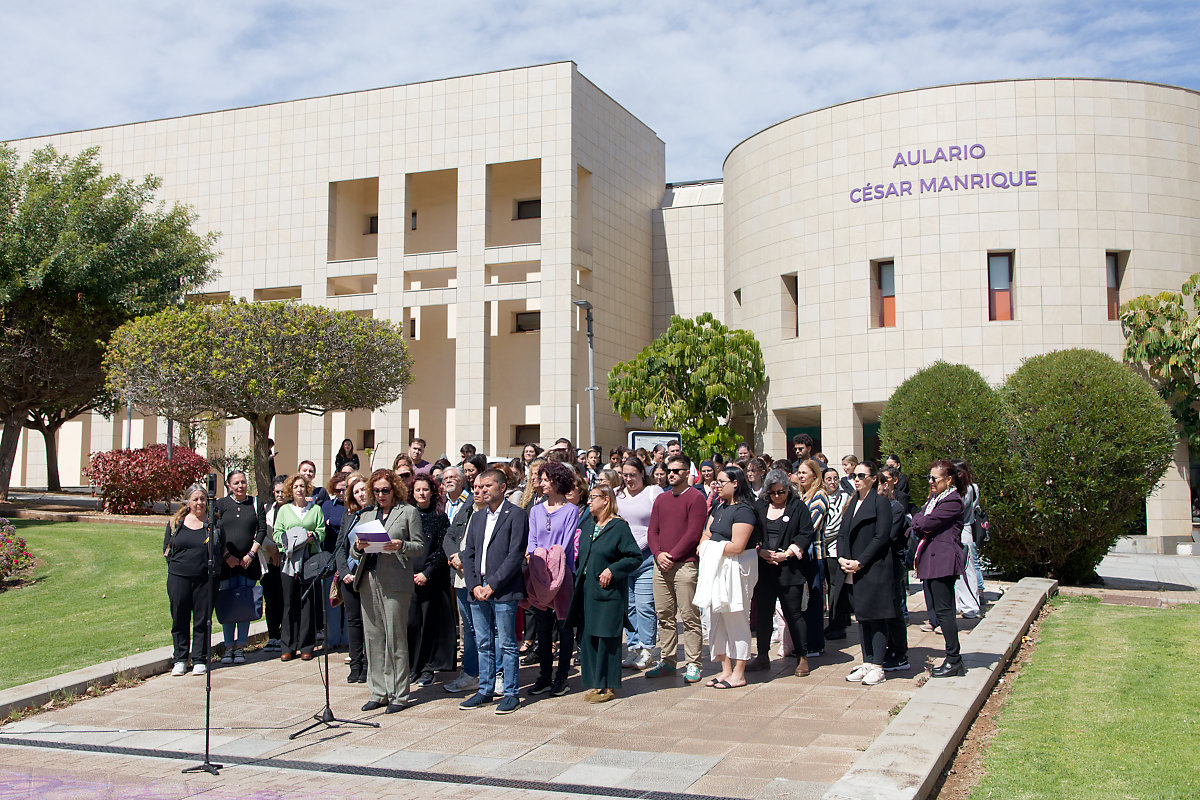
The University of La Laguna commemorated International Women's Day today, Wednesday, March 12, with an institutional event held on the Guajara Campus, consisting of a group drawing performance coordinated by the artist and professor of the Faculty of Fine Arts M. Lohrum, and the reading of the manifesto agreed upon by the Network of Gender Equality Units for University Excellence (RUIGEUThis commemoration was held today because the official date of this protest day, March 8, was last Saturday, a non-teaching day at the institution.
The Rector of the University of La Laguna, Francisco García, also spoke, highlighting the importance of holding such an event: “Diversity enriches, strengthens, and empowers, which is why we must champion it. And there is no better place to do so than the public university.” He lamented that certain seemingly indisputable social achievements are now in danger, and therefore encouraged everyone to maintain their fighting spirit so as not to take any steps backward. As an example of the importance the institution attaches to this commemoration, a wide-ranging program has been scheduled. program of activities which will last for two weeks.
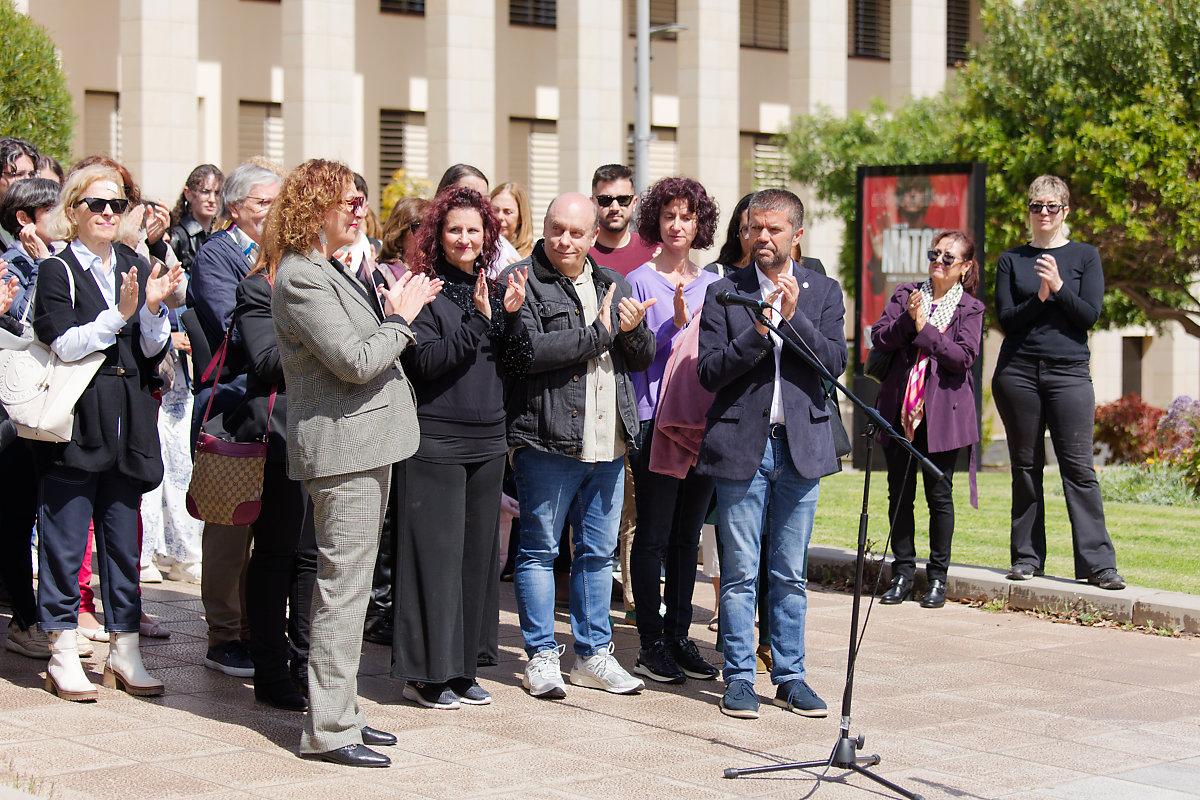
Applause at the end of the manifesto.
Carmen Marina Barreto, director of the institution's Gender Equality Unit, was in charge of reading the RUIGEU manifesto, The text, which has been endorsed by 55 Spanish universities, refers to the upcoming 2025 celebration of the 30th anniversary of the Beijing Declaration and Platform for Action, adopted in 1995 by 189 governments at the 4th World Conference on Women, which “remains the global benchmark for advancing women’s rights in all spheres: education, health, peace, media, economic and social empowerment, and the eradication of gender-based violence.”.
The manifesto also places universities at the forefront of this fight, demanding that they assume an active role in addressing the inequalities that manifest themselves in different areas and exacerbate situations of adversity, as figures demonstrate that armed conflict, climate change, and disability disproportionately affect women. “We demand that universities lead the change toward a more equitable future, ensuring that every woman has the same opportunities to reach her full potential.”.
The existing gender gap in STEM degrees is another issue addressed in this document, as is the recognition and visibility of women's academic and professional work. It also calls for the implementation of co-responsibility and work-life balance policies and "a genuine eradication of harassment and discrimination based on gender" in institutions, as well as the mainstreaming of a gender perspective in curricula.
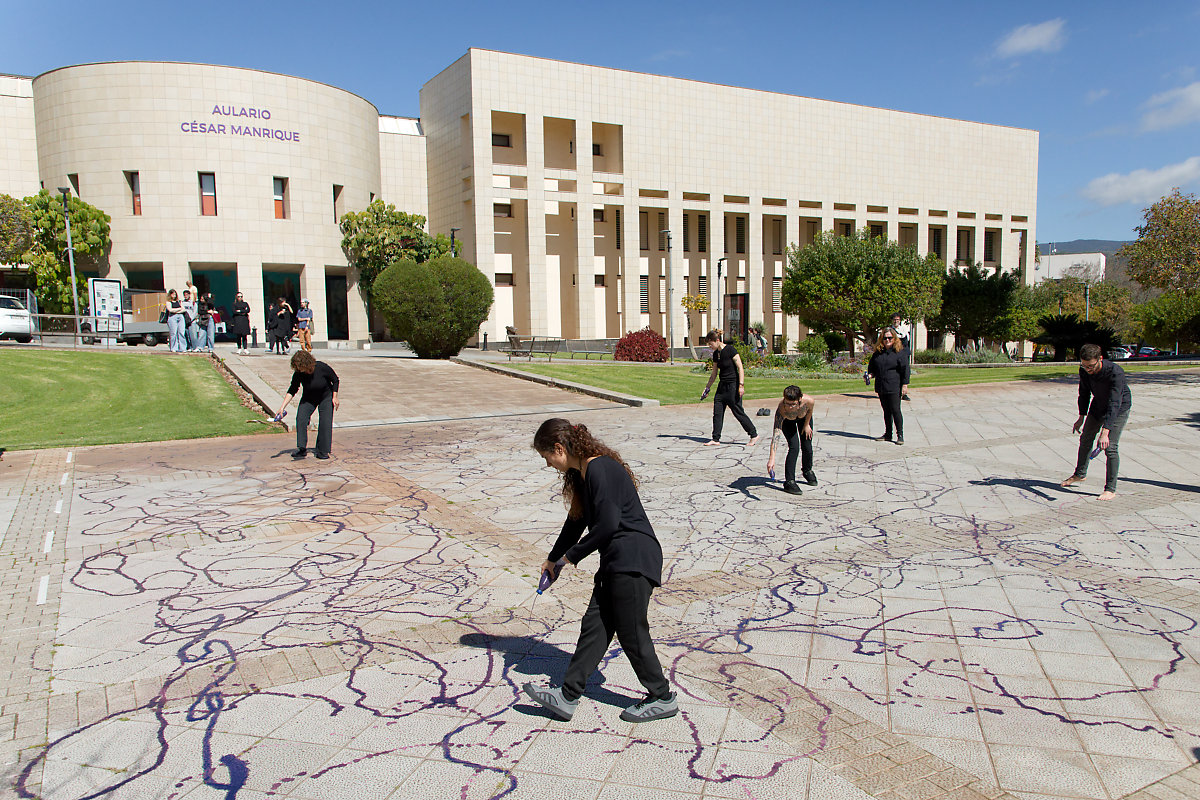 Female Rhythm
Prior to the reading of the manifesto, artist M. Lohrum, accompanied by about fifteen volunteers, coordinated an artistic performance that literally dyed a portion of the Guajara Campus pavement purple, the emblematic color of feminism. This ephemeral artwork, which was recorded on video, was made with cornstarch and food coloring to ensure the coloring was organic, easily washable, and non-polluting because, as the artist explained, feminism and environmentalism are two movements that, in her opinion, should go hand in hand.
For about fifteen minutes, the volunteers moved slowly and silently around the space, dripping thin streams of the pigmented liquid to create this tapestry of protest. The performers' movements were deliberate yet constant, a series of improvised dances generated by the very dynamics of the artwork's creation. As the artist explained, although she doesn't usually give precise instructions about movement in these kinds of actions, those who participate end up finding their own rhythm and synchronizing naturally.
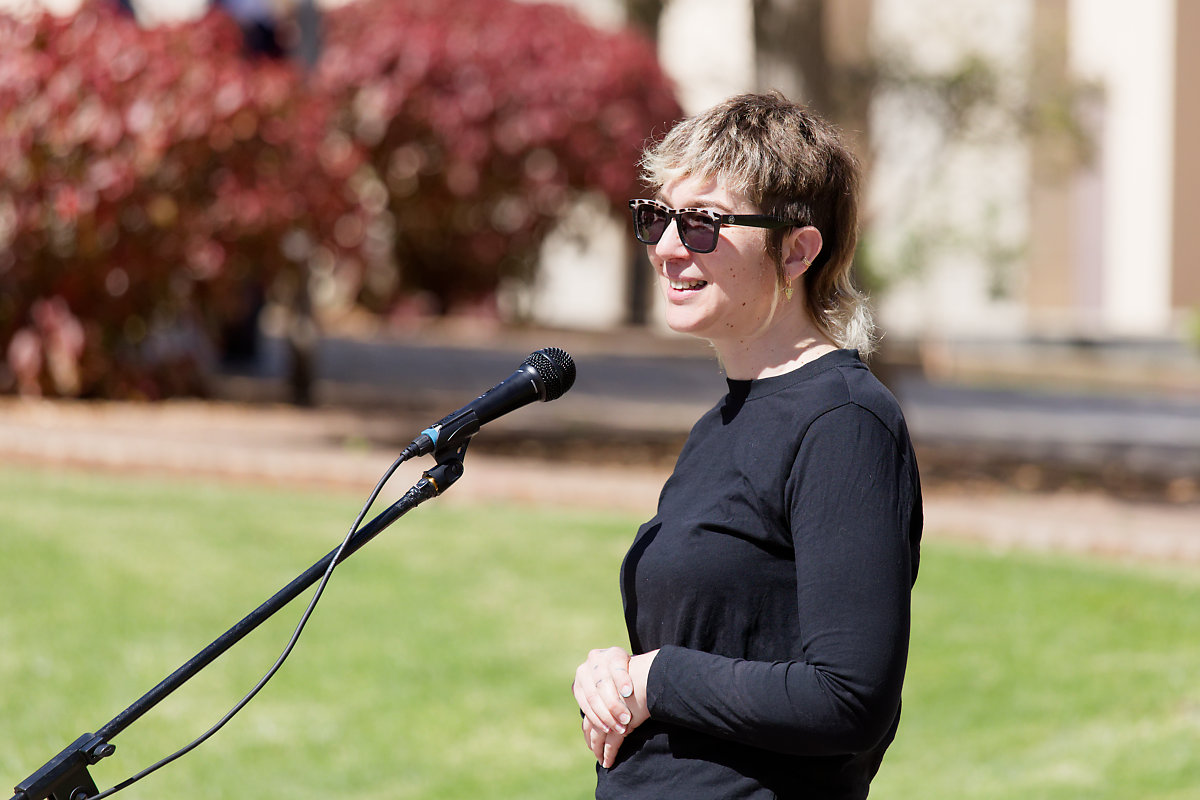
M. Lohrum.
The work was titled “Female Rhythm”, an allusion to Jackson Pollock’s famous painting “Autumn Rhythm”This performance was conceived precisely as a feminist commentary on the work of the American painter and, by extension, on the entire movement to which it belongs, Abstract Expressionism. M. Lohrum explains that this movement has been considered very masculine and patriarchal, as demonstrated by the fact that, of the 42 artists historically associated with it, only 2 were women.

 Spanish
 English
 French