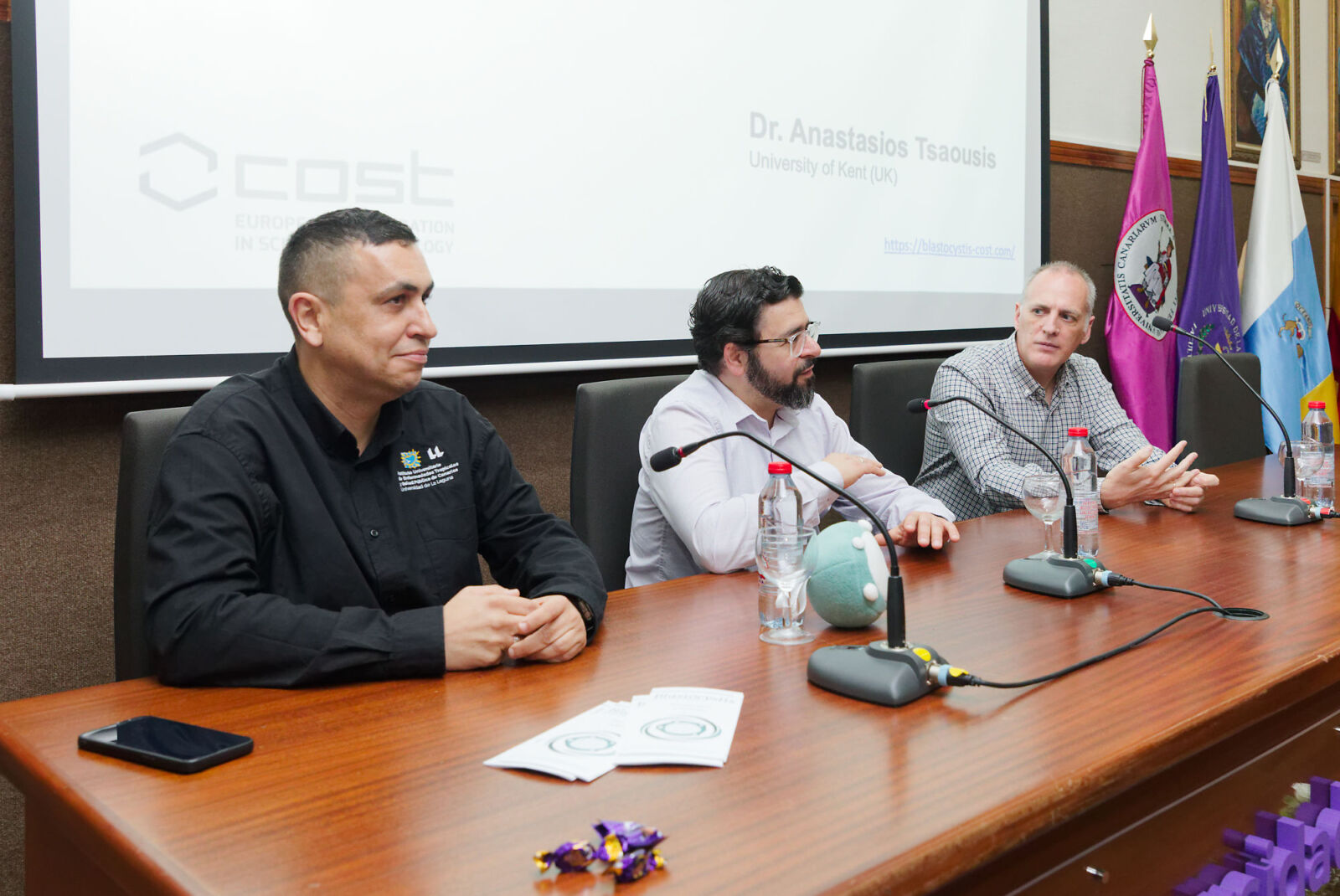
The first international workshop is being held on March 12th and 13th. Blastocystis at the University of La Laguna thanks to the support of the Vice-Rectorate for Research and Transfer and the European COST action Blastocystis under one health. This workshop has been organized by the Faculty of Pharmacy and the University Institute of Tropical Diseases and Public Health of the Canary Islands, both of this academic center.
This event was organized in two phases. On the first day, meetings were held with several members of the research institute, which is also part of the aforementioned COST action consortium, to foster future scientific collaborations. On the second day, a series of presentations related to [topic/topic] were given. Blastocystis and the COST action in the Pharmacy lecture hall with free access and which was attended by about fifty people.
The presentations, moderated by the director of the institute, Jacob Lorenzo Morales, and attended by the vice-dean, Alexis Oliva, presented general aspects of this pathogen in both the international and national spheres, thanks to the presence of Anastasios D. Tsaousis, from the University of Kent (United Kingdom) and principal investigator of the COST action, and David A. Carmena Jiménez, from the Carlos III Health Institute of Madrid.
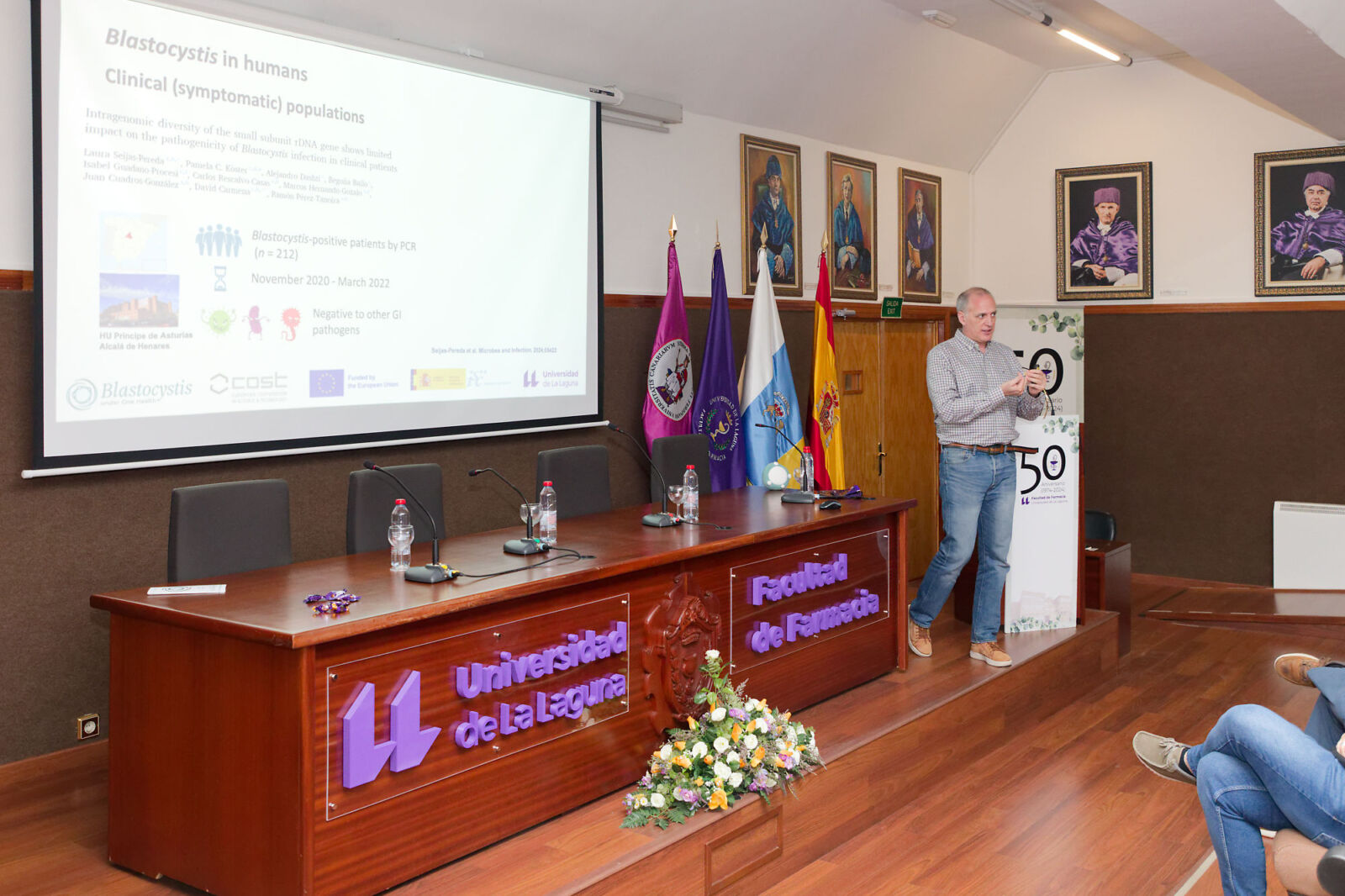 Blastocystis It colonizes at least one billion people, making it the most prevalent gut microbial eukaryote, while recent data indicate a higher prevalence in animals. The problem is that a large proportion of carriers are asymptomatic.
Despite numerous studies, the pathogenicity of Blastocystis It remains controversial. Currently, there are at least 26 genetic subtypes (STs). Of these, ST1-ST9 and ST12 have been found in humans, while the rest have been isolated only from non-human hosts. Furthermore, information on the prevalence, geographic distribution, and host specificity of STs is incomplete.
There are also significant gaps in our understanding of the environmental presence of this microorganism. Taken together, this scarcity of data considerably obscures the research landscape. The specific objectives of this meeting are therefore to continue supporting the advancement of research by bringing together professionals from diverse disciplines and countries, while also fostering the exchange of information on current methodologies, especially in the areas of subtyping, host-Blastocystis-microbiome interactions, and Blastocystis-omics.
Other objectives include promoting capacity building through a transdisciplinary international collaboration network and establishing communication channels with veterinarians, physicians, and the general public. Upon completion of this initiative, participants will be able to apply cutting-edge tools for the molecular identification of Blastocystis, harmonize methodologies for its subtyping, and identify its role within the gut. The aim is to view this microscopic, single-celled organism through the One Health approach, while simultaneously generating new hypotheses to test its role in the intestinal ecosystem, health, and disease. This workshop has successfully enhanced knowledge about this pathogen and fostered national and international collaborations for the University of La Laguna.

 Spanish
 English
 French