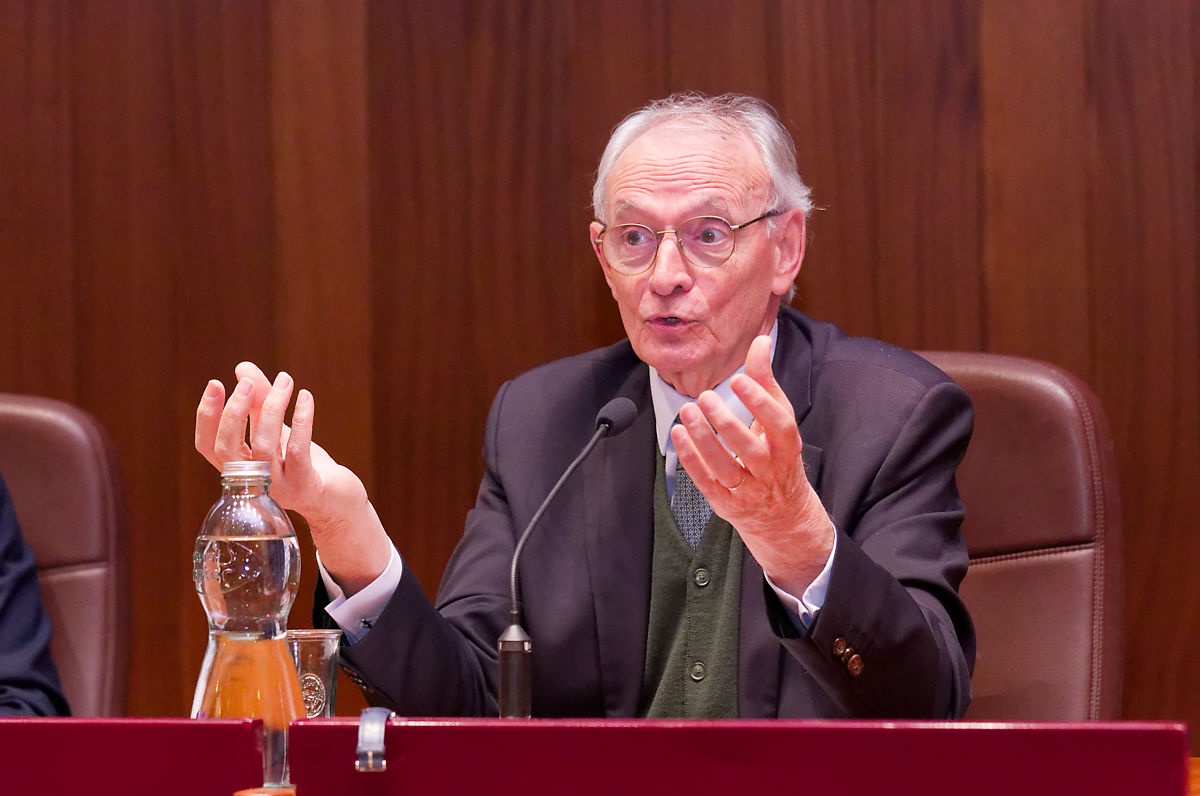
The president of the Economic and Social Council of Spain, Antón Costas, gave a lecture today, Friday, March 14, at the Faculty of Economics, Business and Tourism of the University of La Laguna, in which he offered his vision of the role that economics professionals should play in advising government bodies on their decision-making. While previously their role was to directly advise governments on what to do, now, in this new era of economics that began in the second decade of the century, it should be to "engage with society in order to achieve, through dialogue, negotiation, and consensus, policies that have broad public support.".
Costas was the guest speaker at the presentation of the book “The conflict between tourism expansion and sustainability: the case of LDC”, coordinated by the professor from the Department of Applied Economics and Quantitative Methods Flora Mª Díaz Pérez, Costas himself wrote the preface for the book. The event was also attended by the Rector of the University of La Laguna, Francisco García, and the Dean of the host faculty, José Adrián García Rojas.
The book explores the tension between the need for growth in the tourism sector in developing countries like Senegal, Nigeria, and Angola, and the need to maintain the environmental sustainability of the territories where this activity takes place—a situation that also applies to the Canary Islands. For Antón Costas, this is a perfect example of the kind of tensions that will characterize the economy of the next three or four decades: trade-offs, which he defined as “a conflict between two objectives that are desirable in themselves,” a type of dilemma that will occupy economic science in the immediate future.
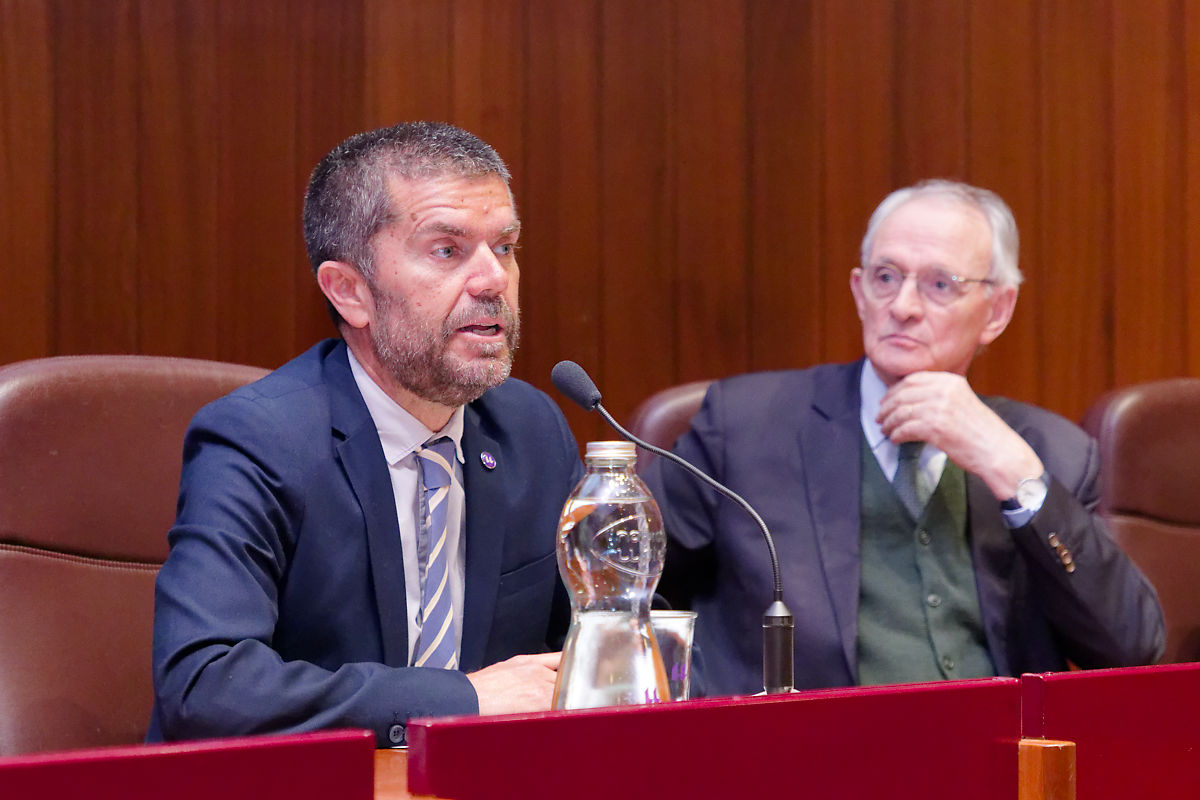 The economy of the last 40 years was called “neoliberalism,” and that of the three decades prior, “Keynesianism.” Faced with the question of how to describe the new trade-off economy that will characterize the next thirty years, Costas referred to the term coined by economist Dani Rodrik, “productivism,” because it will be an era focused on facilitating productivity for people in economies so they can obtain material goods.
The speaker reflected that previously, economics faculties taught techniques for maximizing an economic objective, such as GDP., Because that was the paradigm of that time: to investigate the given and known preferences of the population and develop a function that maximizes them and, with that analysis, recommend fiscal, labor and trade policies.
“This type of economy has been a disaster, because the increase in inequality is spectacular,” Costas stated. During that period of maximization, the desirable goal was thought to be enabling people to consume cheaper goods and services. And it was achieved, at the cost of deindustrializing countries and relocating production to China and other countries. “But what if those weren't the priorities of many people? What if their goal was to have good jobs and provide opportunities for their children? If so, we economists have failed.”.
The inequality created by deindustrialization and the offshoring of the economy during those years of neoliberalism destroyed quality jobs and eroded families' purchasing power, and this has had political consequences. He cited two studies demonstrating that Trump's victory in 2016 and Brexit can be explained by the fact that both options received more votes precisely in those counties and cities where quality jobs had been lost over the previous twenty years due to this process. Therefore, reversing inequality is essential not only for the economy but also to mitigate political instability and prevent autocracies that offer easy solutions with the well-known undesirable effects.
In this new economic era, sustainability is becoming a factor that economists must consider, something that wasn't the case in the previous period, which focused solely on maximizing resources. Therefore, the challenge for new professionals in this field will be to practice a new type of governance based on finding a balance between factors that may be contradictory but equally desirable. For example, the development and preservation of natural resources. “We can no longer choose one while neglecting the other. In universities, we must begin to abandon certain techniques like cost-benefit analysis, which worked very well for previous economic stages but not for the new one.”.
Thus, the new role of economists will no longer be to go to governments as experts and tell them what to do. “Now we have to speak to society so that it has good information about these types of conflicts and support pragmatic policies that are able to balance costs and benefits and do not propose hasty and populist solutions.”.
Despite the current context seeming bleak, Costas chose to take an optimistic view, going so far as to say that Trump's arrival is "a blessing for the European Union," as it has spurred it to react and undertake necessary changes that it had previously been hesitant to implement. He cited as an example the fact that the new German chancellor has already announced a constitutional amendment to allow for larger deficits and thus enable the country to incur greater debt to finance major investments, amounting to no less than 500 billion euros—something that would have been unthinkable in Germany just a few years ago.
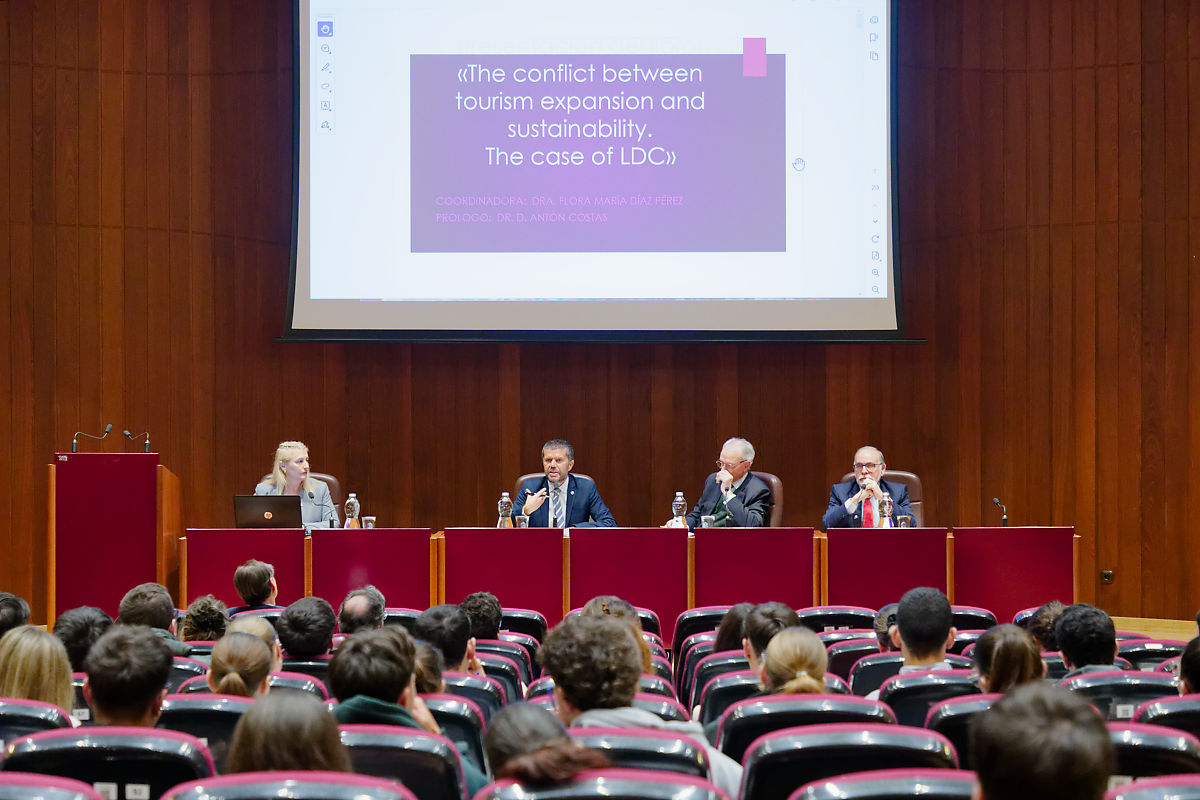 The speaker also took the opportunity to explain the body he chairs, the Economic and Social Council of Spain. This type of organization emerged in Northern European countries after the Second World War and was adopted in Spain in 1988, as a reaction to the general strike called during Felipe González's term. Currently, it is composed of 60 members in addition to the president, of whom one-third represent trade unions, another third represent large employers' and business associations, and the final third represent other organizations from productive sectors such as agriculture, fishing, livestock farming, and social economy entities. Its role is to issue opinions on the legislation that each government will approve and, thus, to understand the position of these sectors.
Regarding the book presented today, in addition to Flora Díaz, its coordinator, it has two other researchers from the University of La Laguna as co-authors, Carlos Gustavo García González y Miguel Ángel Mejías Vera, as well as Manuel Francisco Bandeira, from the Instituto Superior Politécnico do Moxico (Angola) and Hugo Pinto, from the University of Algarve (Portugal). Published by Aula Magna, the work explores the sometimes contradictory, but potentially complementary, balances between the objectives of expanding tourism production and sustaining destinations in the context of Least Developed Countries (LDCs).

 Spanish
 English
 French