
The Government of the Canary Islands has recently published the “Manual for the Promotion of Mental Health, Resilience, and Prevention of Suicidal Behavior,” aimed at social and healthcare mediators and developed by the Canary Islands Health Service in collaboration with several organizations, including the University of La Laguna. The document was presented today, Tuesday, March 25, during a few days held in the auditorium of the Faculty of Social Sciences and Communication, which had a notable attendance of mental health professionals interested in updating their knowledge about the care of people at risk of falling into suicidal behaviors.
The Rector of the University of La Laguna, Francisco García, inaugurated these “Conferences on the Promotion of Mental Health, Resilience, and Prevention of Suicidal Behavior,” noting that suicide is a multidimensional problem influenced by social factors such as economic inequality. He emphasized that public universities can be very useful in addressing this issue, contributing both research expertise and direct assistance, thanks to the Psychological and Speech Therapy Services Unit with which the teaching and research center has been equipped, whose director, the professor of Psychology Wenceslao Peñate, He was one of the speakers at this forum.
García recalled reading a nationwide report two years ago that revealed one in five young people had considered suicide, a statistic he found “unbearable” at the time. Therefore, he felt it was crucial to understand the problem in order to address it, and in that regard, he congratulated the Regional Ministry of Health for its work on the issue. He also mentioned a recent meeting with the Student Council, He was surprised that its members spoke “without taboos” about mental health, with a clarity that probably did not exist in previous generations, which gave him hope for the possibilities of improvement of this multifaceted problem.
The Minister of Health of the Government of the Canary Islands, Esther Monzón, was also present at the opening of the conference and recalled that the World Health Organization considers suicide a major public health problem, which is why her department has opted to address it in a multidisciplinary way and seeking the involvement of all the necessary institutions, since suicide has many social triggers, such as discrimination for different reasons, loneliness and poverty, among others.
She explained that, in collaboration with the island councils and the Canary Islands School of Health and Social Services, she has implemented a training program to provide citizens with tools for suicide prevention, given that early detection is key and, therefore, this has become one of the basic strategic priorities of her department. Furthermore, in collaboration with the Departments of Education and Social Welfare, a specific program for schools has been launched, in addition to the manual for social and healthcare mediators that was presented today during the conference.
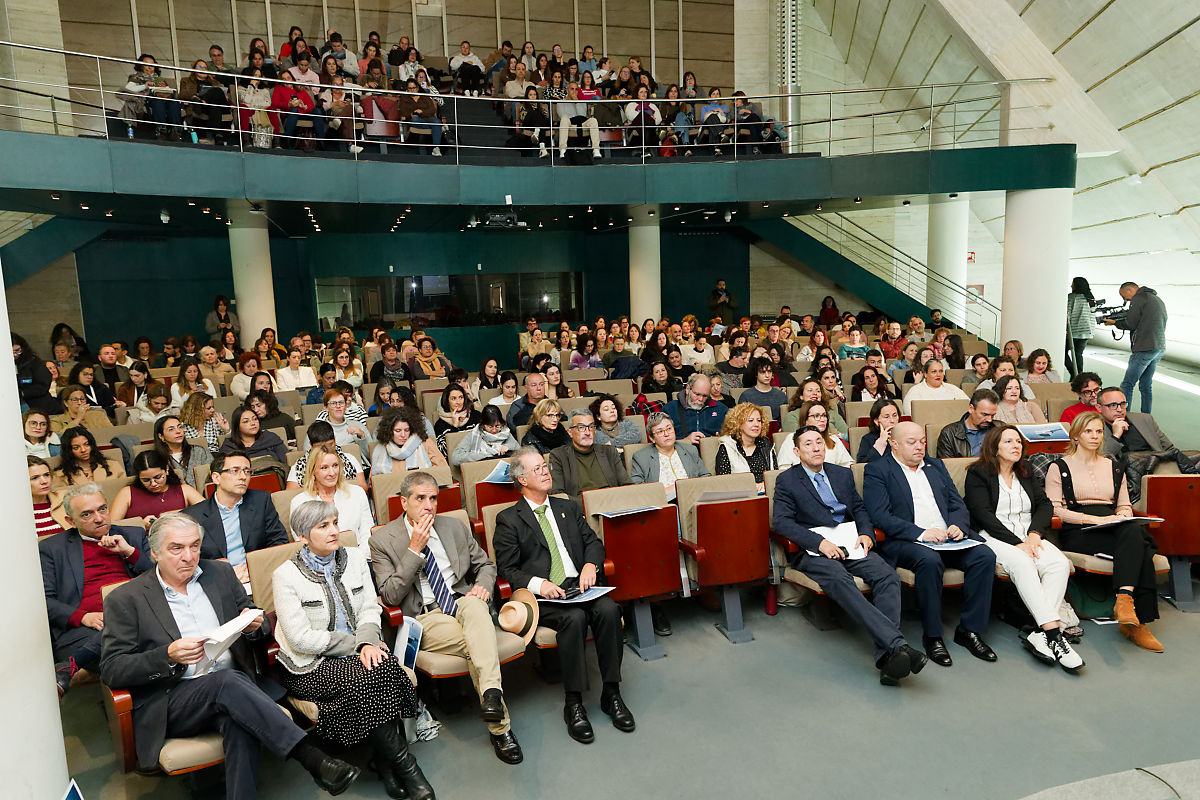
A glimpse of the audience attending this event.
The conference featured presentations by researchers from the Faculty of Psychology at the University of La Laguna and professionals from the Canary Islands Health Service and various departments of the Canary Islands Government. Among other topics, the conference addressed warning signs of suicidal behavior, the role of family and friends in this problem, existing prevention programs, and the promotion of mental health among the Canary Islands population.
Prevention Manual
José Díaz-Flores, Director General of Public Health for the Canary Islands Government, presented the “Manual for the Promotion of Mental Health, Resilience, and Prevention of Suicidal Behavior.” This manual is part of a series of materials and protocols that his department has been disseminating to various groups, including the one presented today for social and healthcare mediators. He explained that the document has two fundamental objectives: to establish that mental health problems and suicidal behavior are not only healthcare issues but also social and healthcare issues, and therefore involve institutions beyond those directly related to health; and to promote training and skills development so that social mediators can better serve the population.
This 300-page manual is available on the regional government's website and is divided into thirteen sections covering theoretical content, practical workshops, and assessment. Among other topics, it addresses myths surrounding suicidal behavior; everything related to feelings, social skills, and strategies for preventing such behavior; and, in general, provides a range of tools for working with this population. Although designed for young people, the manual is also applicable to other age groups and was developed by health promotion and disease prevention specialists from both the Government of the Canary Islands and the University of La Laguna.
Regarding warning signs of suicide, Díaz-Flores explained that they involve abnormal behaviors and actions, such as suddenly saying goodbye, giving an inappropriate gift due to its high value, spontaneous and excessive alcohol and drug use, and disappearing from social and family circles. “Normally, suicidal people are not impulsive, although it is true that anger, impulsiveness, and frustration can influence and lead a person to this behavior.”.
Professor Wenceslao Peñate also participated in the conference with a presentation on promoting mental health and preventing suicidal behavior. In it, he discussed the theoretical and conceptual foundation of the presented manual, offering a “positive view of mental health that addresses not only the negative symptoms that make people vulnerable to suicide, but also the positive symptoms that protect against it. This approach focuses on two distinct areas: reducing risk and increasing protection.”.
Regarding indicators that could be considered warning signs of potential suicidal behavior, the protocol identifies three levels: vulnerability factors related to psychological, socioeconomic, and familial characteristics; precipitating factors, which are highly unpleasant events within the context; and warning signs, both behavioral and verbal. All of this is included in the protocol so that those responsible for its application can identify these three elements.
The positive aspect, as Peñate explains, is that suicidal behavior can be reversed through treatment. “Fortunately, suicidal ideation, planning, and the actual suicide attempt are two different things; when we address the ideation and planning effectively, we can correct suicidal behavior.”.

 Spanish
 English
 French