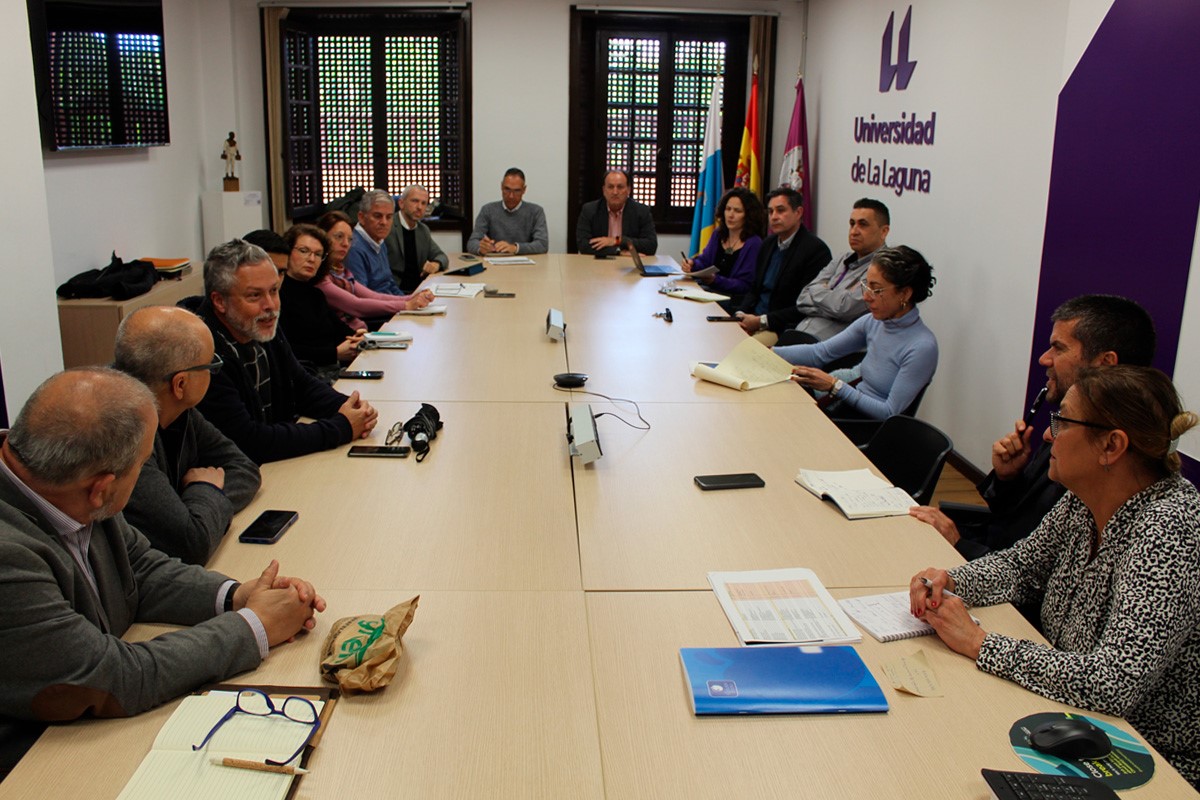
The Rector's Office of the University of La Laguna held a meeting yesterday, March 25th, with some thirty stakeholders to begin the collaborative development of a Canary Islands-Africa cooperation plan, one of the areas encompassed by the Canary Islands-Africa Strategy proposed by the regional government. The two public universities in the Canary Islands have extensive experience in research and knowledge transfer projects, training, development cooperation, and innovation and entrepreneurship with that part of the neighboring continent. They will be responsible for structuring this content with the aim of presenting it to European institutions as a joint document in 2026.
This meeting, held yesterday and continuing today at the University of Las Palmas de Gran Canaria, aims to share the experience and interests of public and private entities in the province of Santa Cruz de Tenerife, given the geostrategic importance of this archipelago, which has also become a hub for business and has important links with the African continent.
At the 2022 European Union-African Union Summit, common goals were established for 2030, entailing substantial investment in the African continent to improve its overall well-being in the areas of health, sustainable growth, decent job creation, and the green transition. Spain has already presented three editions of its Africa Plan (2006, 2009, and 2019), but significant disparities persist in the growth and development of these countries so close to our own—areas in which numerous Canary Island organizations can make important contributions.
The lack of political and economic integration, insufficient access to financing, deficient communications and electrical infrastructure, structural imbalances, gender discrimination, limited access to research and digitization, and institutional fragility are some of the burdens that are felt on the continent.
At the session held at the University of La Laguna, the thirty participating public and private institutions expressed interest in joining this collective effort to improve conditions in West Africa. This proposal extends to other organizations that were unable to attend this initial meeting and that will also participate in developing this initiative, coordinated by two universities in the Canary Islands.
The University of La Laguna carries out regular activities that are already consolidated in this area, such as the editions of the CampusÁfrica reflection and thought event, the participation of both in the consortium with Andalusian universities and Casa África called LiderÁfrica, the collaboration projects carried out together with the Cabildo of Tenerife – Cooperar Cooperando – for the realization of internships in international cooperation projects.
Furthermore, participation in research projects with institutions in Cape Verde, Senegal, Mali, Mauritania, and Gambia is also highly relevant. This participation is facilitated through research groups at this university and research institutes such as the Institute of Tropical Diseases and Public Health of the Canary Islands, the Antonio González Institute of Bio-Organic Medicine, and the Canary Islands Foundation for the Control of Tropical Diseases. Additionally, several laboratories at this institution train future PhD students who will return to their African countries of origin to lead research teams and contribute to a greater understanding of the region.
Topics such as the development of equality policies, the reduction of microplastics, the eradication of highly contagious parasites in young people, and the detection of counterfeit medicines are just some of the ongoing lines of cooperation between this university and its counterparts in West Africa. Furthermore, through the INTERREG-MAC initiative, the University of La Laguna is currently participating in twelve projects, leveraging strengths such as the promotion of the blue economy through aquaculture, smart specialization of the industrial water cycle, microclimate management, cross-border open innovation, and strategic renewable energies, among others. Representatives from all these projects participated in the meeting held at the Rectorate.
International Academic Hub
The purpose of this initiative is to create an International Academic Hub with Africa, which would allow the Canary Islands to be a benchmark under the commitment of its training and research centers, government institutions, non-governmental organizations and business sector.
There would be four areas of action: environment (water and energy, urban management and planning, climate change, mobility), health (medicine, nursing, veterinary medicine, tropical diseases, care and local health systems), social (equality, integration, education, migration, culture, multilingualism and art) and economic (primary systems, sustainable tourism, circular economy and logistics).

 Spanish
 English
 French