
The Cajasiete Chair of Social and Cooperative Economy The University of La Laguna has celebrated its seventh anniversary this week, taking stock of a dynamic activity that, committed to the development and promotion of this type of economic activity, has resulted in 70 seminars held over these years in which more than 2,500 people have participated, not forgetting the 264 companies that have collaborated in more than 200 activities held since 2018.
The anniversary event was presided over by the rector of the University of La Laguna, Francisco García Rodríguez; and included at the head table the dean of the Faculty of Economics, Business and Tourism, José Adrián García Rojas; the president of Cajasiete, Fernando Berge; and the director of the chair, the professor from the Department of Business Management and Economic History Candido Román Cervantes.
During the ceremony, the rector recalled his presence at the establishment of this chair, as he was then Vice-Rector for Relations with Society, with responsibilities in employability and entrepreneurship. “This chair is a benchmark in the Canary Islands, a well-established project focused on the social and cooperative economy, carrying out activities in Tenerife and Gran Canaria. Among its most notable achievements is the Diploma of Expertise in the Management of Social and Solidarity Economy Entities,” he remarked.
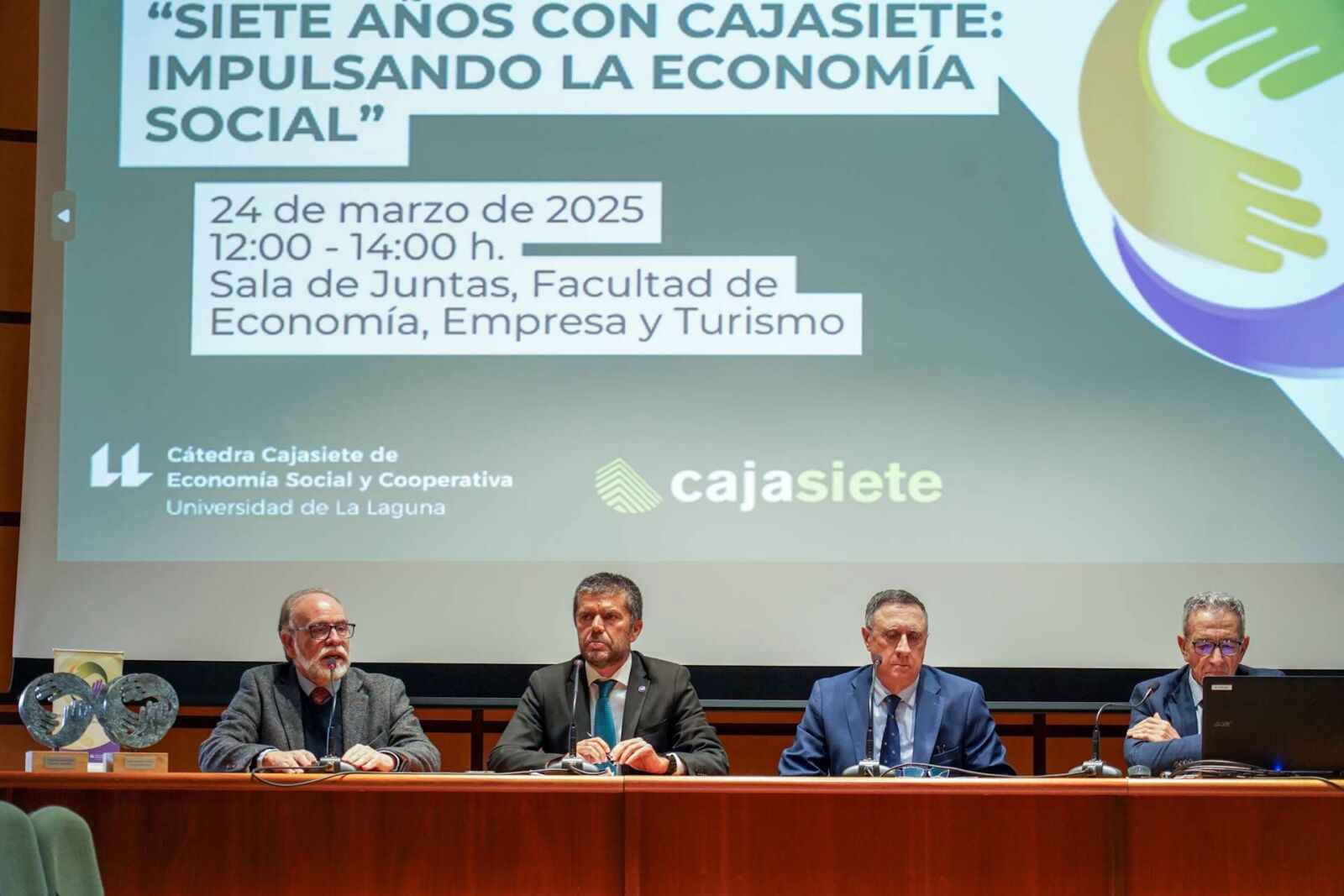
José Adrián García, Francisco García, Fernando Berge and Cándido Román.
The chair's director emphasized in his address that while it began seven years ago with a regional focus, it has become an autonomous entity and is expected to expand its scope in the future. Currently, its governing board comprises staff from both public universities in the Canary Islands, whose work centers on research, training, and outreach. "Since its inception, we have worked to strengthen the social and cooperative economy ecosystem, promoting research, training, and outreach initiatives that have broadened knowledge and awareness of the importance of this economic model for the archipelago," Román highlighted.
For his part, the president of Cajasiete emphasized that thanks to this professorship, the cooperative model has been raised in the Canary Islands and numerous scientific publications on the social economy have been produced. “It is important to highlight the value of the cooperative model and demonstrate not only that it works but also that these companies generate quality employment linked to sustainability,” Berge commented.
To conclude the meeting, the rector presented awards to entities for their involvement with the chair and the social economy in the Canary Islands to Fernando Berge, president of Cajasiete; Ricardo Torres, manager of SAT Fast; Estefanía Hernández Ramos, president of the Nuestra Señora de África 'La Recova' Market; and Víctor Quintana Hernández, general manager of Global 8- Viajeros.

 Spanish
 English
 French