
He Social Council The governing body of the University of La Laguna held an ordinary session today, March 27, in which several procedural matters were approved. One of these was the referendum on the liquidation report of this governing body with respect to 2024, approved by its plenary session, which was initially set at 731,000 euros.
This amount includes a contribution of €450,000 from the regional government, with the remainder coming from the academic institution. It is the same budget as in 2023, with no changes and a high degree of implementation.
This morning's session also included a presentation on the cultural activities carried out by the Alumni Association during the past year, in accordance with the agreement this organization has with the Social Council. In other business, following the renewal of the University's Governing Council, the members of this body were also announced today.
STARS EU
In the section on the rector's report, Francisco García announced that regarding the multi-year financing plan, there is already a first basic document to start working on, presented by the regional executive, and on which the two universities will make contributions.
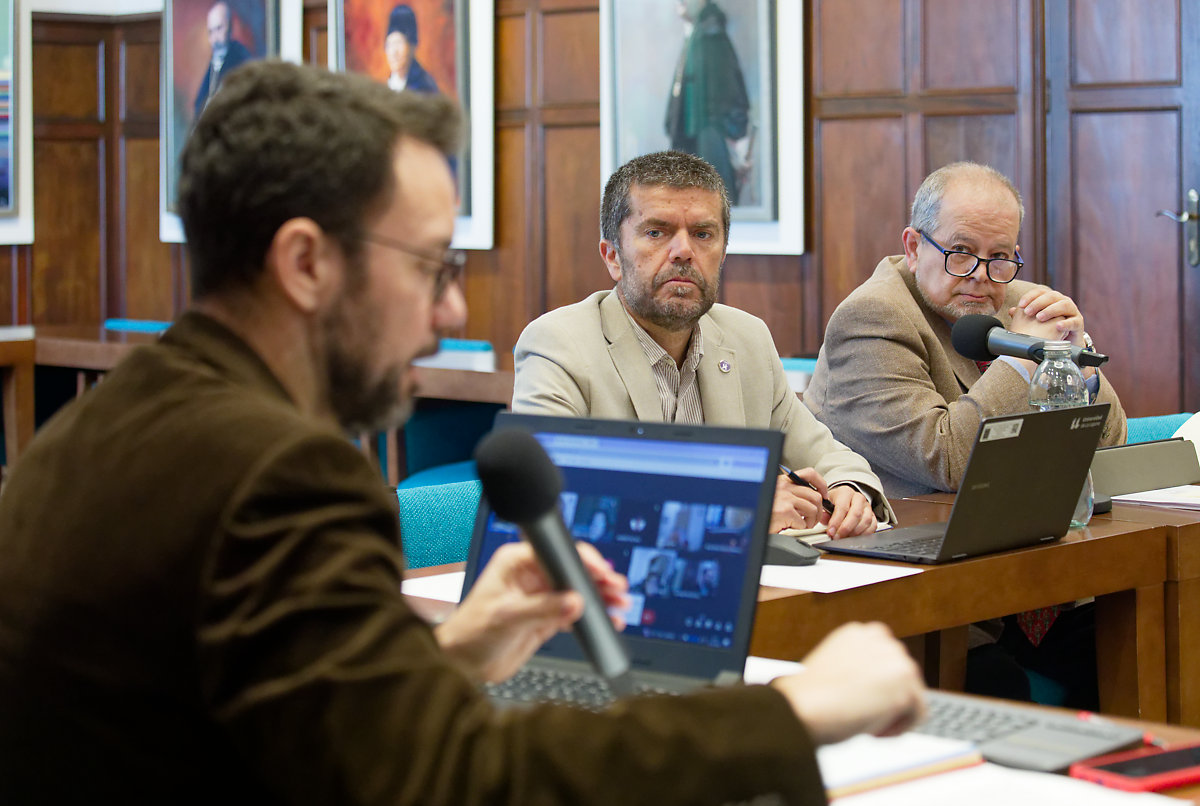
The secretary of the body takes the floor, under the gaze of the rector of the ULL and the president of the Social Council.
He also mentioned the cooperation plan that both universities are developing to present to European bodies regarding cooperation with West Africa. He maintained that this is an opportunity for both institutions, which they intend to seize to contribute their expertise and knowledge, given that they lead research teams and collaborative initiatives with universities and centers in that region of the continent.
The rector went on to explain in detail the recent meeting held in Albania of the European alliance STARS EU, This academic center participates in and leads several working groups of this network. It was noted that a joint virtual campus is being established within the network, and efforts are underway to offer three shared university degrees. The alliance comprises nine regional universities of similar size and significant regional impact, which aligns their strengths and allows for strategic coordination.
On this same subject, the director of the secretariat of the Vice-Rector for Internationalization and Cooperation, José Sigut, was invited to the session, who pointed out that after the expansion of the Erasmus+ mobility program and the establishment of the so-called Bologna Plan, the call for European Universities is the third major step by the Union to create a large common space in higher education.
He highlighted that there are 65 European alliances across the continent, involving 570 universities. In Spain, a working group has been established to address this issue, and we are the third country with the most alliances, with a total of 56 universities participating. Furthermore, 13 of these alliances are led by Spanish institutions.
STARS EU comprises diverse centers forming a community of 150,000 students and 70 faculties. Its priority areas are the green transition, digital transformation, and social values and well-being. The president of the governing body, Francisco Almeida, strongly supported this initiative to join this European structure, which is key to the university's internationalization.
Almeida also reported on recent meetings with various stakeholders in the production and institutional sectors, focusing particularly on the support provided to research groups and seeking to resolve bureaucratic funding issues with regional structures. He announced that the next session of the Social Council will be held in Fuerteventura, providing an opportunity to establish contacts with the island's institutions.

 Spanish
 English
 French