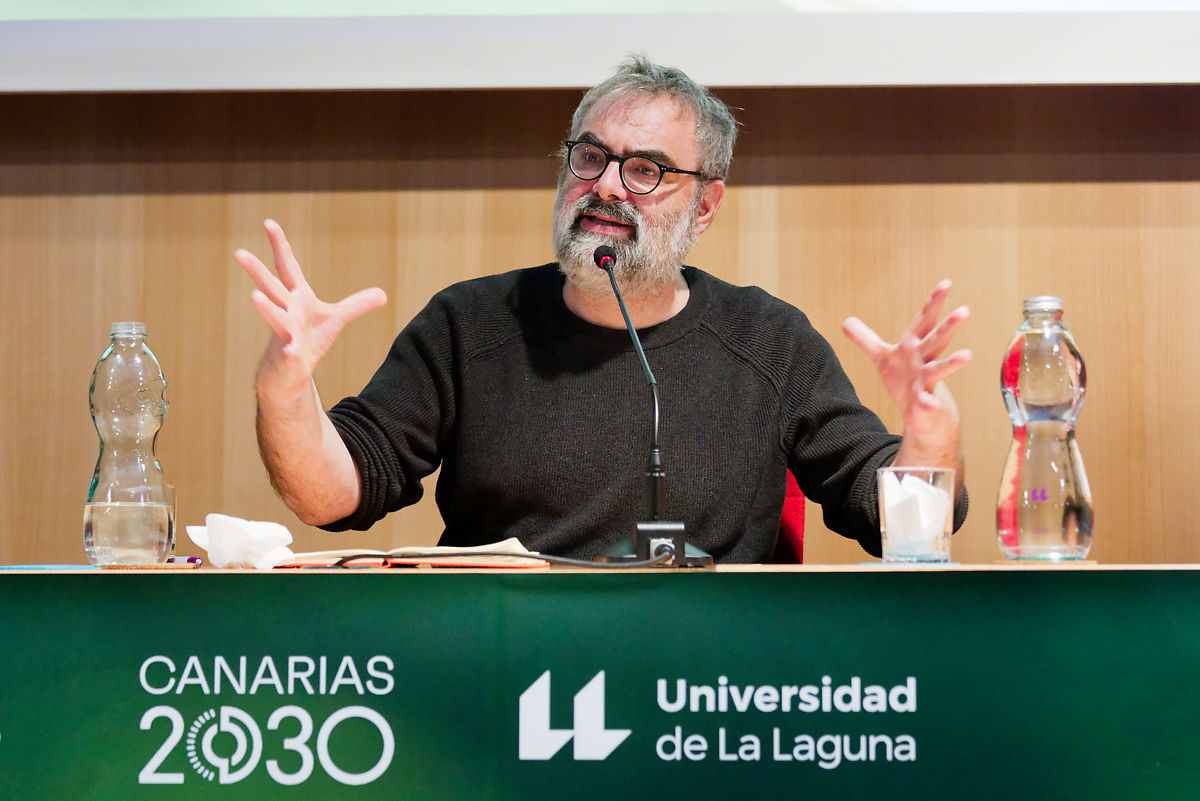
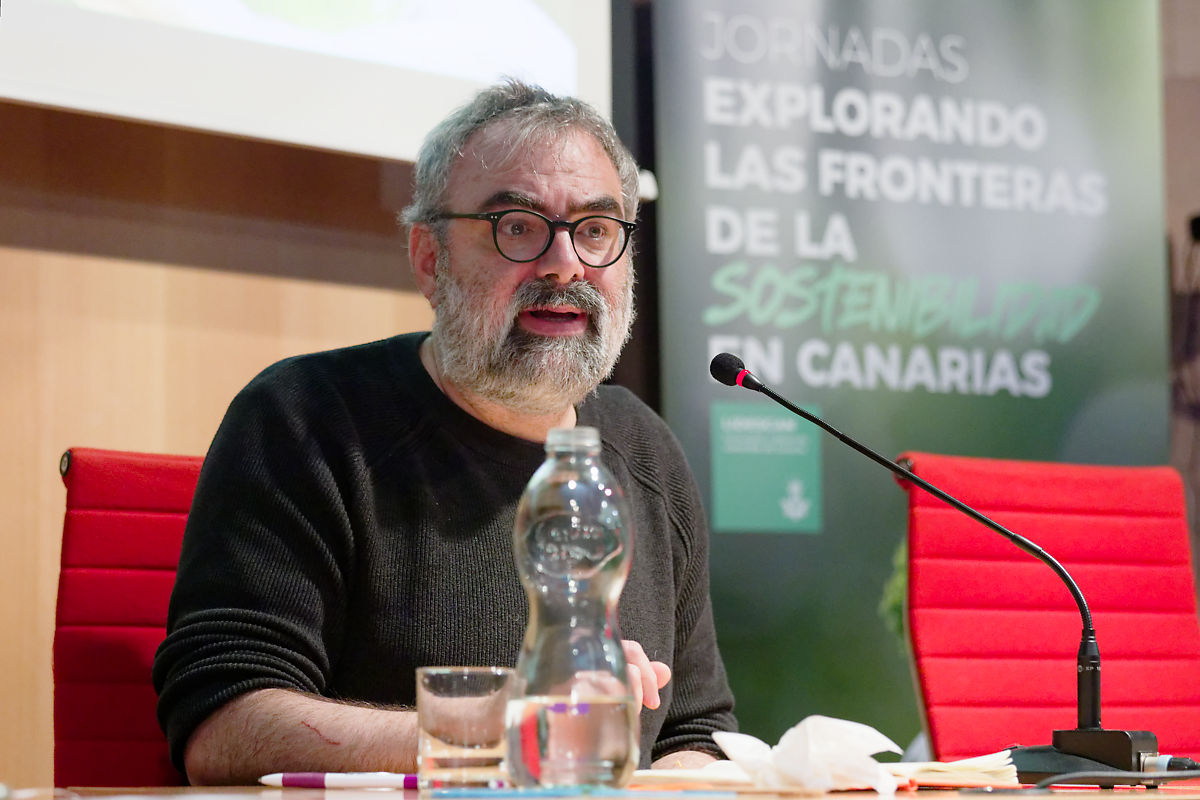
The thinker and activist Amador Fernández Savater He participated today, March 28th, at the University of La Laguna as the closing speaker of the conference. Exploring the frontiers of sustainability, The lectures were organized by the two public higher education institutions through the Lidescan project. The author also spoke about the three collapses occurring today at the individual, social, and terrestrial levels, and the three ecologies that should exist for each.
Experts in ecology, urban planning, demography, economics, renewable energy, and architecture have offered their vision over these two days regarding new opportunities to delve deeper into the concept of sustainability from a more holistic and committed perspective, taking into account all the factors that influence our lifestyle and growth model.
“Philosophy isn’t a recipe for anything, but it can help us think about things differently, from another perspective,” Fernández Savater pointed out at the beginning of his presentation. He advocated examining what isn’t working, what doesn’t fit, based on three symptoms: the first is personal, because mental health problems and panic attacks among young people are evident. The second relates to the social sphere, because institutions and community structures are overwhelmed, while the third symptom affects the Earth itself, through climate change and the destruction of ecosystems.
On an individual, social, and planetary level, it is clear that the symptoms are related to the phenomenon of saturation, of spiraling out of control, to the feeling that we can no longer bear it. This overflow is threatening a consequent collapse, because a panic attack can be followed by depression; in the case of the social body, it would lead to the breakdown of social bonds; and with regard to the collective, nature, the very survival of the planet would be at stake.
Behind these three collapses, each with its own distinct facet, lies a single underlying principle: performance. Bodies must be productive, social relationships are strained, and the planet itself is also affected. "We have internalized the mandate of productivity, and if we don't meet it, we feel like failures." Thus, general competitiveness has become the dominant form of interaction with others, he acknowledged.
In his opinion, the rise of the far right is related to this principle of performance taken to its extreme. “It’s about not seeing the symptom; it’s an authoritarian reinforcement of the performance principle as the principle of reality, because that’s not going to be touched, no matter who gets hurt,” Fernández Savater explained. “The problem is that critical discourse doesn’t take root, it isn’t incorporated as a way of life. Therefore, neither criticism nor narratives are imposed as an alternative for transformation,” he indicated, suggesting that they have no impact on the far right. “We don’t need new narratives, but new experiences, to develop a taste for other things that lead us to a different relationship with ourselves and with others.”.
 Three ecologies
If there are three collapses, we need three ecologies: the ecology of ourselves, the ecology of our relationships with others, and the ecology of caring for the planet. We must consider them together, intertwined. “Sensitivity is a political battleground; that is, degrowth is mere rhetoric if there is no genuine desire to degrow.”.
The writer wondered how to change desire, which constitutes a major challenge. It's about desire as a driving force, as the impetus of life. That's why he asserted that politics must touch people's desires. "Politics must incorporate the artistic, the aesthetic, and the therapeutic.".
For Fernández Savater, what capitalism does is "block the imagination," leaving no channel open. "There is no room for discovery, because we are already told from the outside what we have to be and what we have to desire. There has to be a void and a waiting, and it is there that we can create," contrasting it with the objects, technologies, and immediate answers that the market constantly offers.

 Spanish
 English
 French