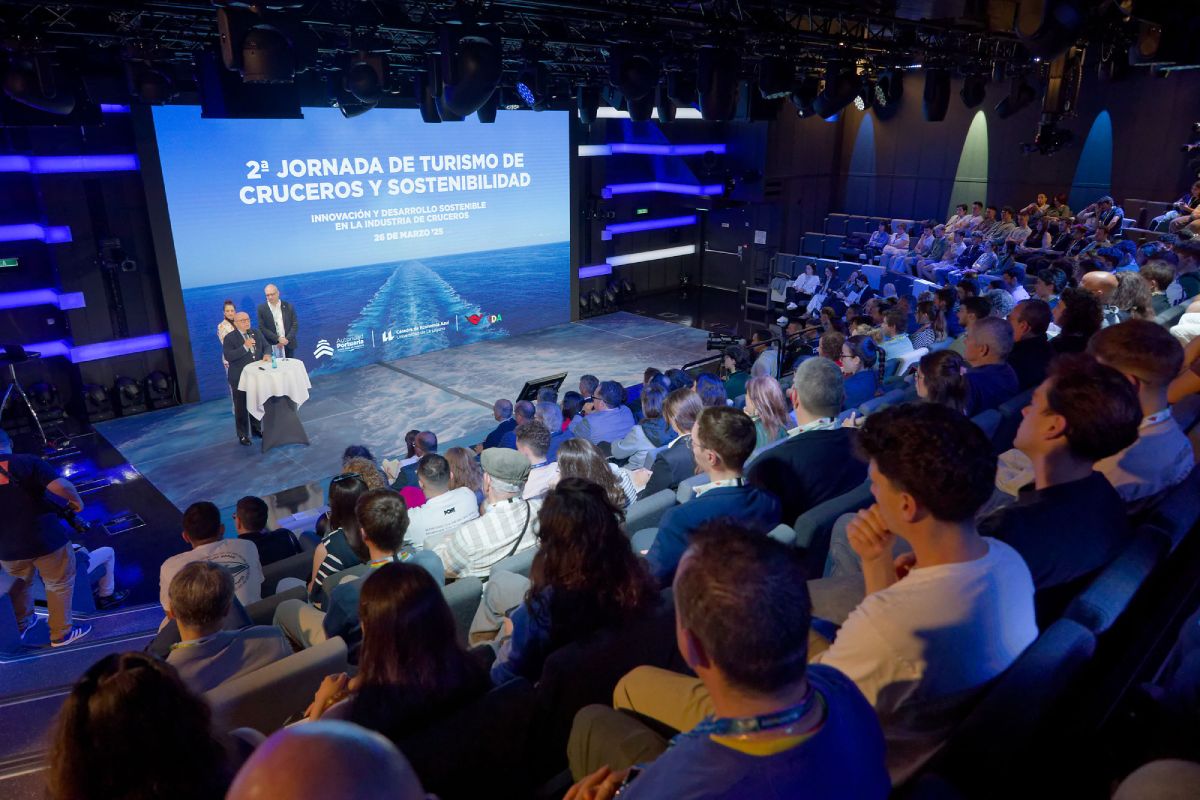
Circular and regenerative thinking, environmental impact reduction protocols and technologies, and legislation for the use of renewable fuels and achieving carbon neutrality in maritime transport shaped the “2nd Cruise Tourism and Sustainability Conference,” held yesterday, Thursday, March 27, in the port of Santa Cruz de Tenerife. The event served as a forum for dissemination and discussion surrounding the industry. Organized by the Blue Economy Chair of the University of La Laguna and the Santa Cruz de Tenerife Port Authority, the conference took place aboard the AIDAcosma cruise ship, one of the first to operate exclusively on liquefied natural gas (LNG) and a regular customer of the Tenerife port, where it receives weekly refueling.
Based on the requirements imposed by the European Union regarding CO₂ emissions and other polluting gases, in force from January 1, 2030 for cruise ships, the content of the day was oriented by the participating professionals towards the mandatory adoption of protocols and advanced technologies to reduce the environmental impact.
In their opening remarks, the president of the Port Authority of Tenerife, Pedro Suárez; the Vice-Rector for Culture and University Extension at the University of La Laguna; and Carlos Mora, director of the Blue Economy Chair, all agreed on the importance of initiatives already underway in the port of Santa Cruz de Tenerife, such as the supply of electricity to passenger ships and LNG to the AIDAnova cruise ship, the first of its kind in the world, which contributes to the protection of our delicate ecosystem. León expressed her satisfaction that this event fosters “the union of science, industry, innovation, and society for the same purpose.”.
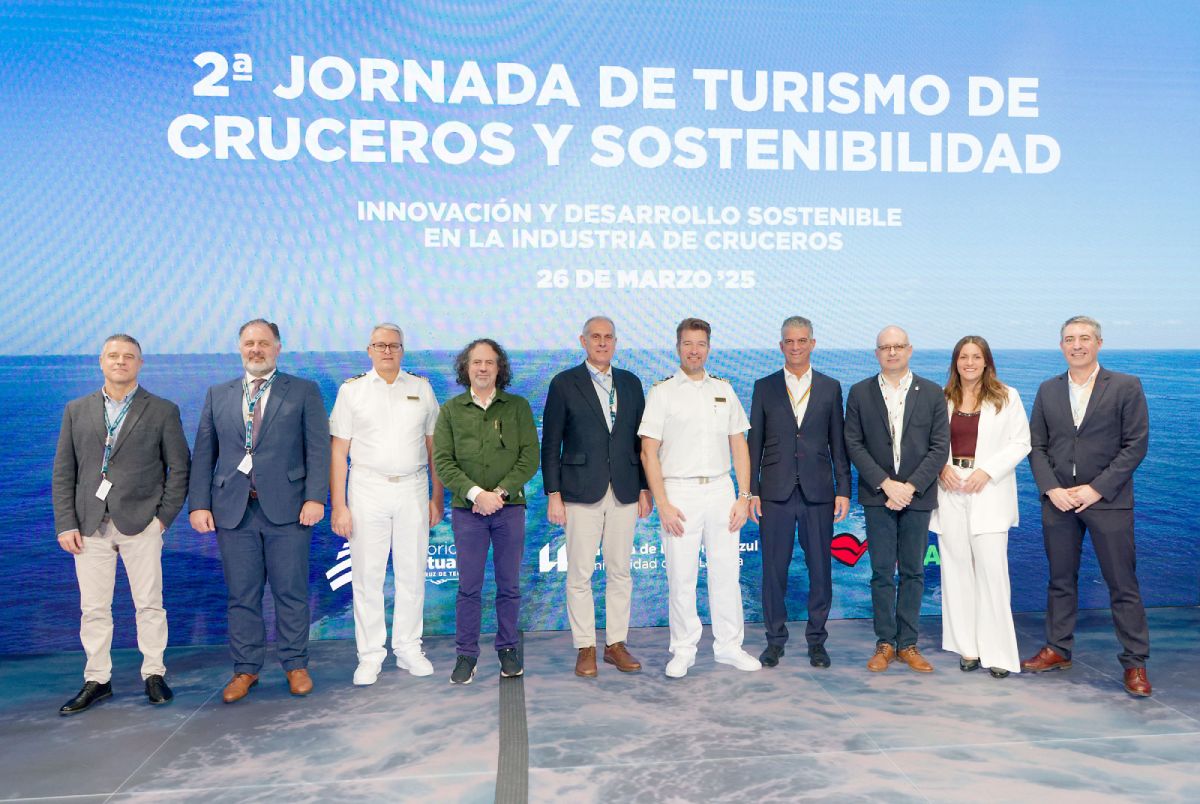
Participating speakers.
Carlos Mora noted that of the 10.4 million passengers who passed through the Canary Islands ports in 2024, approximately 3.2 million were cruise passengers, representing 32.71% of the total. The chair's director pointed out that these ships require specific logistics and services tailored to their passengers, which entails a series of complex actions that provide high added value, but which must also lead to positive synergies. He added that this is possible through the direct involvement of the cruise lines themselves with local communities, taking into account issues that go beyond the mere operation of the ships, an aspect in which there is growing interest.
To achieve this, as Manuel Maqueda, Professor of Applied Circular Economy at Harvard University, asserted, it is essential to begin with a “precise design” of any initiative or business model to be implemented before developing it, ensuring, above all, that it is truly necessary. Only in this way, according to the expert, will it be possible to add value to the service, which he termed a “genuine circular economy” linked to regenerative thinking.
The regulatory challenges facing the maritime transport industry, and therefore cruise ships, were the subject of the presentation by Federico Navarro, coordinator of the General Sub-Directorate of Safety, Pollution and Maritime Inspection of the Ministry of Transport and Sustainable Mobility, while José María Reyes, head of Green Ports Business Development at ENDESA, detailed the process by which electricity will soon be supplied to a cruise ship in the port of Cádiz, the first in the country.
On behalf of the shipping company, the Head of Human Resources for the AIDAcosma, Martin Oberle, gave a talk aimed specifically at the students in attendance, while the ship's captain, Vincent Cofalka, discussed the systems available on the AIDAcosma and other company vessels, including LNG, electrical connection, water purification and reuse, waste sorting and treatment centers, and even hybridization through energy storage in batteries, as is the case with the AIDAprima. These achievements have been made possible by AIDA Cruises' long-standing commitment to sustainability across its entire fleet through innovation and technology, as well as the measures they employ for the protection of marine ecosystems and the social projects the shipping company develops in developing countries.
In this regard, Cofalka emphasized that “we have built 56 schools and have more than 24 school projects funded or in the planning stages. Not only is the infrastructure created, but funding is also provided for ten years to cover maintenance and teacher salaries.”.

 Spanish
 English
 French