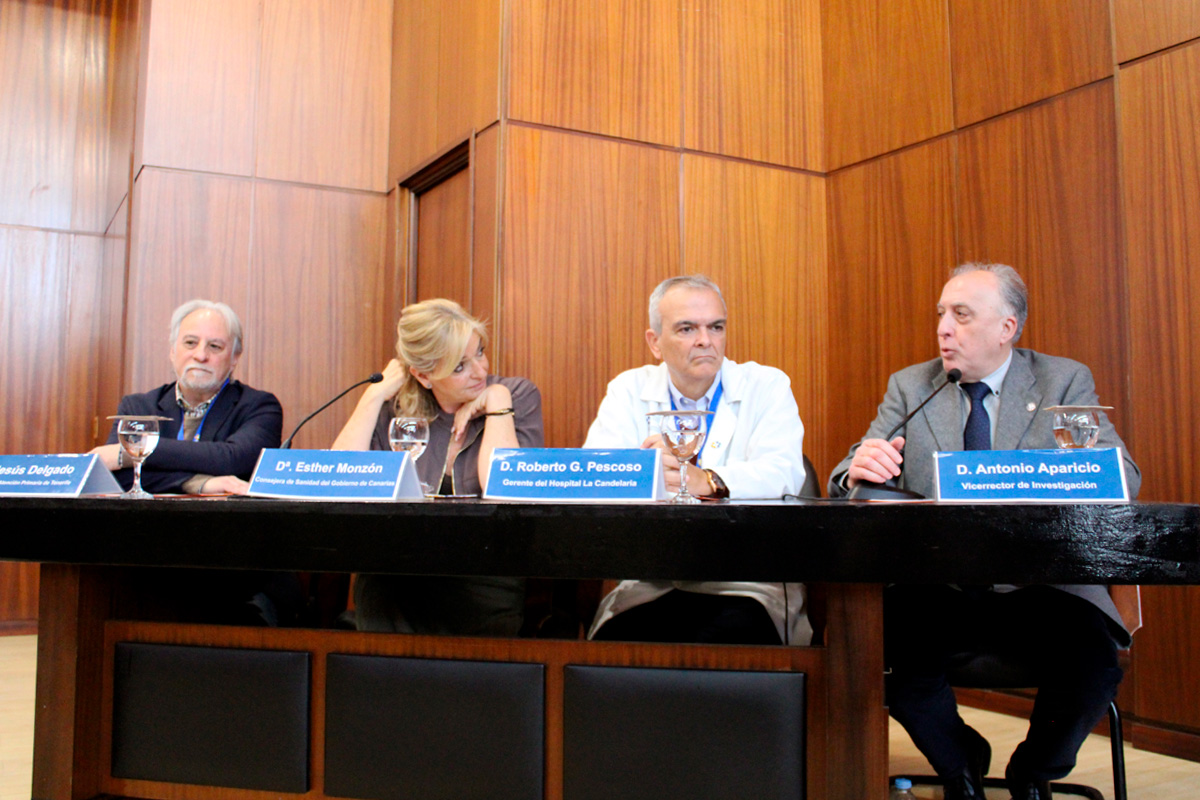
The Hospital Nuestra Señora de Candelaria hosted the first Open Day of the Research Unit of the Nuestra Señora de Candelaria Hospital Complex (CHUNSC) and the Tenerife Primary Care Management (GAPT). The event's opening ceremony was attended by the Minister of Health of the Canary Islands Government, Esther Monzón; the Vice-Rector for Innovation and Transfer of the University of La Laguna, Antonio Aparicio; the Manager of the Nuestra Señora de La Candelaria University Hospital, Roberto Gómez; and the Manager of Primary Care in Tenerife, Jesús Delgado. The objective of this event was to highlight the health research carried out by the various medical and nursing research groups that make up this multidisciplinary structure and to promote collaboration and knowledge transfer between clinical care and health research.
The Minister of Health emphasized the need to strengthen health research "as a driving force behind innovation, improved quality of care, and the search for solutions to the challenges faced daily by healthcare professionals." Monzón also highlighted the importance of this scientific forum in promoting knowledge exchange and cross-disciplinary collaboration among professionals from various specialties and centers.
For his part, the Vice-Rector of the University of La Laguna highlighted the institution's commitment to biomedical research, particularly through its university institutes. Currently, this academic center has four institutes dedicated to promoting research in this field: the Institute of Biomedical Technologies, the Antonio González University Institute of Bio-Organic Chemistry, the University Institute of Neuroscience, and the University Institute of Tropical Diseases and Public Health of the Canary Islands. Aparicio also emphasized the University of La Laguna's commitment to strengthening research collaboration and knowledge transfer to society through its Knowledge Transfer Office. He considered it a "key opportunity, a necessity, and an obligation" for university institutions to foster these synergies.
Rebeca Baz, deputy director of the Knowledge Transfer Office at the University of La Laguna, gave a presentation on the main collaboration agreements that can be established between research institutions. In her presentation, she highlighted the infrastructure of the General Research Support Services at the University of La Laguna (SEGAI), to which
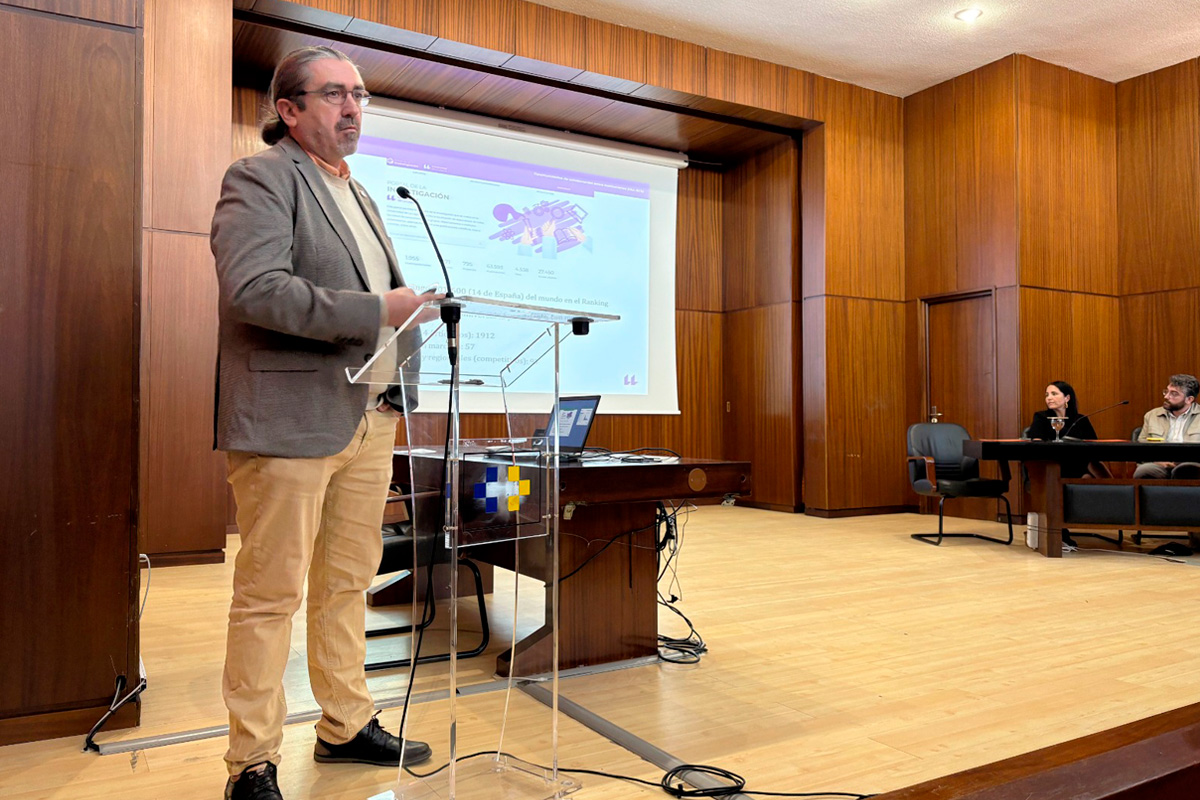
Roberto González.
which are accessible to researchers in the health field. For his part, Roberto González, director of the Secretariat of University Institutes and Publications at the University of La Laguna (ULL), presented an overview of the health research areas at the institution, emphasizing the interdisciplinary nature of the projects developed in the health sciences institutes. González noted that more than 400 professionals from the University of La Laguna are currently involved in these areas and highlighted both the high scientific productivity and the significant impact of this research on Canarian society.
During this event, the Canary Islands Health Research Institute was presented. It is currently undergoing accreditation by the Carlos III Health Institute, becoming the first of its kind in the archipelago. Its scientific director, Fernando Gutiérrez, emphasized the importance of having such an institution in the Canary Islands, as it will boost R&D&I in the healthcare sector and allow access to specific funding opportunities. For his part, the Vice-Rector for Research and Transfer, Antonio Aparicio, highlighted that the creation of the Canary Islands Health Research Institute will be key to expanding the potential of biomedical research in the region and strengthening synergies between researchers and the healthcare sector.
The Research Unit of the Nuestra Señora de Candelaria University Hospital and the Tenerife Primary Care Management is a multidisciplinary structure whose objective is to generate scientific knowledge and apply it to health promotion. In addition to basic, clinical, and epidemiological research, it employs advanced technologies, such as biotechnology and Big Data, to improve the diagnosis, treatment, and prevention of diseases, with a focus on personalized medicine and translational research. Its activity centers on prevalent and high-impact diseases in the Canary Islands population. During the remainder of the day, presentations were given by the heads of the basic biomedical research, clinical biomedical research, and epidemiological and qualitative research groups that comprise the Research Unit, who presented the various projects they are developing within the context of health research.
The event was organized in collaboration with the Government of the Canary Islands, the Canary Islands Health Service, the University of La Laguna and the Canary Islands Foundation Institute of Health Research.

 Spanish
 English
 French