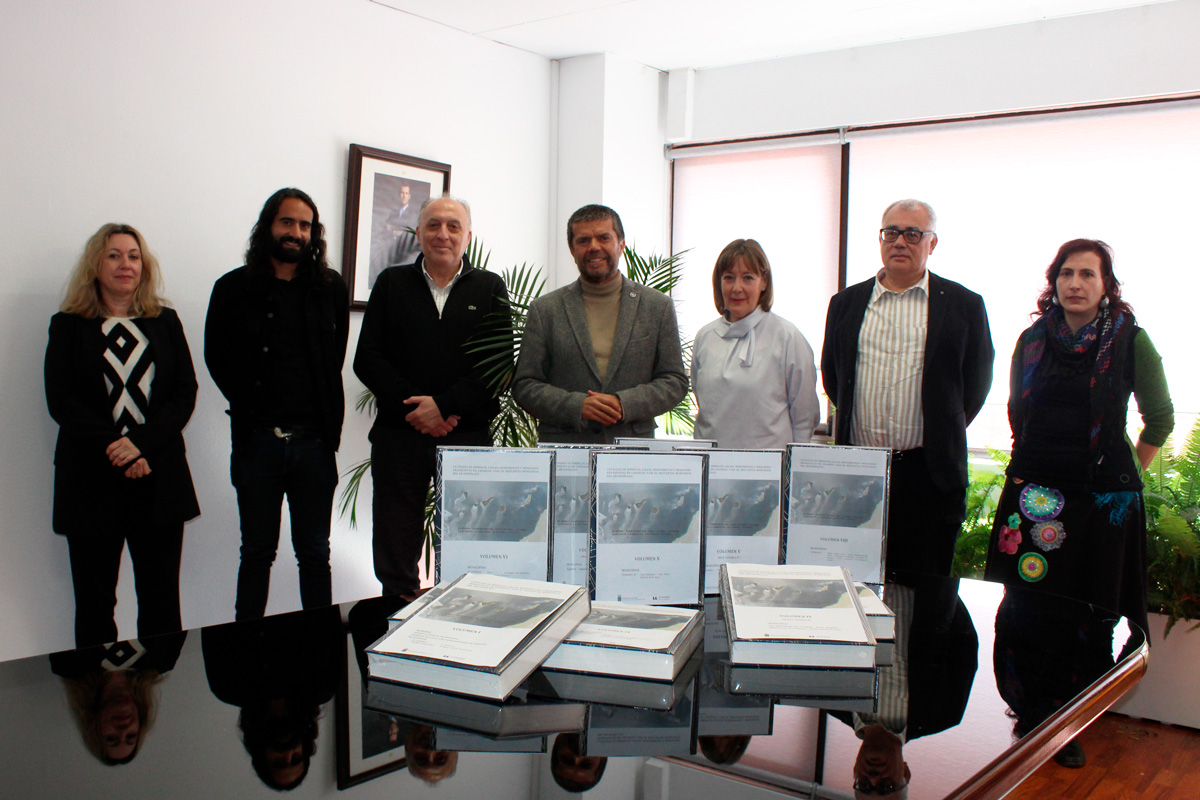
The rector of the University of La Laguna, Francisco García, received this week the visit of the Art History research team in charge of making the Catalogue of Symbols, Streets, Monuments and Francoist Mentions in the Canary Islands, whose third and final installment consists of a total of 9,300 pages, relating to the remaining islands of the archipelago, and after having already delivered the first phase (municipality of Santa Cruz de Tenerife) and the second (island capitals).
The catalogue, according to the agreement signed in June 2022 with the regional Executive and complying with the requirements of the organic law on this matter, accounts for the Francoist elements found on the eight islands, and which to date correspond to a total of 428 elements registered, of which 225 correspond to the province of Santa Cruz de Tenerife and 203 to Las Palmas.
The remains include names of public spaces, sculptures, objects, inscriptions, gravestones, coats of arms, and honors and distinctions alluding to the era of the dictatorship. The work has been led by the professor of Art History. Isabel Navarro Segura and by the tenured professor Jesús Pérez Morera, along with researchers Yanira Hermida Martín and Kumar Kishinchand López and the collaboration of Yolanda Peralta Sierra and Ricardo Guerra Palmero.
In July 2023, the second phase of this work was delivered, referring to the island capitals, and with this third phase, the task of the research team from the University of La Laguna would be completed, who refer to the arduous work of searching for information in the municipal archives, many of which are not yet digitized, and the lack of proactivity found in some localities.
This final phase of the project was delivered on time and in the proper format at the end of March. It should be complemented by dissemination activities, as indicated in the agreement signed with the academic center, so that its content is known and valued at all educational levels in the archipelago. The professor herself points out that a profound lack of knowledge of recent Spanish history has been evident, as well as the increasingly pronounced tendency among young people to align themselves with far-right alliances.
She recounts that after the signing of the agreement in 2022, and while the first phase was being developed, the Democratic Memory Law came into force, which, the professor explains, has meant a necessary update to guarantee the unavoidable harmonization of institutional actions on historical memory in the national context and of the autonomous communities, given the disparity of actions.
The law in force itself states that it aims to "preserve and maintain the memory of the victims of the War and the Francoist dictatorship, through knowledge of the truth, as a right of the victims, the establishment of justice and promotion of reparation and the establishment of a duty of memory of the public authorities, to avoid the repetition of any form of political violence or totalitarianism.".
The "Catalog of Symbols and Elements Contrary to Democratic Memory" is the procedure defined in current legislation, which includes a register of vestiges of the State, in collaboration with the autonomous communities through a process of integrating the procedures followed in the different territories of the country. In addition to the catalogue, the law itself indicates the opportunity to create a virtual documentary center for historical memory in the Canary Islands, develop curricular content for inclusion in primary, secondary, and upper secondary education, and prepare content for university degrees—all of which remain to be addressed.
The current document has been established in accordance with that Law, and its methodology has been submitted for approval by the body defined in the regulation, the Technical Commission of Historical Memory, which, after the presentation of the document corresponding to the first phase -municipality of Santa Cruz de Tenerife-, was definitively approved in November 2022.
At the reception, the rector stated that the University of La Laguna was proud to have completed this extensive research project, describing it as a “magnificent way to share our accumulated knowledge with society.” He also emphasized that the catalog strengthens historical memory, “so that we never forget what happened,” while also serving as a powerful tool for citizens who have not had direct access to information about these significant events in our country's recent history.

 Spanish
 English
 French