The Spanish Constitution of 1978 charted the course towards democracy, playing a crucial role in overcoming the patriarchal order of Francoism. It also bears witness to the political consensus and social circumstances that existed almost five decades earlier, when achieving true equality was still unimaginable.
Ruth Rubio and Octavio Salazar, professors of Constitutional Law at the University of Seville and the University of Córdoba, respectively, are well aware of the current limitations and challenges that the Constitution must overcome regarding feminism. This shared commitment led them to jointly produce the work Gender order in the Spanish Constitution, published in 2024, which they have just presented at the University of La Laguna in a research seminar entitled «Gender order and constitutionalism: proposals for parity reconstruction», through the Gumersindo Trujillo Cultural Chair of Autonomic and Constitutional Studies.
As experts in the field, they propose a feminist revision of the Constitution through specific proposals, addressing gender issues from a parity perspective. Therefore, they advocate for the application of inclusive language in Spain's supreme law, as well as the inclusion of issues such as gender violence, care work as an essential part of the social, economic, and political system, marriage equality, and diversity, among others.
Ruth Rubio, formerly a professor at other academic institutions such as New York University, Princeton or the European University Institute in Florence, believes that we have laws "that have been paving the way and a constitutional jurisprudence that, in general, has not held us back too much, even though it remains subject to some willful interpretations.".

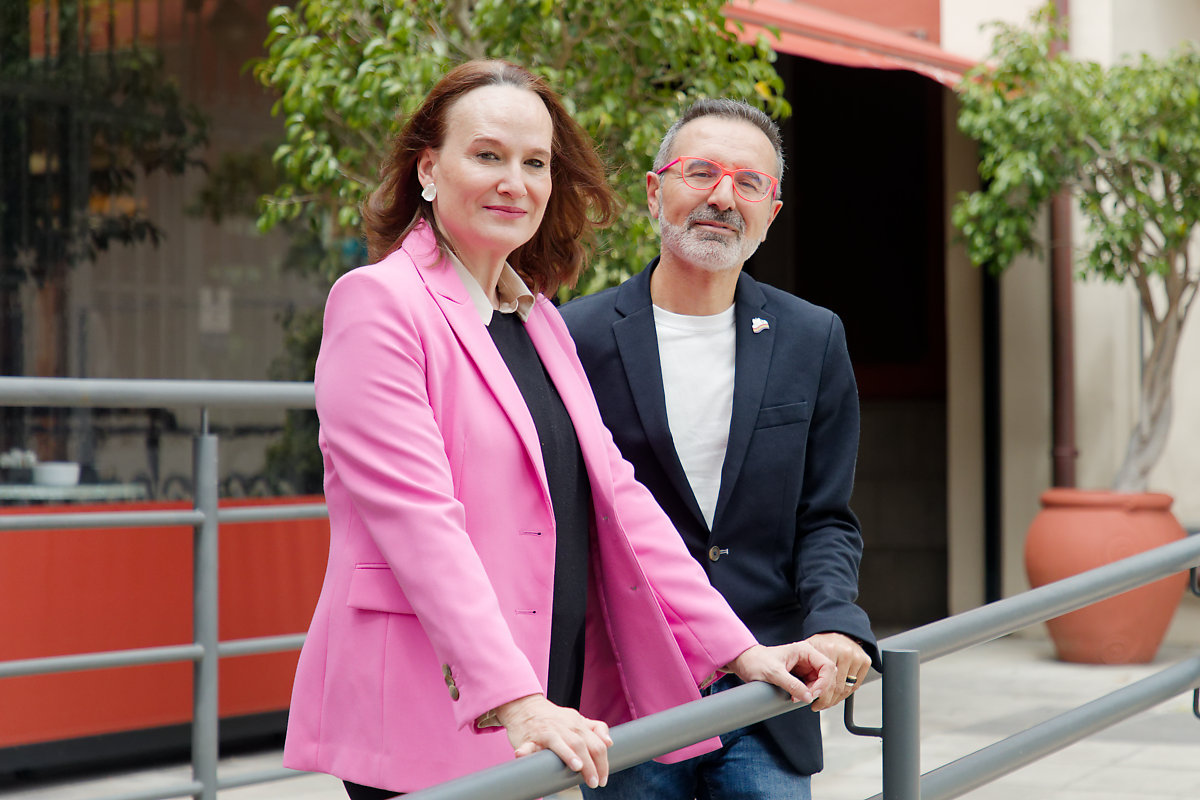
A moment from the interview.
The professor argues that by incorporating subjects such as those mentioned above, it is possible to “send a very clear message that would allow the Constitution to be used much more proactively, especially in these times of regression, to anchor and safeguard these rights from being so politicized.” She also points out that some political forces are questioning legislative advances while regressive reforms are already underway in other countries, dismantling legal gains in LGBTQ+ or reproductive rights, for example.
Octavio Salazar, a member of the Feminist Network of Constitutional Law and the Expert Committee of the European Institute for Gender Equality, describes the Spanish Constitution as excessively rigid in terms of its potential for reform, as was the case with other constitutions that emerged after the Second World War. In his words, this condition subjects Spanish society to a “paradoxical” situation in the present: “On the one hand, we must be aware that the text has already yielded all it can on many issues. On the other hand, we live in a political context where reform is practically impossible, since the necessary majorities would not be reached, and the procedure that would have to be followed to address issues related to law or even the Crown seems like science fiction.” Even so, he insists on the need to “have these issues firmly established in the Constitution so as not to be at the mercy of the will of the majority forces in power,” given the regressive international political context.
Equal democracy and education
Both Rubio and Salazar advocate for a structural shift in the Spanish Constitution, moving from equality to parity. “The liberal constitutionalism project is based on the premise that society, and therefore the State, is structured around the reproductive heterosexual family, which defines the boundaries within which women must develop and define themselves as citizens,” Rubio explains.
From this perspective, they propose a central break from gender roles and expectations, as well as the gender structure of the State, to "imagine a new being that reconciles all human capacities and needs, and that creates, therefore, a society where care and life are at the center of social, political and economic organization, without division between public and private space, from intersectionality," argues the professor.
From their expert perspective, they frame it as a way to overcome the differentiation between men and women, whereby they are considered equal before the law but which generates division through the subordination of women, even changing the way they relate to one another. “It is about dismantling a deeply entrenched political and cultural order, which is linked to economic value or recognition; therefore, it would be a radical, fundamental transformation that goes beyond the simplistic view of equal representation in institutions,” Salazar concludes.
This new ethical perspective would also help overcome the current crisis of values, a void into which an ultraliberal neoconservative movement is seeping from a certain point of view. "Technological and economic, including fundamentalist religious factions of different faiths to whom we have given terms like family and nation, something that connects in a very visceral way with values," explains the specialist.
Constitutional scholars present feminism not only as a content-based project, but also as a methodological one in university education, arguing that “parity should not be limited to professorships or deanships, but that gender should be present across all subjects, including law, modifying even the way classes are taught and the very architecture of the spaces, to make them horizontal and flexible,” Rubio explains. She cites the example that, when issuing a ruling, a female judge tends to contextualize much more and take into account the human interrelationships present in a legal situation, and that this should be transferred to the classroom.
Salazar concludes the conversation by clarifying that feminism does not only propose a rights agenda for women but also represents "another way of understanding life and organizing society. It is not an identity struggle, but an emancipatory commitment for all people, taking into account the various gaps that generate subordination for many human beings. We are talking, therefore, about changing the rules of the game.".

 Spanish
 English
 French