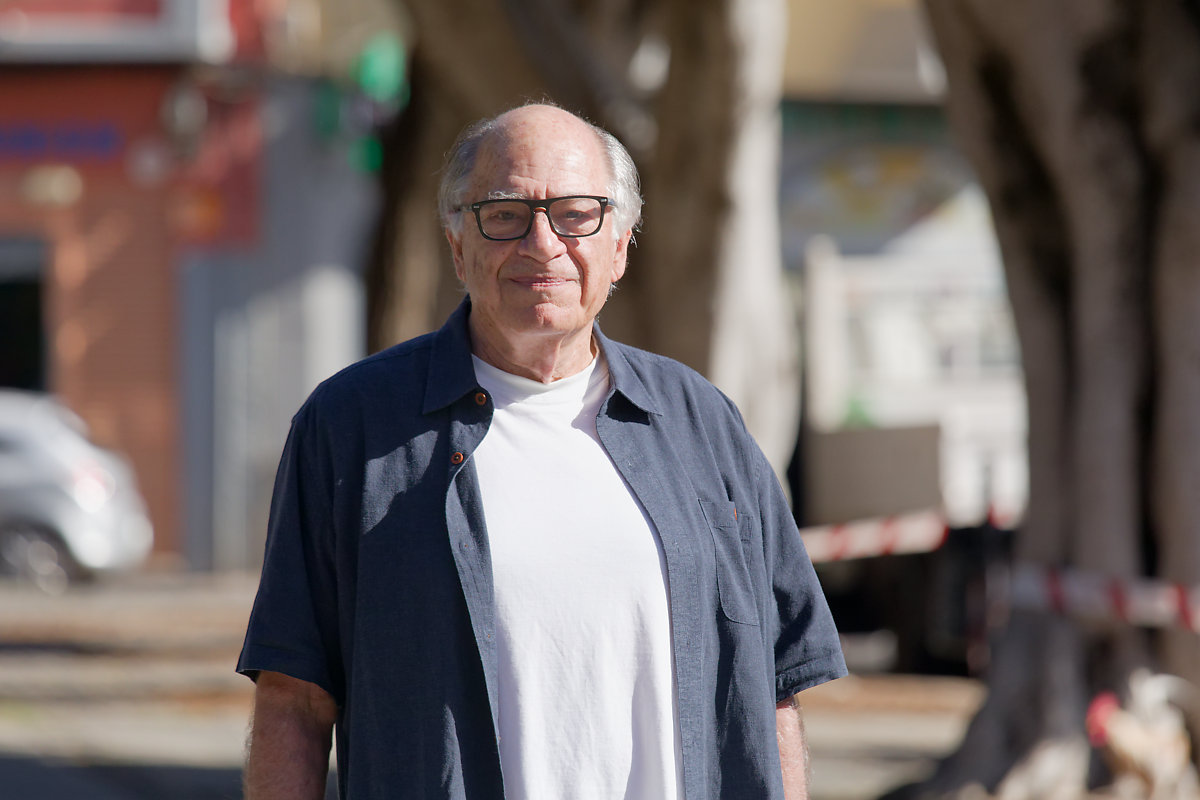
Michael Ben-Eli He possesses a unique professional profile that combines architecture and cybernetics, a mixture from which emerged the Sustainability Laboratory which he founded in 2008 in New York with the aim of proposing innovative solutions with a systemic-holistic approach to the various challenges involved in the pursuit of sustainability. This consultant, who has collaborated with some of the most relevant international organizations, was a speaker at the end of March at the conference “Exploring the Frontiers of Sustainability in the Canary Islands”, during which he presented a diagnosis Regarding the Canary Islands, he saw opportunities for improvement. We were able to discuss these issues, as well as his professional career, in more detail after his presentation at the University of La Laguna.
He started out as an architect and studied with Richard Buckminster Fuller, who was already interested in sustainability at the time. Could you explain that connection?
I went to London to study architecture. I didn't know Fuller, and during the first semester of my first year, I attended a lecture he gave. He was talking about the project he was promoting at that time, called the "World Decade of Design Science" ("“World Design Science Decade”His idea, typical of Fuller, was very ambitious: that all the architecture schools and students on the planet would collaborate on a ten-year program to redesign the world. I had never heard anything like it; for me, architecture was Frank Lloyd Wright or Le Corbusier: you design a building, a table… And here was someone talking about the planet as a whole as an object of design. I, at 21, was trembling with excitement.
Sitting next to me was Keith Grichloff, a young painter who became a mathematician and taught there. He wasn't my professor, but I knew him, so, excited, I asked, "How can we get involved in this program?" He replied, "Well, I've been doing some geometry research for Fuller, and I'm having breakfast with him tomorrow. Why don't you come along?" So, I joined them for breakfast with a great deal of anticipation. There was an immediate connection with Fuller, and I decided to work on the program.
The Architectural Association The Arts Academy in London was a very cutting-edge, progressive, and quirky school, so they allowed me to work with him outside of the course. The term “sustainability” didn’t exist then, and everything he addressed, such as natural resources and population, is now included under the umbrella of sustainability, but these were topics I wasn’t aware of, and he opened my eyes. Upon graduating, he asked me to follow him into the University of Carbondale, in Illinois. And that's how I came to the United States.
 How has the concept of sustainability evolved over the years?
In the 1960s, it became clear that something was becoming unbalanced. Attention was focused primarily on environmental issues. The Green Revolution, so to speak, started it all. Fuller focused on "appropriate technology"; he recognized that there was a resource problem, so he advocated for the idea of doing more with less—that is, how technology can allow us to make better use of every molecule, every unit of time. The Green Revolution took hold, and the emphasis shifted to the environment, to what we should and shouldn't do to it.
In recent years, it has become clear that the concept of sustainability is much broader, encompassing not only the impact on the environment and technology, but also questions about how society is governed and the structure of the economy. I would say the concept has expanded and, at the same time, become more diffuse. Now we use it for everything.
He established five fundamental principles or domains of sustainability, and there's one that puzzles me: the spiritual one. Could you explain them?
If we relate [the term] to the human relationship with the biosphere, the concept is anchored in a particular type of interaction between a population and the carrying capacity of an environment. This can apply to any population and any environment: lions on the savanna or humans on the planet. This balance is dynamic and cyclical, because the environment defines what population is possible, and this, in turn, impacts the environment.
This balance is affected by various factors. Some are material or metabolic, such as resource consumption and the generation of byproducts that must be absorbed, which are physical in nature. And many others are not: the political system, the institutional, the social, the financial. These are not physical; they are more abstract, but they affect this balance. So, when I tried to analyze them, I thought it would be convenient to group them into different domains.
There is the material domain, which deals with the material world, the energy and matter that underlie existence. There is the economic domain, which is the framework through which we evaluate our actions from an economic perspective. There is the social domain, which asks how society is organized. And there is what we call the domain of “life.” I don’t like to use the term “environment” because it emphasizes the idea that the environment is out there and we are here, but in reality, we are part of it. That’s why I use “domain of life.” At first, I thought I had it figured out, that these were the four that comprise it.
But I always felt something was missing, and I couldn't identify it until I realized it was precisely what you're asking about: spirituality. Why is it important? Because spirituality is the value; the others have to do with how you do things, and spirituality is the main reason you do them.
During the years I developed that framework, I was still working with different organizations like the World Bank and sharing my ideas with colleagues who told me, “Don’t even think about using that word. If you want companies and institutions to take you seriously, don’t talk about spirituality.” I suppose I lacked self-confidence back then, and that’s why I included or excluded it depending on the audience. Until I realized that the purpose of humanity’s existence and the cosmos is truly the center; it’s what holds everything else together.
It may be naive, but I believe that humans are fundamentally spiritual creatures and, at their core, are intuitively driven by the desire to reach for something greater than themselves and to incorporate a broader, more complete scope into their vision. This is essentially the concept of “bodhisattva”"In Buddhism: the human being who goes beyond the ego to take ever greater scope in his consideration.".
 She also studied cybernetics. What led her to that discipline and how does it merge with architecture?
When I graduated from the AA, after all those years with Fuller, I realized I wouldn't go into architecture. And also that the problems Fuller addressed had to do with managing a complex reality with many variables. During my early years in London, I met a very interesting British cyberneticist, Gordon Pask, who at that time ran a fantastic little lab called System Research.
He was working intensively on developing a cybernetic theory of learning, about how a system acquires knowledge and what happens to it when it learns. This was in the 1960s, so the technology was very different. It was the same story: he gave a lecture and I thought, “Wow, this is fantastic!” So I started working at System Research while I was a student. And through that association, I became acquainted with systems thinking and cybernetics.
Cybernetics studies how systems organize themselves, adapt, evolve, learn, and change over time. I realized that a new epistemology for addressing complexity was developing within general systems theory and cybernetics. I thought, “Here’s a tool for dealing with complexity; I should get hold of it.” And that’s when, while working with Fuller in the United States, I decided to pursue a PhD, and Gordon accepted me as a student. I did my dissertation in cybernetics with him at the Brunel University (London).
What motivated the creation of the Sustainability Lab in New York in 2008?
When I left Fuller, there was a group in London led by Stafford Beer, another prominent cyberneticist, developing concepts of cybernetics applied to management. They analyzed organizations—a company, a government, you name it—as organisms and asked how they were structured and whether that structure was pathological or functioning well. I began working for several years as a consultant, addressing change management processes in organizational architecture and strategy development in sectors such as healthcare and financial institutions, among others.
In the 1980s, I was involved in projects that were beginning to address sustainability. They started by tackling large-scale regional development issues, which soon led me to the heart of multilateral development agencies that, after the Rio Summit of the UN In 1992, they defined sustainability in their own terms. As you know, “sustainable development” is that which meets the needs of the present without compromising the ability of future generations to meet their own needs. A definition, by the way, that I never liked because it is very difficult to implement: it sounds great, but it is not rigorous enough.
After Rio, the main international organizations were the first to try to internalize the concept of sustainable development. Therefore, I worked as a consultant on projects with the World Bank, he Global Environment Facility, he World Convention on Biodiversity and others on these topics, providing a systemic perspective. And for a while I was very happy because I was right at the heart of this whole sustainability movement.
 It was at the beginning of it all…
It was the vanguard, so to speak. But I soon perceived a huge gap between the rhetoric of sustainability and what was actually happening on the ground. I felt I was wasting my time because institutions were all talk and no action. This led to a professional crisis, and I decided to stop working and think about what to do next. It was then that I realized the transformation humanity must undergo to move toward sustainability. It's unprecedented. There's no experience. There are no experts. No one knows how to manage 10 billion people on the planet in a more or less harmonious, peaceful, and abundant way. There's no recipe you can follow. You have to experiment.
You need a laboratory.
That was the next step. Where do you experiment? In a laboratory. And what does the planet need now? After 1992, a business council for sustainable development was created, which included the world's largest companies, including oil companies, and those organizations, both in the private and public sectors, weren't ready for that kind of radical transformation. The planet needed a global laboratory for experimentation in sustainability, and nobody was doing it. So it was a bit naive, because I had no resources and no knowledge, but in 2008 we established the laboratory.
And what support did he receive at the beginning?
Nothing. I was just sitting alone in my room (laughs). But the interesting thing was the message I was trying to convey: that if you adopt a holistic, systemic perspective and analyze any problem—no matter what it is—from the perspective of the five principles, you make a difference.
If we look at the organizations I mentioned earlier, there are departments for women, for fishing, for the environment, for this, for that… But I didn't want to define the lab by the areas of each problem because, in reality, it doesn't matter: give me any problem, and if I adopt a systemic perspective and look at it from that perspective, that's what will make the difference. But that idea was too abstract, and back in 2008 I realized that we urgently needed a project somewhere, where it would be possible to demonstrate the application of those principles in real life.
I had access to the Ben-Gurion University of the Negev (Israel) and I was very impressed by the technology developed there to address different aspects of desert life: water management, solar energy, and many others. At the same time, I met the Bedouin community of the Negev and thought, “Here we have such an impossible and difficult situation that if we can carry out a project, no matter the cost, it will truly validate the idea of the laboratory.”.
I was fortunate, because while researching what was happening in the Bedouin community, I met Mohamed Al-Nabari, the mayor of Hura, one of the small Bedouin villages. He had a master's degree in organic chemistry, which is very unusual, and he had worked in the private sector for years until he decided to work in the community and became mayor. He was very enthusiastic about the idea I proposed, and that's how the project was born. Wadi Attir Project, which became the laboratory's flagship project.
Working with that community, we try to develop a sustainable agriculture model in an arid environment in collaboration with university scientists, but producing radical innovation in each of the different areas: social, community, technological… based on Bedouin knowledge and tradition, but enhanced with advanced technology.
 And two different realities worked together, because without the Laboratory perhaps the university and the Bedouin community would never have come together.
That's the point: the lab has always acted as the DNA of an idea, seeking out the necessary ingredients. And what drives collaboration is purpose. It's not just about saying, "We need to create a network of universities and institutions," because that doesn't lead anywhere.
When you focus on a problem, you're completely trapped by the current conditions. And if you want something new, by definition you can't produce it with the existing situation. Otherwise, it would already exist. So this is what we call a design approach, something Fuller vehemently advocated. You start with a vision of what you want to achieve, even if it seems crazy and everyone tells you it's impossible. And then you ask yourself what you need to achieve it: experts in these areas, funding, people to get involved… And you build the machinery to accomplish that purpose. You don't try to achieve it with what already exists, because that's what created the problem in the first place.
Since we're in the Canary Islands, I have to ask you for your assessment of the state of sustainability in the Islands.
I'm a little afraid to speak because I don't want to offend anyone. But there are three important things. First, the Canary Islands are a fantastic and unique place on the planet, and I hope they don't follow the path of the rest of the world.
Second, there are many people here who understand the issues, even if they aren't academics. They understand sustainability. The farmers here consistently produce organic food; they know the subject matter, even if they don't know the theory. So there's a lot of potential and many people in different groups working on it. My impression, speaking during the Global Sustainability Fellows [meetings organized by its Sustainability Laboratory in which The University of La Laguna participatedThe issue was that the Canary Islands possess the capacity and the understanding, but the existing system doesn't provide the necessary support. They can't do what they want, so there's an internal conflict. Because, let's face it, it's a very conservative society with a deeply entrenched bureaucracy, with countless regulations for everything. And innovation can't happen, because innovating means breaking the rules. So this is the third component.
They have a unique location with the opportunity to become a global model of sustainable development in island ecology and occupy a prominent place on the global sustainability agenda. They possess the necessary talent and capacity. They have an exceptional scientific team, not only from universities, but also from the Astrophysical Institute and other entities. But all of this is fragmented, not integrated, and they lack the freedom to do what some know must be done.
So there is unique potential and capacity, but also a framework that doesn't encourage innovation. Even if the message is, "We will invest in innovation, we will become sustainable," there is a governance problem, not only at the governmental level, but even within the university. If you want to do something at the university, there are so many regulations that, in the end, time is wasted justifying the purchase of a computer instead of leveraging resources and experimenting.
What do you think are the main challenges facing our territory?
I believe there are several important challenges. One of them is the basic economic model, which needs to be developed. We can't rely on the public sector as much as some islands do. We can't depend solely on agriculture, on exporting bananas or similar products. We need to start developing a knowledge-based industry that is independent and doesn't require external resources, like in Singapore.
Because, as I understand it, the quality of students graduating from universities here is very high, but they don't stay; they go elsewhere because there are no opportunities. They're not going to grow bananas after studying artificial intelligence. It's essential to create a new, diverse economic model that doesn't depend on just one or two sectors, as is the case here.
Food security issues must also be addressed, and to support innovation, investment is needed in the infrastructure itself: how energy is produced, how water and waste are managed, how transportation works, and, of course, urban development as an ecological concept in itself. Will urban sprawl be allowed to occur haphazardly, or will sustainability principles be incorporated into planning? These are the factors that must converge to produce the innovation that could make the Canary Islands a model for the world.
But that requires a completely different governance structure. Because here there's a hierarchy: the government of each island, the Canary Islands government, the Spanish government, and finally, the EU government. Each one with its own affairs, so it's very difficult to move freely. This is the creative question the government must answer: how to create more space for freedom of expression, not in a political sense, but in the sense that people can experiment, do real things, and hit the mark. And if there are a hundred experiments and only one becomes something significant, that's what will determine the future of this place.
 What do you think is the role of academia in the problem of sustainability?
Academia must undergo the same kind of reform and understand that its role is to support new ideas and innovations, rather than impose them by force. I know that discipline is required in teaching, and courses are necessary, but academia must foster conceptual integration instead of specialization. That's part of the problem: everything is defined by small details, and systems thinking is not a significant component in academia today.
The world's complex problems cannot be addressed without the ability to think systemically. It's impossible, because then we always focus on one small thing after another, but the whole is never simply the sum of its parts; it's a synergy, the result of interaction. The academic world must be bolder in fostering genuine innovation; it must be at the forefront of innovation instead of merely repeating what is already known.
In simple terms, it's clear that most of the mechanisms and ways of doing things we have come from a distant past, when humanity's condition on the planet was completely different. There weren't even a billion people on the planet; there was scarcity, and everyone competed for water and other resources. So, there are governance mechanisms and financial concepts that evolved long before the Industrial Revolution. Now we have something completely different, and we're trying to manage it with traditions that belong to the medieval era, so we need to rethink everything. There's no other way, and this isn't a criticism of the existing system; I'm not saying government is bad, I'm saying government has to be more creative. How? I don't know, but it has to find a way.
Communications Office

 Spanish
 English
 French