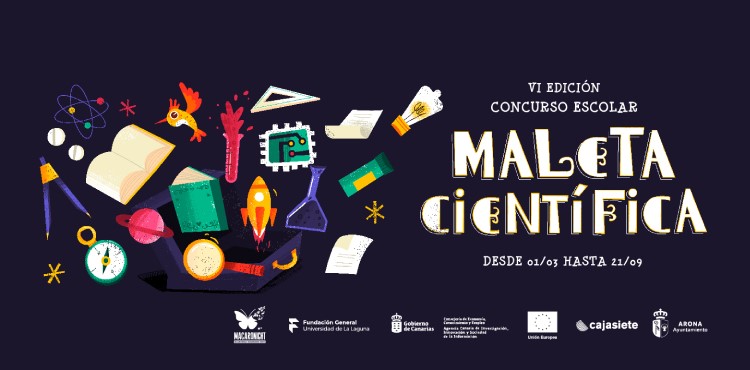
The University of La Laguna, through its Scientific Culture and Innovation Unit (Cienci@ULL), has opened registration for the sixth edition of the Canary Islands Children's Science Suitcase Competition This initiative is aimed at students in the 4th, 5th and 6th grades of primary schools in the Canary Islands.
The main objective is to foster creativity and innovation from an early age, providing a platform for young people to explore and share their scientific knowledge. Through their participation, they will have the opportunity to demonstrate their creativity, ingenuity, and scientific skills by creating a science kit following the criteria established in the guidelines. competition rules.
For this activity, students will form groups of up to ten and create a model or prototype representing a scientific event or discovery made by a researcher from the Canary Islands. The model will be presented inside a suitcase designed and created by the student group. In addition, each group will create a video presentation clearly explaining the event or discovery they selected for their suitcase.
Registration will be open until September 21, 2025. Submissions will be accepted exclusively through [platform name/platform name]. online form. Furthermore, once the model is finished and before the deadline set in the rules, a video presentation of the model, according to the evaluation criteria, must be sent to the following email address: gciencia@fg.ull.es.
Three prizes will be awarded to the highest-rated projects, distributed as follows: first prize (€1,500), second prize (€750), and third prize (€500). These funds will be used by the winning schools to purchase educational materials. The prizes will be awarded on September 26, 2025, during the Macaronight event.
This initiative is a pre-activity within the framework of the European project MacaroNight (European Researchers' Night of Macaronesia). MacaroNight is an initiative promoted by La Palma Research Centre, Observatorio Do Mar Dos Açores, Big Van Ciència, the University of Madeira, and the General Foundation of the University of La Laguna. It is co-financed by the European Commission under the Marie Skłodowska-Curie Actions (MSCA), an initiative to promote scientific careers in Europe, which falls under Horizon Europe, the European Union's Framework Programme for Research and Innovation. In Tenerife, it is supported by Cajasiete, the Canary Islands Agency for Research, Innovation and the Information Society of the Government of the Canary Islands, and the Arona City Council.

 Spanish
 English
 French