
From a young age, words became a necessary refuge, a tool to unravel the truths hidden behind the everyday, and above all, a powerful ally against the oblivion imposed by time and the interests of those who write official history.
He has made the written word not only his profession, but also an essential form of existence. Luis García Montero, Poetry is not simply an aesthetic exercise or a literary technique: it is the most genuine way to understand everyday life and to engage with memory. Born and raised in Granada, a city marked by the legacy of Federico García Lorca, he soon understood that writing could be an act of resistance against oblivion and imposed narratives.
From his beginnings in the "poetry of experience," he has championed clarity as a way to connect with others. His language, accessible yet imbued with emotional depth, has made him a recognizable voice within the contemporary literary landscape. It is no coincidence that his verses evoke everyday scenes and then delicately weave in reflections on time, love, and identity. In them, one always perceives the ethical impulse of someone who believes that writing is also assuming a responsibility toward life.
A life between literature and memory
Memory, in his work and thought, is not an abstract concept. It is the tool that allows peoples to recognize themselves, but also the compass that guides individual decisions. In his conversation, García Montero insists that forgetting is a way of renouncing oneself, a way of allowing oneself to be molded by external forces. And that, for him, is one of the greatest threats of the present: the ease with which human experience is trivialized through simplistic or ideologically driven discourses.
 His life partner, the novelist Almudena Grandes, shared his passion for memory. Together they constructed a shared narrative that was not only literary, but also political, cultural, and vital. In his words, to speak of Almudena is to speak of the ethics of remembrance, of how literature can give voice to the silenced and dignity to those marginalized by official history. After her death, that literary alliance has transformed into an even more intimate and necessary commitment.
From this conviction, García Montero maintains that history cannot be limited to major events. “History also encompasses the intimate,” he affirms, and in that phrase lies a whole manifesto: understanding that the collective is also written from the personal. That is why he argues that feelings, when articulated from consciousness, also have a political dimension. «What we say when we say ‘I love you,’» he repeats, is not a trivial matter. It is a way of questioning how we love, from what values, with what words.
Saying 'I love you' in times of haste
García Montero focuses particularly on this point. In a world dominated by speed, by the logic of immediacy, saying "I love you" is also an act of resistance. "The current rush makes words lose their weight," he laments, and that's why he argues that language needs to be reclaimed as a space for reflection. In his classes and lectures, he often explains how the great poets of the Golden Age used the language of love not only to seduce, but also to affirm their inner freedom. "Garcilaso didn't just talk about love; he talked about a new way of being in the world, of constructing subjectivity," he remarks.
From this perspective, love becomes an essential dimension of identity. In García Montero's poetry, there is no naive romanticism, but rather a constant search to understand what it means to open oneself to the other, to recognize them, to care for them. To say "I love you," then, is not simply to express a feeling, but to formulate a position in the world: an affirmation against indifference, a commitment to vulnerability as the driving force of human connection. He adds that intimacy, properly understood, can be a battleground where ideologies are contested, where it is decided whether or not power enters "our bed.".
The poet argues that, in many contemporary discourses, saying "I love you" has become devoid of meaning, as if it were an automatic formula. He emphasizes the importance of restoring meaning to language.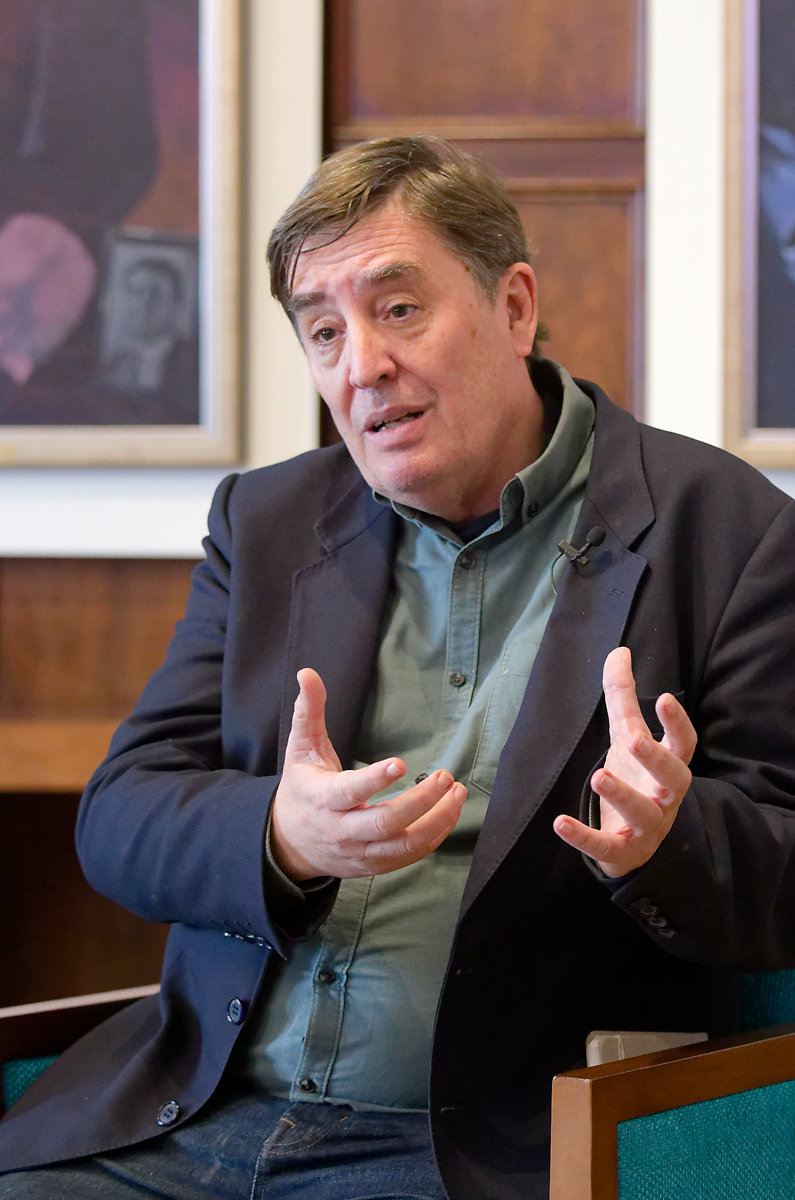 loving with ethical, critical, and conscious content. “When one says 'I love you,' one has to ask oneself what one is saying. One has to understand the context, the history, the weight that that word carries in the life of the one who pronounces it and the one who receives it.‘.
Young people, networks and the future of language
During the interview, he repeatedly emphasizes the role of new generations. He believes in youth, not as an idealized stage of life, but as an essential energy for renewing culture. However, he is also concerned about the fragility of language in an information-saturated environment. “Young people have intuition and sensitivity, but sometimes the system imposes a relentless culture on them, where there is no time to question the meaning of words,” he says.
Social media, which he doesn't demonize but observes with critical distance, has altered reading and writing habits. “On Twitter or Instagram, communication is fast, without time for nuance. And poetry, on the other hand, needs that slowness, that care,” he reflects. In response, he champions spaces for listening, such as poetry podcasts or readings, where the human rhythm of language can be rediscovered.
In this regard, she notes that some current discourses attempt to sow distrust in achievements that were once considered firmly established. She points out with concern that “there is a rush to erase past gains,” and observes how some young people reproduce harmful rhetoric, such as the use of the term 'feminazism,' which she considers not only a conceptual error but also a cultural setback. ‘If we don't educate people about the value of language, reactionary messages will slip through without us even realizing it,’ she warns.
Furthermore, he issues a warning about the advance of artificial intelligence in the literary field. In his view, no machine can replace the lived experience behind an authentic verse. “Poetry is born from human trembling, from the dialogue with oneself. A machine can imitate structures, but it cannot know what desire, loss, or love are,” he argues. In this sense, he believes that the future of language lies not in uncontrolled technological innovation, but in the ethical and responsible use of the available tools. One can be contemporary without sacrificing depth.
The Cervantes Institute as a space for cultural defense
Since taking over as director of the Cervantes Institute in 2018, García Montero has sought to project an image of Spanish as a language of critical thinking, plurality, and encounter. Beyond promoting the language itself, she believes the institution must also protect the cultural tradition that sustains it. She has championed the presence of contemporary authors, fostered dialogue among Iberian languages, and defended the internal diversity of Spanish—a language spoken with many accents that enriches its identity through difference.
 For him, Spanish is not a uniform language, but a mosaic where diverse voices converge. “The Spanish spoken in Lima, Bogotá, or Cádiz is not the same, but they all enrich the same tradition. The Cervantes Institute must make this plurality visible, not erase it,” he maintains. In his words, a cultural institution cannot be neutral or self-referential; it must engage with reality. That is why he argues that the institute he directs must also be in dialogue with current debates: equality, memory, sustainability, and digitalization.
He doesn't see his role as a bureaucratic task, but rather as a natural extension of his literary work. For him, writing, teaching, and directing the Cervantes Institute are all part of the same ethical map: a defense of language as a tool for encounter, resistance, and transformation. "Language is where we reflect on ourselves. That's why we must take care of it," he summarizes.
Ultimately, talking with Luis García Montero is talking with someone who hasn't lost faith in the power of words. His verses, his reflections, his perspective on literature and education remind us that it's still possible to say "I love you" with all its meaning. And that in saying it, if we do so consciously, lies the seed of a profound and silent, yet luminous, resistance.
Because perhaps —as he himself has written so many times— remembering, writing, loving, are nothing more than different ways of not giving up.
Communications Office

 Spanish
 English
 French